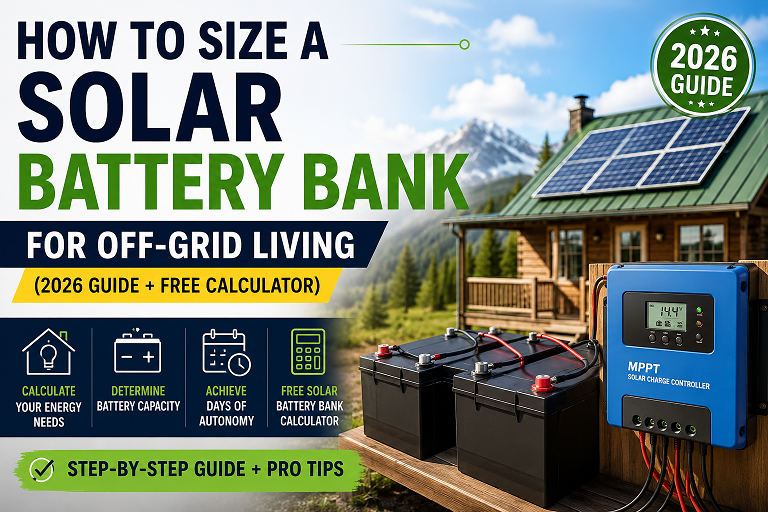
How to Size a Solar Battery Bank for Off-Grid Living (2026 Guide + Free Calculator)
The formula: Battery Bank (kWh) = Daily Usage (kWh) × Days of Autonomy ÷ Depth of Discharge. A cabin using 3 kWh/day with 3 days autonomy on LiFePO4 at 80% DoD needs 11.25 kWh of battery capacity. The same setup with lead-acid at 50% DoD needs 18 kWh — 60% more battery for identical usable energy. For most off-grid systems in 2026: use LiFePO4, plan for 3–5 days autonomy, and build on a 48V system if your daily load exceeds 5 kWh.
Undersizing your battery bank is one of the most expensive mistakes in off-grid solar. Run out of stored energy on a cloudy winter week and you either go without power, buy a generator on short notice, or spend thousands replacing undersized batteries with a proper system.
Oversizing wastes money on batteries you never use — and battery capacity is not cheap. A 10 kWh LiFePO4 battery bank costs $1,500–$3,000 in 2026. Buying twice what you need is a real financial loss.
Getting the sizing right requires four inputs: your daily energy consumption, your desired days of autonomy, your battery chemistry’s depth of discharge, and your system voltage. This guide walks through each one with real numbers, then gives you a free interactive calculator to put it all together.
Part of the Shalkot DIY Solar Series
This is Article 4 in our solar series. If you haven’t already sized your panel array, start with our Solar Panel Calculator. For the charge controller that connects your panels to this battery bank, see our Best Solar Charge Controller guide.
The Battery Sizing Formula
Every battery bank sizing calculation comes down to one core formula with four variables. Master this and you can size any off-grid battery system:
Step 1 — Calculate Your Daily Energy Usage (Load Audit)
The most important input is your actual daily energy consumption. Do not guess at this. A load audit — listing every device you run, its wattage, and how many hours per day — takes 30 minutes and prevents years of under- or over-built battery storage.
How to Do a Load Audit
For every device you plan to power: find its wattage (usually on a label or in the manual), estimate realistic daily hours of use, and multiply. Add everything up for your total daily watt-hours, then divide by 1,000 for kWh.
| Device | Watts | Hours/Day | Wh/Day | Notes |
|---|---|---|---|---|
| LED lighting (6 bulbs) | 60W total | 5 hrs | 300 Wh | 9W per bulb × 6 |
| Refrigerator (efficient) | 150W | 8 hrs effective | 1,200 Wh | Runs ~1/3 of the time = 8 effective hrs |
| Laptop | 65W | 4 hrs | 260 Wh | Charger + screen |
| Phone chargers (2) | 20W | 2 hrs | 40 Wh | 10W per phone |
| WiFi router | 12W | 24 hrs | 288 Wh | Always on |
| Water pump (well) | 500W | 0.5 hrs | 250 Wh | Runs intermittently |
| Ceiling fan | 50W | 8 hrs | 400 Wh | Medium speed |
| TV (40 inch LED) | 60W | 3 hrs | 180 Wh | Evening use |
| Coffee maker | 900W | 0.25 hrs | 225 Wh | 15 min daily |
| Microwave | 1,100W | 0.25 hrs | 275 Wh | 15 min daily |
| Total Daily Usage | 3,418 Wh = 3.4 kWh/day | Modest off-grid cabin, no AC or electric heat | ||
Typical Daily Usage by Off-Grid Setup Type (2026)
Weekend cabin (minimal loads): 1–2 kWh/day
Full-time off-grid cabin (no AC/electric heat): 2–5 kWh/day
Comfortable off-grid home with mini-split AC: 8–15 kWh/day
Full off-grid home with electric cooking and AC: 15–30 kWh/day
Average US grid-tied home (for reference): ~30 kWh/day — off-grid systems are designed for far less after efficiency improvements.
Add 20% to Your Load Audit Total
Always add a 20% safety buffer to your calculated daily usage before running the sizing formula. This accounts for inverter efficiency losses (typically 85–95%), wire resistance losses, battery efficiency losses on charge/discharge cycles, and load growth as you add devices over time. If your load audit totals 3.4 kWh/day, use 4.1 kWh/day as your input to the formula.
Step 2 — Choose Your Days of Autonomy
Days of autonomy is the number of consecutive days your battery bank must power your system with zero solar input — true worst-case. Choosing the right number for your climate is the single biggest driver of how large (and expensive) your battery bank will be.
| US Climate Zone | Example States | Recommended Autonomy | Why |
|---|---|---|---|
| Desert / Southwest | Arizona, New Mexico, Nevada, Southern California | 2–3 days | Rarely more than 1–2 consecutive cloudy days. High sun hours year-round. |
| Southern Sun Belt | Texas, Florida, Georgia, Carolinas | 2–3 days | Good year-round sun. Hurricane risk — consider generator backup for multi-day outages. |
| Midwest / Mountain | Colorado, Kansas, Missouri, Illinois, Ohio | 3–5 days | Moderate winter cloud cover. Snow on panels occasional concern. |
| Northeast | New York, Pennsylvania, Massachusetts, Maine | 4–5 days | Multi-day overcast stretches common in winter. Low December–January sun hours. |
| Pacific Northwest | Washington, Oregon | 5–7 days | 7+ consecutive cloudy days possible in winter. Most experienced installers recommend generator backup rather than sizing for 7-day worst case. |
Generator Backup vs More Battery
For Pacific Northwest and New England off-grid systems, sizing the battery bank alone for 7-day worst-case winter periods is usually not cost-justified — that could mean 40–60 kWh of battery storage at $6,000–$15,000. Most experienced off-grid builders in cloudy climates pair a reasonably sized battery bank (3–4 days autonomy) with a small propane or gas generator for backup during extended winter cloudy periods. A quality 3,500W generator costs $800–$1,500 and runs 8–10 hours on a gallon of gas — much cheaper than 20 kWh of extra LiFePO4 batteries.
Step 3 — Understand Depth of Discharge (DoD)
Depth of discharge is the most misunderstood variable in battery sizing. The rated capacity on a battery label — say, 100 Ah — is the total capacity. You can never safely use all of it, and how much you can use depends entirely on the battery chemistry.
| Battery Type | Max Safe DoD | Usable % of Rated Capacity | Cycle Life at Recommended DoD |
|---|---|---|---|
| LiFePO4 (lithium iron phosphate) | 80–90% | 80% (standard for longevity) | 2,000–5,000 cycles |
| AGM (sealed lead acid) | 50% | 50% | 400–600 cycles |
| Flooded lead acid (FLA) | 50% | 50% | 500–800 cycles (with proper maintenance) |
| Gel battery | 50–60% | 50–60% | 500–700 cycles |
Never Discharge Lead-Acid Below 50%
Discharging lead-acid batteries below 50% does not just reduce their life slightly — it dramatically accelerates sulfation, which permanently reduces capacity. A battery regularly discharged to 80% may fail after 200 cycles instead of 600. If your system regularly drains lead-acid batteries past 50% during cloudy stretches, you will be replacing them far sooner than their rated lifespan. This is the primary reason LiFePO4 wins the 10-year cost comparison despite its higher upfront price.
Step 4 — Choose Your Battery Bank Voltage (12V, 24V, or 48V)
System voltage determines the architecture of your entire electrical system — your charge controller, inverter, wire sizing, and fuse ratings all depend on this choice. Make this decision before buying any components.
Why 48V Is the Clear Choice for Home Systems
At the same power level, 48V carries one-quarter the current of 12V. Lower current means thinner, cheaper cables; smaller, cheaper fuses; less heat and voltage drop over long wire runs; and smaller charge controllers. A 5,000W inverter on a 12V system draws over 400A — that requires enormous, expensive cabling. The same inverter on 48V draws only 104A — manageable with standard 2/0 AWG wire. This is why every serious off-grid home battery system in 2026 runs on 48V.
Free Interactive Battery Bank Calculator
Enter your values below and click Calculate to get your battery bank size instantly:
Worked Examples: Real Systems for Real Situations
Here are four complete real-world sizing calculations for the most common US off-grid setups in 2026:
LiFePO4 vs Lead-Acid: The 10-Year Cost Comparison
LiFePO4 costs more upfront. Lead-acid is cheaper per kWh of rated capacity. But when you account for usable capacity, cycle life, and maintenance, the real cost comparison looks completely different:
| Factor | LiFePO4 | AGM Lead-Acid | Winner |
|---|---|---|---|
| Upfront cost per kWh (rated) | ~$300–$600/kWh | ~$150–$250/kWh | Lead-Acid |
| Usable capacity | 80% of rated | 50% of rated | LiFePO4 |
| Cost per usable kWh | ~$375–$750/usable kWh | ~$300–$500/usable kWh | Lead-Acid (slight) |
| Cycle life | 2,000–5,000 cycles | 400–600 cycles | LiFePO4 — 5–10× |
| Replacements in 10 years | 0 (one set lasts 10+ years) | 2–3 replacements | LiFePO4 |
| Maintenance required | None | Regular water checks (FLA), equalization charges | LiFePO4 |
| Weight (10 kWh bank) | ~130–160 lbs | ~350–500 lbs | LiFePO4 — 60% lighter |
| 10-year total cost of ownership | Lower (one set + zero maintenance) | Higher (multiple replacements + maintenance time) | LiFePO4 wins long-term |
When Lead-Acid Still Makes Sense in 2026
Lead-acid is still a reasonable choice for: temporary or experimental systems you plan to replace within 3 years, budget builds where upfront cost is the only constraint, or systems in heated spaces (lead-acid performs better than LiFePO4 in sustained below-freezing temperatures). For any permanent off-grid system where you want it to last a decade without maintenance, LiFePO4 is the right choice. For a complete head-to-head comparison including cold weather performance, self-discharge rates, and brand recommendations, see our guide: LiFePO4 vs AGM Battery for Solar: Which Is Worth It?
5 Battery Sizing Mistakes That Cost Real Money
Mistake 1: Using the Rated Capacity as Your Usable Capacity
A 200Ah 12V battery is not 200Ah of usable storage. At 50% DoD for lead-acid, it is 100Ah. At 80% DoD for LiFePO4, it is 160Ah. Sizing your bank based on total rated capacity will leave you 20–50% short on power during cloudy stretches. Always size based on usable capacity at your battery’s recommended DoD.
Mistake 2: Ignoring Inverter Efficiency Losses
Your inverter converts DC battery power to AC household power at 85–95% efficiency. This means 5–15% of your battery energy disappears as heat before reaching your appliances. A system designed for exactly your load with no efficiency buffer will always run short. Divide your load audit total by 0.92 (92% efficiency) before running your sizing calculation.
Mistake 3: Sizing for Average Weather, Not Worst-Case
Your battery bank needs to handle the worst solar production stretch of the year in your location — not the average month. In most US locations, January and December have the lowest sun hours and the highest heating loads simultaneously. If you size for June weather and January tests your system, you will run out of power exactly when you need it most.
Mistake 4: Mixing Old and New Batteries in the Same Bank
Adding new batteries to an existing bank with degraded old ones pulls the entire system toward the weakest cell. New batteries charge to full while old ones lag behind, causing the controller to stop charging early. The new batteries never reach full charge, reducing your effective capacity. If you need more storage, either replace the entire bank or build a separate new bank managed by a separate controller.
Mistake 5: Undersizing the Charge Controller and Inverter for Future Expansion
Battery capacity is relatively easy and cheap to add later — just parallel more batteries. Charge controllers and inverters are expensive to replace. If you plan to double your battery bank in two years, buy a charge controller and inverter rated for your target final capacity now. You will save significant money and labor compared to replacing undersized components later.
Size Your Full Solar System — Panels + Battery Bank Together
Use our Solar Panel Calculator to determine how many panels you need to recharge this battery bank daily in your state’s sun hours.
Frequently Asked Questions
How do I calculate the size of a solar battery bank I need?
Use this formula: Battery Bank (kWh) = Daily Energy Usage (kWh) × Days of Autonomy ÷ Depth of Discharge. First, complete a load audit to find your actual daily kWh usage. Divide by 0.92 for inverter efficiency. Multiply by your desired days of autonomy. Divide by your battery’s DoD (0.80 for LiFePO4, 0.50 for lead-acid). Multiply by 1.20 for a 20% safety buffer. The result is your target battery bank size in kWh. Use the interactive calculator above to run the numbers for your specific situation.
How many days of autonomy do I need for off-grid living?
It depends entirely on your climate. Sunny climates like Arizona and Nevada: 2–3 days is typically sufficient. Moderate climates like Texas and Colorado: 3–5 days. The Northeast (NY, MA, PA): 4–5 days. The Pacific Northwest (WA, OR): 5–7 days minimum, though most experienced installers recommend pairing a 3–4 day battery bank with a generator for extended winter cloudy periods rather than sizing for worst-case 7-day scenarios alone. Generator backup is significantly cheaper than 20+ kWh of extra battery capacity.
What is depth of discharge and why does it matter for sizing?
Depth of discharge (DoD) is the percentage of a battery’s total rated capacity you can safely use before recharging. LiFePO4 lithium batteries can be discharged to 80–90% without significant cycle life reduction. Lead-acid batteries (AGM and flooded) should only be discharged to 50% — going deeper dramatically accelerates sulfation and reduces lifespan. This means a 10 kWh LiFePO4 battery provides 8 kWh of usable energy, while a 10 kWh lead-acid provides only 5 kWh. For the same usable capacity, you need roughly 60% more lead-acid battery compared to LiFePO4.
What voltage should my off-grid battery bank be?
For systems under 2 kWh, 12V is fine. For systems of 2–10 kWh, 24V is practical. For systems over 10 kWh or any full home off-grid system, 48V is the standard in 2026. Higher voltage means lower current for the same power, allowing thinner cables, smaller fuses, and less voltage drop over long wire runs. Every serious home battery system built in 2026 uses 48V. Making the 48V choice now saves significant money on cables and components compared to retrofitting a 12V or 24V system later.
How much battery does an off-grid cabin need?
A modest full-time off-grid cabin without air conditioning or electric heat typically uses 2–5 kWh per day. With 3 days of autonomy at 80% DoD for LiFePO4 and a 20% buffer, a cabin using 3.5 kWh daily needs approximately 15–17 kWh of battery capacity. A practical build is three to four 48V 100Ah LiFePO4 batteries in parallel (15.36–20.48 kWh). This is the most common full-time off-grid cabin battery build in the US in 2026. Estimated cost: $2,400–$6,400 depending on brand.
Is LiFePO4 or lead-acid better for an off-grid battery bank?
LiFePO4 is the clear choice for any permanent off-grid system in 2026. It delivers 2,000–5,000 cycles vs 400–600 for AGM, offers 80% usable capacity vs 50% for lead-acid, weighs 60–70% less, requires zero maintenance, and has a 10-year total cost of ownership that is consistently lower than lead-acid despite higher upfront cost. Lead-acid is only justified for temporary or purely budget-constrained setups where you plan to replace the batteries within 3–4 years anyway. For a full comparison, see our LiFePO4 vs AGM Battery guide.
Can I add more batteries to my solar bank later?
Yes, with important rules. You can add batteries in parallel (same voltage, more capacity) as long as you use the identical battery model, same chemistry, and ideally same age. Mixing old and new batteries degrades the entire bank toward the weakest unit. Never mix LiFePO4 and lead-acid in the same bank. If you plan to expand, buy your charge controller and inverter sized for your future target capacity now — those components are expensive to replace. Adding batteries is easy; replacing undersized control components is costly.
Continue Building Your Off-Grid Solar System
- Off Grid Authority — How to Build a DIY Solar Battery Bank: Complete 2026 Guide, March 2026
- The Green Watt — Solar Battery Bank Sizing Calculator, April 2026
- The Green Watt — Solar Battery Sizing Calculator: LiFePO4 Guide, April 2026
- Anern Store — The Off-Grid Solar Battery Sizing Calculator You Need, October 2025
- Agent Calc — Solar Battery Bank Calculator: Size Your Off-Grid Storage
- Solar Math Lab — Off-Grid Battery Bank Sizing Calculator
- Solar Size Calculator — Days of Autonomy Calculator, 2025
- AltE Store — Off Grid Solar System Sizing Calculator
- FranklinWH — How to Determine the Right Size Solar Battery for Your Needs
7 thoughts on “How to Size a Solar Battery Bank for Off-Grid Living (2026 Guide + Free Calculator)”