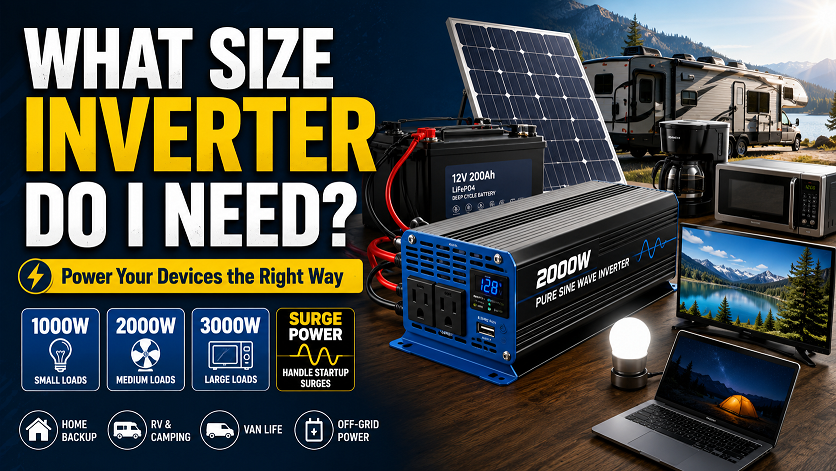
What Size Inverter Do I Need? 2026 Sizing Guide + Free Calculator
Add up the watts of every AC device you plan to run at the same time — then add 25%. That is your minimum inverter size. Most van and RV solar builds need a 1,000–2,000W pure sine wave inverter. Home backup systems typically need 2,000–3,000W. Always buy pure sine wave — never modified sine wave, which damages CPAP machines, laptop chargers, and variable-speed motors. Size by your loads, not by your panel wattage.
Buying the wrong size inverter is one of the most common and costly mistakes in DIY solar. Too small and it shuts down or burns out when you run your coffee maker and laptop at the same time. Too large and you waste money on a unit that runs at 5% efficiency, dumping heat and draining your battery faster than necessary.
This guide gives you the exact formula to size your inverter correctly, a free watt calculator, a 50+ appliance wattage reference table, and the top pure sine wave inverters for every system size in 2026.
DIY Solar Series
This article focuses on inverter sizing. For RV and van-specific solar builds, see our DIY Solar for RV and Van Life guide. For battery sizing math, see our Battery Bank Sizing Calculator. For charge controller selection, see Best Solar Charge Controller.
How Inverters Work (And Why Size Matters)
Your solar panels and battery bank run on DC power (direct current) — typically 12V, 24V, or 48V. Nearly every household appliance runs on AC power (alternating current) at 120V in the US. An inverter converts DC from your battery into AC for your appliances.
The watt rating on an inverter tells you the maximum continuous AC power it can deliver. A 1,000W inverter can power 1,000 watts of AC loads simultaneously without overheating — no more. If you exceed that, the inverter trips its overload protection or, in cheap units, burns out entirely.
Pure Sine Wave vs Modified Sine Wave Inverters
This is the single most important inverter decision you will make. Get it wrong and you risk damaging hundreds of dollars of electronics.
The “$40 Amazon Inverter” Trap
Search “inverter” on Amazon and the first results are modified sine wave units at $35–$60. They work fine for charging a basic drill or running an incandescent light bulb. They will damage your CPAP machine, confuse your laptop’s power supply, cause audio hum, and shorten the life of any appliance with a variable-speed motor. The $20 you save is not worth it. Every pure sine wave inverter in this guide costs under $200 for 1,000–2,000W — there is no reason to buy modified sine wave for any solar or off-grid application.
Continuous Watts vs Surge Watts — Critical Distinction
Every inverter has two watt ratings. Most buyers only look at one. That mistake causes inverters to trip during normal use.
| Rating | What It Means | How to Use It |
|---|---|---|
| Continuous Watts | Maximum power the inverter sustains indefinitely without overheating | Must be ≥ sum of all simultaneous AC loads + 25% buffer |
| Surge Watts (Peak Watts) | Short burst (1–5 sec) the inverter handles to start motor-driven appliances | Must be ≥ startup surge of your highest-draw motor appliance |
| Appliance | Running Watts | Startup Surge | Surge Multiplier |
|---|---|---|---|
| Window AC (5,000 BTU) | 500W | 1,500–2,000W | 3–4× |
| Standard Fridge (18 cu ft) | 150W | 800–1,200W | 5–8× |
| Sump Pump (1/2 HP) | 800W | 2,000–3,000W | 2.5–4× |
| Well Pump (1 HP) | 1,000W | 3,000–5,000W | 3–5× |
| Circular Saw (7.25″) | 1,400W | 2,800–4,200W | 2–3× |
| Table Saw (10″) | 1,800W | 4,500–7,200W | 2.5–4× |
| Microwave (900W) | 900–1,200W | 1,000–1,400W | 1.1–1.5× |
| Coffee Maker | 900–1,200W | 1,000–1,300W | 1.1× |
| Laptop Charger | 45–90W | 90–120W | 1–1.5× |
| CPAP (no humidifier) | 30–60W | 60–80W | 1–1.3× |
Refrigerator Startup Surge Is the Most Misunderstood Spec
A standard household refrigerator rated at 150W running draws up to 1,200W for the first 1–3 seconds when the compressor starts. An inverter rated at only 1,000W continuous (even with 2,000W surge) will trip its protection circuit every time your fridge kicks on. If you plan to run a standard household fridge, buy a 2,000W pure sine wave inverter with at least 4,000W surge — or switch to a 12V DC compressor fridge (BougeRV, ARB, Dometic) that runs directly from your battery with no inverter needed at all.
Free Inverter Size Calculator
Enter every AC appliance you plan to run through your inverter. The calculator adds them up, applies the 25% safety buffer, and recommends the right inverter size and a matched battery capacity for your runtime goal.
Inverter Size Tiers — Which One Do You Need?
| Use Case | Typical Loads | Inverter Size | Battery Needed | System Voltage |
|---|---|---|---|---|
| Van life (DC-first build) | Laptop, CPAP, occasional blender | 600–1,000W PSW | 100Ah LiFePO4 | 12V |
| Full-time van / small RV | Laptop, CPAP, power tools, microwave | 1,000–1,500W PSW | 200Ah LiFePO4 | 12V |
| Class C / Travel Trailer | Full kitchen, standard fridge, TV | 2,000W PSW | 200–300Ah LiFePO4 | 12V or 24V |
| Class A Motorhome | Rooftop AC, microwave, all appliances | 2,000–3,000W PSW | 400Ah LiFePO4 | 24V or 48V |
| Home backup (partial) | Fridge, lights, internet, phone charging | 2,000W PSW | 200–400Ah LiFePO4 | 24V or 48V |
| Home backup (whole house) | All appliances, well pump, AC | 3,000–5,000W PSW | 400–800Ah LiFePO4 | 48V |
Wattage Reference Table — 50+ Common Appliances
Use this table to build your load list for the calculator above. Running watts are typical averages — check your device’s label or manual for exact figures.
Kitchen Appliances
| Appliance | Running Watts | Startup Surge | Inverter-Friendly? |
|---|---|---|---|
| Coffee maker (drip) | 900–1,200W | 1,000–1,300W | Yes — 1,500W+ PSW |
| Microwave (900W) | 900–1,200W | 1,000–1,400W | Yes — 1,500W+ PSW |
| Blender | 300–750W | 600–1,200W | Yes — 1,000W+ PSW |
| Toaster | 800–1,500W | 900–1,600W | Yes — 2,000W PSW |
| Toaster oven | 1,200–1,800W | 1,300–2,000W | Yes — 2,000W+ PSW |
| Electric kettle | 1,000–1,500W | 1,000–1,600W | Yes — 2,000W PSW (high draw) |
| Instant Pot (6 qt) | 1,000W | 1,100W | Yes — 1,500W PSW |
| Standard fridge | 100–400W | 800–1,500W | Yes — 2,000W PSW (surge concern) |
| Dishwasher | 1,200–2,400W | 1,400–2,600W | 2,000–3,000W PSW + large battery |
Computers and Electronics
| Appliance | Running Watts | Startup Surge | Inverter-Friendly? |
|---|---|---|---|
| Laptop (15″) | 45–90W | 60–120W | Yes — 600W+ PSW |
| MacBook Pro (M-series) | 30–60W | 70–90W | Yes — 600W+ PSW |
| Gaming laptop | 130–230W | 200–300W | Yes — 1,000W+ PSW |
| Desktop PC (mid-range) | 200–350W | 400–600W | Yes — 1,000W+ PSW |
| 27″ Monitor | 25–60W | 30–70W | Yes — 600W+ PSW |
| Phone charger | 15–30W | 20–35W | Yes — any PSW |
| Tablet charger | 20–40W | 25–50W | Yes — any PSW |
| TV (40″) | 60–120W | 70–140W | Yes — 600W+ PSW |
| Gaming console (PS5/Xbox) | 100–200W | 150–250W | Yes — 1,000W PSW |
| WiFi router | 10–20W | 15–25W | Yes — any PSW |
Medical Devices
| Appliance | Running Watts | Startup Surge | Notes |
|---|---|---|---|
| CPAP (no humidifier) | 30–60W | 60–80W | Always use PSW — MSW damages CPAP internals |
| CPAP with humidifier | 60–120W | 80–140W | Must be PSW — humidifier motor is sensitive |
| BiPAP | 50–100W | 80–120W | PSW required — check DC adapter option on your model |
| Nebulizer | 50–100W | 60–120W | PSW only |
| Oxygen concentrator | 150–600W | 200–800W | PSW required — high-priority load, size battery carefully |
Power Tools
| Appliance | Running Watts | Startup Surge | Inverter-Friendly? |
|---|---|---|---|
| Drill (corded) | 400–600W | 600–900W | Yes — 1,000W PSW |
| Jigsaw | 400–600W | 600–900W | Yes — 1,000W PSW |
| Circular saw (7.25″) | 1,200–1,600W | 2,400–4,000W | 2,000W+ PSW, 4,000W+ surge needed |
| Table saw (10″) | 1,800W | 4,500–7,200W | 3,000W+ PSW, significant surge required |
| Air compressor (1 HP) | 1,000–1,500W | 3,000–4,500W | 2,000W+ PSW, 4,500W+ surge capacity |
Matching Your Inverter to Your Battery Bank
Your inverter and battery bank must be sized together. A large inverter on a small battery bank creates two problems: excessive current draw that stresses the battery, and very short runtimes that make the inverter impractical.
| Battery Bank | Max Practical Inverter | Runtime @ 500W Load | Runtime @ 1,000W Load |
|---|---|---|---|
| 100Ah @ 12V LiFePO4 | 1,000W PSW | ~1.9 hrs | ~0.9 hrs |
| 200Ah @ 12V LiFePO4 | 1,500–2,000W PSW | ~3.8 hrs | ~1.9 hrs |
| 300Ah @ 12V LiFePO4 | 2,000W PSW | ~5.8 hrs | ~2.9 hrs |
| 200Ah @ 24V LiFePO4 | 3,000W PSW | ~7.7 hrs | ~3.8 hrs |
| 200Ah @ 48V LiFePO4 | 5,000W PSW | ~15.4 hrs | ~7.7 hrs |
When to Upgrade from 12V to 24V or 48V
If your inverter needs exceed 2,000W, seriously consider a 24V system. At 24V, a 2,000W inverter draws only 90A from the battery — compared to 180A at 12V. Lower current means thinner, cheaper wire runs, less heat, and better battery longevity. At 3,000W+ loads, 48V is the practical choice for whole-home backup systems. The downside: most van life accessories (12V fridge, 12V USB ports, 12V lighting) require a DC-DC converter if your main bank is 24V or 48V.
Inverter Wiring and Installation Rules
An inverter draws more current from your battery than almost any other component in your system. Incorrect wiring causes fire, not just equipment failure.
Never Use Extension Cords on High-Power Inverters
Running a 2,000W inverter through a standard 16-gauge household extension cord is a fire hazard. Standard extension cords are rated for 10–15A at 120V (1,200–1,800W) — a 2,000W load exceeds this. At high loads, undersized extension cords heat up inside the insulation and can melt or ignite. If you need to extend an inverter’s output, use a proper 12-gauge or 10-gauge extension cord rated for the load, and keep it as short as possible.
Best Pure Sine Wave Inverters 2026 — Ranked by Size
- Best-selling van life inverter — massive community support and documentation
- 93% peak efficiency — runs cool even at sustained 800W loads
- Battery temperature sensor included — prevents overcharge in hot weather
- Low idle draw (~9W) — won’t drain battery while on standby
- 2× AC outlets + USB-A — covers most van and small RV needs
- 4,000W surge handles standard refrigerator startup without tripping
- Remote on/off switch included — mount near driver’s seat
- 4× AC outlets + 2× USB — enough for full RV loads
- LCD display shows input voltage, output watts, and battery status
- Proven track record in Class C and travel trailer builds
- VE.Direct port — integrates with Victron SmartSolar and BMV monitors
- VictronConnect app monitoring — see inverter status alongside solar production
- Lowest idle draw in class (~7W) — ideal for always-on van builds
- 5-year warranty — industry-leading for this size category
- Best choice if you already have Victron charge controller and BMV
- 6,000W surge handles well pumps, AC units, and large power tools
- L6-30 30A outlet for high-draw appliances and transfer panel connections
- 6× standard AC outlets — enough for partial whole-home backup
- Built-in transfer switch option — works with automatic generator changeover
- AIMS is the go-to brand for off-grid homesteaders and serious backup systems
Size Your Battery Bank to Match Your Inverter
Once you know your inverter size, use our Battery Bank Sizing Calculator to find the right Ah and kWh for your system and runtime goals.
Frequently Asked Questions
What size inverter do I need for a 400W solar system?
Size your inverter based on your AC loads — not your panel wattage. A 400W solar system pairs well with a 1,000W pure sine wave inverter for most van and RV builds. Add up the watts of every AC device you plan to run simultaneously, add 25%, and that is your minimum inverter size. If you only run a laptop (65W), phone charger (30W), and CPAP (50W), a 600W PSW inverter is sufficient and more efficient than a 2,000W unit idling at low load.
Pure sine wave vs modified sine wave inverter — which do I need?
Always buy pure sine wave (PSW) for solar, RV, van, and home backup. Modified sine wave (MSW) inverters damage CPAP machines, overheat laptop chargers, cause hum in audio equipment, and shorten the life of variable-speed motors. Pure sine wave inverters cost $20–$60 more and are worth every dollar. The only scenario where MSW is acceptable is running simple resistive loads (basic power tools, incandescent bulbs) from a temporary car inverter — and even then PSW is the safer choice.
What is the difference between continuous watts and surge watts on an inverter?
Continuous watts is what the inverter sustains indefinitely — size your inverter by this number. Surge watts is the short burst (1–5 seconds) for starting motor-driven appliances. A refrigerator that runs at 150W may surge to 1,200W on compressor startup. Your inverter’s surge rating must exceed this peak startup draw. Most quality inverters have a surge rating of 2× their continuous rating — a 1,500W inverter typically surges to 3,000W, which handles most standard refrigerator startups.
How do I calculate what size inverter I need?
Add the running watts of every AC appliance you plan to run at the same time. Add 25% as a safety buffer. That is your minimum continuous watt rating. Then check the highest-surge device (usually a fridge, AC, or power tool) — your inverter’s surge rating must exceed its startup draw. Example: laptop (65W) + coffee maker (900W) + phone (30W) = 995W × 1.25 = 1,244W minimum. Buy a 1,500W inverter. Use the free Inverter Size Calculator above for precise results.
What size inverter do I need for a refrigerator?
A standard household refrigerator (15–20 cu ft) runs at 100–400W but surges to 800–1,500W on compressor startup. You need a 2,000W pure sine wave inverter with at least 4,000W surge to run a standard fridge safely. If you are building a van or RV system, consider a 12V DC compressor fridge (BougeRV, ARB, Dometic) instead — it runs directly from your battery with no inverter, uses 50–70% less energy, and eliminates the startup surge problem entirely.
Can I run an air conditioner on an inverter?
Yes, but it is demanding. A 5,000 BTU window AC draws 450–600W running and surges to 1,800W — a 2,000W pure sine wave inverter handles it. A 12,000 BTU RV rooftop AC draws 1,200–1,500W running and surges to 4,500W — you need a 3,000–4,000W inverter. For van and RV use, a 12V/24V mini-split designed for DC systems (Fogatti, Zero Breeze) is far more efficient because it eliminates the DC-to-AC-to-compressor conversion loss.
What size inverter do I need for a 200Ah battery?
A 200Ah LiFePO4 at 12V holds 1,920Wh of usable power (at 80% DoD). A 1,000W inverter at full load drains it in about 1.9 hours. At a more realistic 500W load, you get about 3.8 hours of runtime. A 1,000–1,500W pure sine wave inverter is the practical sweet spot for a 200Ah battery — large enough to handle most AC loads, sized so you get meaningful runtime without excessive current draw stressing the battery cells.
Continue Your DIY Solar Build
- Renogy — Pure Sine Wave Inverter Product Documentation and Technical Specifications, 2026
- Victron Energy — Phoenix Inverter Product Manual and VE.Direct Protocol Guide, 2026
- AIMS Power — 3000W PSW Inverter Specifications and Installation Guide, 2026
- Giandel — 2000W Inverter Technical Sheet and User Reviews, 2026
- Windy Nation — Inverter Sizing Guide: How to Calculate Your Power Needs, 2025
- altE Store — Pure Sine Wave vs Modified Sine Wave: Which Do I Need?, 2026
- Engineers Who Van Life — Van Life Electrical System Guide: Inverters, 2026
- DIY Solar Power Forum — Community Reviews: Best 1000W–2000W Inverters for Solar, 2026
Test, message – Thank you!