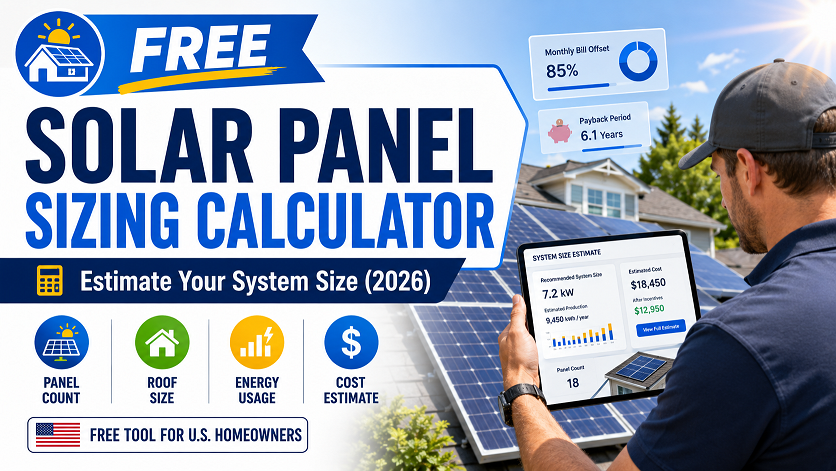
Free Solar Panel Sizing Calculator 2026
Stop guessing how many solar panels your home actually needs. This free solar panel sizing calculator 2026 uses your real annual electricity usage, your US location’s peak sun hours, and your preferred panel wattage to give you a precise system size — the same method professional solar installers use.
All you need is your annual kWh usage from your utility bill. Don’t have it handy? Use the quick-pick buttons to start with a national average. Read our full guide on How Many Solar Panels Do I Need for a 2,000 Sq Ft Home?
Solar Panel Sizing Tool
Discover more: Business & Productivity Software | Electronics & Electrical | Home Improvement
Solar Panel Sizing Tool
Enter your details below to find out exactly how many panels you need.
Estimates use a 0.85 system efficiency factor per industry standard. Costs based on $2.80–$3.20/watt national average (2026). Consult a licensed electrician before installation.
Estimates use a 0.85 system efficiency factor per industry standard. Costs based on $2.80–$3.20/watt national average (2026). Consult a licensed electrician before installation.
What Your Results Mean
Your panel count is the minimum number of 400W, or your chosen wattage, modules needed to offset 100% of your home’s yearly electricity consumption. Because solar output varies slightly season to season, most installers recommend rounding up by 1–2 panels as a production buffer — especially in cloudy northeastern states like New York, Pennsylvania, or Washington.
Discover more: Solar Panel | Electronics & Electrical | Home Automation
Your system size (kW) is the total installed capacity. A typical 2,000 sq ft home lands between 6 kW and 10 kW depending on location and usage habits. Larger isn’t always better — an oversized system produces excess power your utility may not fully compensate for under net metering.
Your cost estimate is based on the 2026 national average of $2.80–$3.20 per watt for fully installed residential systems. If you’re going the DIY route, your hardware-only cost can drop by $5,000–$10,000, since labor and overhead typically account for 40–50% of a professional quote.
The 30% Federal Residential Clean Energy Credit applies dollar-for-dollar to your federal income tax liability. For a $20,000 system, that’s $6,000 back at tax time. This credit is locked in through 2032, so 2026 remains one of the best years in history to go solar.
Ready to take the next step? See our complete DIY Solar Panel Installation Guide 2026 for the exact tools, permits, and wiring steps needed to build your system from scratch. For a complete breakdown of what a DIY system costs at your panel count, see our DIY Solar System Cost guide for 2026.
Solar Panel Sizing Calculator 2026: FAQ
How accurate is this solar panel sizing calculator 2026?
This calculator uses the same formula professional installers use: Annual kWh ÷ (Peak Sun Hours × 365 × 0.85 system efficiency) ÷ Panel Wattage. It factors your exact US location and applies the 0.85 industry-standard efficiency factor for inverter, wiring, and temperature losses.
What panel wattage should I choose in the calculator?
Most homes in 2026 use 400W Standard Mono panels. Budget builds use 350W Poly, while premium N-Type 440W–480W panels offer higher efficiency for limited roof space. Higher wattage means fewer panels needed.
Does the 30% federal solar tax credit apply in 2026?
Yes. The 30% Federal Residential Clean Energy Credit is locked in through 2032. For a $20,000 system, you get $6,000 back as a dollar-for-dollar reduction in federal income tax liability. This calculator shows both gross and net cost.
Should I oversize my solar system?
Most installers recommend rounding up by 1–2 panels as a production buffer, especially in cloudy states like New York, Pennsylvania, or Washington. But oversizing too much may not pay off if your utility has poor net metering rates.