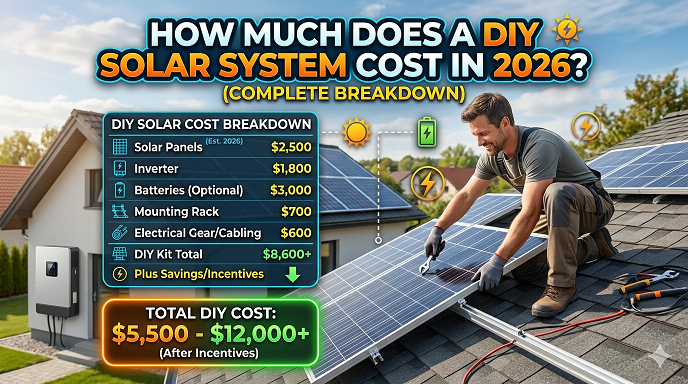
How Much Does a DIY Solar System Cost in 2026? (Complete Breakdown)
A DIY solar system in 2026 costs $3,000–$20,000 before the 30% federal tax credit, depending on size. A 7 kW home system runs $6,000–$10,000 DIY vs $19,000–$22,000 professionally installed — you save $8,000–$15,000 by doing it yourself. Both qualify for the same 30% federal Investment Tax Credit. At current US electricity rates of $0.17/kWh, most DIY systems pay for themselves in 4–7 years and save $35,000–$75,000 over 25 years.
The national average installed cost for a residential solar system in the US in 2026 sits at roughly $2.95 per watt before incentives, according to Lawrence Berkeley National Laboratory’s Tracking the Sun dataset and SEIA Q1 2026 market data. For a typical 7 kW home system, that’s $20,650 before the tax credit — and about $14,455 after.
But that’s for a professional installation. The DIY number is dramatically different. DIY kits cost $6,000 to $12,000 for a standard home and include panels, inverters, and mounting hardware. The gap between professional and DIY isn’t a rounding error — it’s $8,000 to $15,000 that stays in your pocket.
This guide gives you every number you need: cost by system size, a component-by-component breakdown, the tax credit math, a free payback calculator, and the best kits available right now with real purchase links.
Article 9 in the Shalkot DIY Solar Series
Before budgeting, know your system size. Use our Solar Panel Calculator to determine how many panels your home needs — then come back here for the exact cost breakdown for your size. The full installation guide is at Article 02.
DIY Solar Cost by System Size (2026)
System size is the biggest driver of cost. Here is what you can expect at each scale, based on 2026 direct-to-consumer equipment pricing:
| System Size | Panels Needed | DIY Cost (before credit) | After 30% Credit | Best For |
|---|---|---|---|---|
| 2 kW | 5 × 400W panels | $3,000–$4,500 | $2,100–$3,150 | Off-grid cabin, RV, weekend use |
| 4 kW | 10 × 400W panels | $4,500–$7,000 | $3,150–$4,900 | Small home, apartment with solar |
| 6 kW | 15 × 400W panels | $6,000–$9,000 | $4,200–$6,300 | Average 1,500–2,000 sq ft home |
| 7 kW | 17–18 × 400W panels | $7,000–$10,500 | $4,900–$7,350 | Standard 2,000 sq ft home |
| 10 kW | 25 × 400W panels | $10,000–$15,000 | $7,000–$10,500 | Larger home, EV charging |
| 12 kW | 30 × 400W panels | $13,000–$20,000 | $9,100–$14,000 | Large home, high usage |
| + Battery backup (10 kWh LiFePO4) | Add to any above | + $3,000–$6,000 | + $2,100–$4,200 (credit applies) | Off-grid capability, outage protection |
Every Component Priced — What You’re Actually Paying For
Here is the complete cost breakdown for a typical 7 kW DIY system (17 panels at 400W each) in 2026. This is the most common system size for a 2,000 sq ft US home:
Where to Buy Components for the Lowest Price
Panels + charge controllers: Renogy.com direct, GoGreenSolar.com, Wholesale Solar (altE Store) — often 10–20% cheaper than Amazon.
Racking: IronRidge.com direct or eBay from solar liquidators — huge savings on racking.
Inverters: Amazon for Growatt and SMA; manufacturer direct for Fronius and Enphase.
Wire and conduit: Home Depot, Lowe’s, or electrical supply houses (Grainger, Anixter) — much cheaper than solar-specific suppliers for wire.
DIY vs Professional Installation: The Real Cost Comparison
A solar installation quote is not one number — it is the sum of six distinct cost categories. When you go DIY, you eliminate three of them entirely: labor, company overhead, and sales commission. Here is the exact breakdown for the same 7 kW system:
The 30% Federal Tax Credit Math
The 30% federal Investment Tax Credit (ITC) is the most powerful financial incentive in US solar in 2026 — and it fully applies to DIY installations. Here is exactly how the math works at different system costs:
How to claim: File IRS Form 5695 with your federal tax return for the year your system achieves Permission to Operate. The credit directly reduces your federal tax bill — if the credit exceeds your tax liability, the unused portion carries forward to future years.
Important: You must owe federal income taxes to benefit. If you owe $0 in federal taxes, you cannot use the credit (though it carries forward). Consult a tax professional for your specific situation.
State and Local Incentives — Stack on Top of the Federal Credit
The 30% federal ITC is just the start. Many states offer additional incentives that stack on top: California has the Self-Generation Incentive Program (SGIP) for battery storage. New York offers a 25% state tax credit (up to $5,000). Massachusetts has the SMART program. Texas, Florida, and Arizona offer property and/or sales tax exemptions on solar. Search “[your state] solar incentives 2026” or use DSIRE (dsireusa.org) to find every incentive available in your zip code. Once your system has Permission to Operate, don’t forget to claim the 30% federal solar tax credit on IRS Form 5695 — it could save you $2,000–$8,000 on your next tax return.
Free DIY Solar Payback Period Calculator
Best DIY Solar Kits in 2026 — Ranked by Use Case
Complete solar kits bundle panels, controller or inverter, mounting hardware, and wiring into one purchase with guaranteed compatibility. DIY solar panel kits cut professional installation cost by 50–70% by eliminating labor, and the kits have gotten simple enough that a homeowner comfortable on a roof with basic tools can handle the installation in a weekend.
Here are the top-rated kits available right now with current pricing and purchase links:
- Most documented DIY kit — massive community support
- Expandable — add more panels to same controller
- 25-year panel performance warranty
- Compatible with 12V/24V LiFePO4 and AGM
- Optional Bluetooth monitoring add-on
- 23% efficient N-type panels — highest in class
- Rated for 2,400 Pa wind + 5,400 Pa snow loads
- Built-in RV/van DNA — compact, durable
- Excellent for roof or ground mount
- Available at Home Depot + Lowe’s for easy returns
- Panels, battery, inverter, and controller in one compatible ecosystem
- App-controlled — real-time monitoring from phone
- Modular — add battery packs as needs grow
- 15-minute setup for portable configurations
- Best for non-technical users or renters
- Professional-grade EG4 hybrid inverter — grid-tie + off-grid capable
- Phone system design support included with purchase
- Strong community of DIY off-grid builders using this setup
- Expandable battery storage (EG4 48V batteries)
- Better price than buying components separately at this scale
Adding Battery Storage — What It Costs in 2026
Battery backup is optional for grid-tied systems but adds significant value. In 2026, a 10 kWh LiFePO4 battery bank costs approximately $1,500–$3,200 (two 48V 100Ah batteries). The 30% federal tax credit applies to battery storage when it is charged primarily by solar (not from the grid). A battery-equipped system qualifies for a larger tax credit and keeps your lights on during outages. For sizing help, use our Battery Bank Calculator.
Where Solar Saves the Most — Cost and Payback by State
Your electricity rate is the single biggest factor in your payback period. States with high electricity rates see the fastest solar payback — sometimes as low as 3–4 years for DIY systems:
| State | Avg Rate (2026) | 7 kW DIY Cost (after credit) | Est. Monthly Savings | Payback Period |
|---|---|---|---|---|
| Hawaii | $0.39/kWh | $5,600 | $540/mo | 0.9 years |
| California | $0.28/kWh | $5,600 | $388/mo | 1.2 years |
| Massachusetts | $0.25/kWh | $5,600 | $284/mo | 1.6 years |
| New York | $0.22/kWh | $5,600 | $214/mo | 2.2 years |
| Colorado | $0.15/kWh | $5,600 | $196/mo | 2.4 years |
| Texas | $0.14/kWh | $5,600 | $183/mo | 2.6 years |
| Florida | $0.14/kWh | $5,600 | $183/mo | 2.6 years |
| National Average | $0.17/kWh | $5,600 | $145/mo | 3.2 years |
| Arizona | $0.13/kWh | $5,600 | $170/mo | 2.7 years |
Estimates based on 7 kW DIY system at $8,000 before credit, after 30% ITC ($5,600 net), system efficiency 80%, 5.0 peak sun hours. Actual results vary by location, roof orientation, and shading.
Hidden Costs Most Guides Don’t Mention
The component list is just the start. You’ll probably drop another $1,200–$2,500 on things that aren’t panels. Think permit fees (usually $300–$1,000), specialized electrical tools like a torque wrench or MC4 crimpers, and a one-day consultation with a licensed electrician.
| Hidden Cost | Typical Amount | Can You Avoid It? |
|---|---|---|
| Permit plan set service | $200–$800 | You can draw your own plans, but a supplier’s plan set saves 10+ hours and reduces rejection risk |
| Electrical tools (torque wrench, MC4 crimper) | $80–$200 | Yes — rent instead of buy for a one-time install |
| Roof assessment / structural engineer | $200–$500 | Required in high-wind zones or older homes with unknown rafter spacing |
| Main electrical panel upgrade | $1,200–$2,500 | Only if your existing panel is at capacity or outdated — check this early |
| Roof repairs before installation | $500–$5,000+ | Cannot avoid if roof is in poor condition — solar accelerates leak damage on failing roofs |
| Rope, harness, and fall protection | $100–$300 | Non-negotiable safety requirement — do not skip |
| Utility interconnection application fee | Free–$200 | Usually free; some utilities charge up to $200 |
| Net metering meter upgrade | Free (utility provides) | Not your cost — utility installs as part of interconnection |
The #1 Hidden Cost: Buying the Wrong Controller or Inverter
The most expensive mistake in a DIY solar build is buying a charge controller with insufficient input voltage for your panel configuration, or an inverter undersized for your actual loads. A controller ruined by voltage overage costs $100–$280 to replace. An inverter that can’t handle your load on a cold winter morning costs $900–$2,000 to swap. Spend 30 minutes verifying compatibility between every component before purchasing — our Wiring Guide and Charge Controller guide walk through exactly how to do this.
Know Your System Size Before You Budget
Enter your monthly kWh usage and state into our Solar Panel Calculator — it tells you exactly how many panels, what system size, and gives you a ballpark cost estimate for your specific situation.
Frequently Asked Questions
How much does a DIY solar system cost in 2026?
A complete DIY solar system in 2026 costs between $3,000 and $20,000 before the 30% federal tax credit, depending on system size. A small 2–3 kW off-grid system runs $3,000–$6,000. A standard 7 kW grid-tied home system costs $6,000–$10,500. A large 12 kW home system runs $13,000–$20,000. After the 30% federal Investment Tax Credit, subtract 30% from equipment and permit costs. A $8,000 DIY system becomes $5,600 after the credit.
How much can I save by doing solar myself vs hiring a pro?
The national average installed cost for a residential solar system is roughly $2.95 per watt before incentives. That makes a 7 kW professional installation approximately $20,650 before the tax credit. The same system DIY costs $6,000–$10,500 — a savings of $8,000–$15,000. DIY solar panel kits cut professional installation cost by 50–70% by eliminating labor. Both qualify for the same 30% federal tax credit.
How long does it take for a DIY solar system to pay for itself?
Most DIY solar systems pay for themselves in 4–7 years at the US average electricity rate of $0.17/kWh in 2026. In high-rate states like California ($0.28/kWh) or Massachusetts ($0.25/kWh), payback can be as short as 1–2 years. After that 30% credit, most DIYers are hitting their break-even point in 5 to 8 years. Since these systems are rated to last 25+ years, your electricity is essentially free for nearly two decades after you pay off the equipment. Use our payback calculator above for your specific numbers.
What is the cheapest way to go solar in 2026?
The cheapest entry into solar in 2026 is a plug-in solar system (1–1.2 kW) for $800–$1,500 in the 23+ states that allow it — no permit, no utility approval, just plug into a dedicated outdoor outlet. For a full roof system, the cheapest path is a DIY grid-tied system with a string inverter, standard monocrystalline panels from direct suppliers (Renogy.com, GoGreenSolar.com), and a simple south-facing asphalt shingle roof — avoiding microinverters, battery backup, and complex roof layouts that add cost. A 4 kW DIY system can be built for under $4,500 before the 30% tax credit in 2026.
Does the 30% federal tax credit apply to DIY solar?
Yes, fully. The 30% federal Investment Tax Credit applies to DIY solar systems through 2032. You claim it on IRS Form 5695. All equipment costs (panels, inverter, racking, wiring, batteries), permit fees, and any electrician costs qualify. Your own unpaid labor does not qualify. The credit is a direct dollar-for-dollar reduction in your federal tax liability — not just a deduction. If the credit exceeds your tax liability in year one, the unused portion carries forward to subsequent tax years.
What is the most expensive part of a DIY solar system?
Solar panels account for 40–45% of a complete DIY system cost — typically $3,400–$5,100 for a 7 kW system. The inverter is the second most expensive component at $900–$4,200 depending on whether you choose a string inverter or microinverters. Racking and mounting hardware runs $900–$1,500. If you add battery storage, LiFePO4 batteries often become the most expensive single item — a 10 kWh LiFePO4 bank costs $1,500–$3,200 and is covered by the 30% tax credit when charged primarily by solar.
Can I get a complete DIY solar kit instead of buying components separately?
DIY solar panel kits have gotten simple enough that a homeowner comfortable on a roof with basic tools can handle the installation in a weekend. Complete kits from Renogy, BougeRV, Rich Solar, and EcoFlow bundle panels, controller or inverter, mounting hardware, and wiring into one purchase with guaranteed compatibility and tech support. Kits cost $400–$15,000 depending on size. For systems under 3 kW, a complete kit saves significant time. For systems over 5 kW, buying components individually typically saves $500–$2,000 but requires more research to ensure compatibility.
Complete Your DIY Solar Knowledge
- SolarVisionAI — Solar Panel Installation Cost: The Complete 2026 Breakdown, April 2026
- EnergySage — Solar Panel Cost in 2026: Pricing and Savings Breakdown, April 2026
- Angi — How Much Does It Cost to Install Solar Panels? [2026 Data]
- EcoFlow — DIY Solar System Guide 2026: Components, Costs, and Installation Tips, March 2026
- EcoFlow — Solar Panel Installation Cost: A 2026 ROI Breakdown
- Anker SOLIX — Cost to Install Solar Panels Yourself: 2026 Guide
- This Old House — Solar Panel Cost in 2026: Pricing and Savings Breakdown
- RadCity.net — 10 Best Solar Panel Kits for Homes in 2026 (DIY)
- Off Grid Authority — Best Off-Grid Solar Kits in 2026: Complete Buyer’s Guide
- Lawrence Berkeley National Laboratory — Tracking the Sun, Q1 2026; SEIA US Solar Market Insight Q1 2026
5 thoughts on “How Much Does a DIY Solar System Cost in 2026? (Complete Breakdown)”