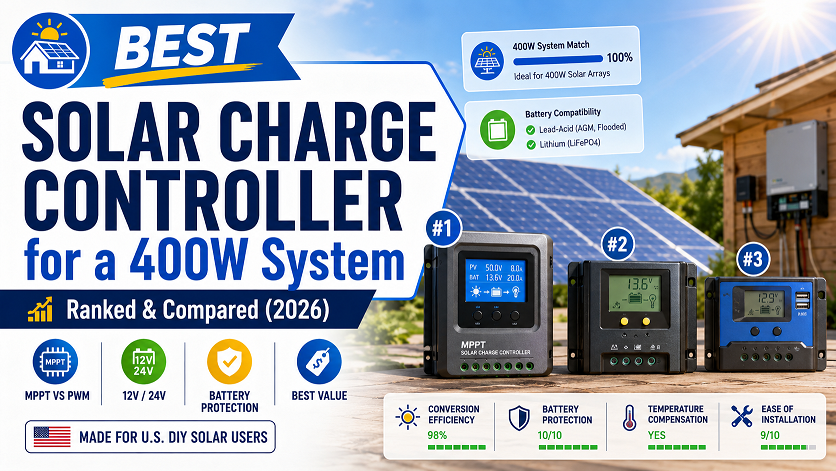
Best Solar Charge Controller for a 400W System in 2026 — Ranked & Compared
For a 400W solar system, you need a 40A MPPT charge controller on a 12V battery bank. The best overall is the Victron SmartSolar MPPT 100/50 (~$280) — built-in Bluetooth, 98% peak efficiency, fastest cloud-event tracking at 1–3 seconds. The best value is the Renogy Rover 40A (~$180) — solid performance, good app support with optional BT-1 module, and excellent Amazon support. The best budget pick is the EPEver Tracer 4210AN 40A (~$100) — reliable hardware, 150V input, but slower tracking. Never use a PWM controller on a 400W system — it wastes 20–30% of your energy. MPPT only.
The charge controller is the brain of your solar system. It sits between your panels and your battery bank, managing how power flows to prevent overcharging, optimize charging efficiency, and protect your batteries’ long-term health.
For a 400W system — the most popular DIY solar size for RVs, off-grid cabins, and home battery backup in 2026 — the controller choice comes down to one primary decision: which MPPT controller gives you the best combination of efficiency, monitoring, battery compatibility, and value for your budget.
This guide cuts through the noise with real 2026 performance data, clear sizing math, and honest assessments of the top four controllers for 400W systems.
Already know what you need?
If you haven’t sized your full system yet, start with our Solar Panel Calculator to confirm your panel count, then come back here to pick the right controller. For the complete installation walkthrough, see our DIY Solar Installation Guide.
MPPT vs PWM — Why MPPT Is the Only Choice for a 400W System
The fundamental difference between MPPT and PWM controllers is how they handle the voltage mismatch between your solar panels and your battery bank. For a 400W system, this difference is not academic — it directly determines how much energy your panels deliver to your batteries every single day.
| Factor | PWM Controller | MPPT Controller | Verdict for 400W |
|---|---|---|---|
| How it works | Directly connects panel to battery, pulses connection to regulate voltage. Wastes excess panel voltage as heat. | DC-to-DC converter. Takes high panel voltage, steps it down to battery level, boosts current in the process. | MPPT wins |
| Energy efficiency | 70–75% effective (wastes 25–30% of panel potential) | 93–99% effective | MPPT wins by 20–30% |
| 400W panel → 12V battery | Delivers ~280–300W effective charging power | Delivers ~370–390W effective charging power | MPPT +90W daily |
| Low-light performance | Poor — efficiency drops sharply in clouds or shade | Excellent — still harvests significant power in partial shade | MPPT wins |
| Cold weather | Poor — Voc rises in cold, PWM wastes more | Excellent — higher Voc = more energy harvested | MPPT wins |
| Cost | $15–$60 | $100–$280 for 400W-capable units | PWM cheaper upfront |
| Payback vs PWM | — | MPPT premium pays back in months via energy savings | MPPT better value long-term |
Do Not Use a PWM Controller on a 400W System
A modern 400W solar panel has an open-circuit voltage (Voc) of approximately 42–50V. A PWM controller forces that voltage down to 13–14V to match a 12V battery, effectively throwing away more than half of your panel’s potential power. In real-world testing, MPPT controllers harvest 20–30% more energy than PWM on identical panels over a full week, with the gap exceeding 30% on partly cloudy days. The MPPT price premium pays back within months. PWM is suitable for small 80W or under systems where panel voltage closely matches battery voltage — not for 400W.
How to Size Your Charge Controller for a 400W System
The 1.25 multiplier (25% safety buffer) accounts for edge-of-cloud effect — when clouds part suddenly, panels briefly produce more than their rated wattage due to reflected sunlight. A controller rated exactly at your array’s maximum will be pushed over its limit during these events, causing power clipping or overheating.
Also Check: Maximum PV Input Voltage
Every charge controller has a maximum PV input voltage (typically 100V or 150V). Your panel array’s open-circuit voltage (Voc) — especially in cold weather when Voc rises — must never exceed this limit. A 400W panel typically has a Voc of 42–50V. Two panels in series = 84–100V. Check that your controller’s max input voltage exceeds your array’s cold-weather Voc before purchasing. The Victron 100/50 handles up to 100V input; the Victron 150/35 handles 150V — better suited for two panels in series in cold climates.
Best Solar Charge Controllers for a 400W System — Ranked
These four controllers represent the top options for 400W systems in 2026, ranked by overall performance. All are MPPT only — no PWM recommendations for this system size.
- Built-in Bluetooth — pairs in 15 seconds via VictronConnect app
- Fastest MPPT tracking speed: 1–3 seconds on cloud events vs 5–8 sec competitors
- 98% peak efficiency — highest of any tested controller
- Scored 9.2/10 by Off Grid Benchmark — beats all alternatives
- Harvested 12% more energy on partly cloudy days vs EPEver in field tests
- Excellent historical data logging and customizable charging curves
- Native LiFePO4 support with proper charging profiles
- Massive ecosystem: integrates with Victron BMV shunt, Cerbo GX, MPPT RS
- Best build quality of any tested controller — rated for 10+ years service
- Most expensive at ~$280 — nearly 3× the EPEver budget option
- 100V max PV input — two standard 400W panels in series in cold climates may exceed this; consider the Victron 150/35 instead
- VictronConnect app requires Bluetooth range — for remote monitoring you need additional Victron hardware (GlobalLink or Cerbo GX)
- Overkill for very simple systems where monitoring is not a priority
- Best value for a 400W system — $180 vs $280 for Victron
- Excellent 4.6/5 stars across 4,000+ Amazon reviews — proven reliability
- Native LiFePO4 support with Renogy Rover Li version
- LCD display shows nearly every system spec in real time
- Optional BT-1 Bluetooth module ($30) adds app monitoring
- Renogy DC Home app is functional and beginner-friendly
- Performance lands between EPEver and Victron — solid middle ground
- Renogy’s US customer support and warranty service is reliable
- Compatible with all standard battery types: FLA, AGM, Gel, LiFePO4
- Bluetooth not built-in — requires separate BT-1 module purchase ($30)
- Renogy app less feature-rich than VictronConnect — less historical data
- Wire terminals slightly loose in tested units — tighten carefully
- 12/24V only — no 48V support; not for larger off-grid home systems
- MPPT tracking speed slower than Victron — slightly less effective on rapid cloud events
- Best price at ~$100 — half the cost of Renogy, one-third of Victron
- Best build quality hardware of any tested controller — “built like a tank”
- Best wire terminals of any solar controller tested — large, easy, reliable
- 150V max PV input — handles two 400W panels in series safely in cold climates
- Proven workhorse — widely used in off-grid installations worldwide
- Can support LiFePO4 with custom charging profile via MT50 display
- Slowest MPPT tracking: 5–8 seconds on cloud events — consistently lags Victron
- Harvested 6.5% less energy than Victron 150/35 in SunForgeLab field tests
- No built-in Bluetooth; Bluetooth dongle option has been unreliable in testing
- Basic LCD display — add MT50 remote meter ($25) for better visibility
- No native LiFePO4 preset — requires manual custom profile setup which intimidates beginners
- On partly cloudy days gap vs Victron widened to 8–10% due to slow MPP hunting
- Supports 12V, 24V, and 48V battery systems — room to scale up
- 150V max PV input — safe for two panels in series in cold climates
- Native LiFePO4 support — no custom profile needed
- Dual USB charging ports — handy for RV and van setups
- ~$150 price point — middle ground between EPEver and Renogy
- Good value for 48V system buyers who don’t want to pay Victron prices
- Less proven track record vs Renogy and Victron at this price
- Bluetooth optional and app less polished than Victron or Renogy
- Performance slightly below Renogy Rover in head-to-head tests
- Customer support less established than Renogy’s US operation
Side-by-Side Comparison — All Four Controllers
| Controller | Price | Amps | Max PV V | Bluetooth | LiFePO4 | 48V | Best For |
|---|---|---|---|---|---|---|---|
| Victron SmartSolar 100/50 | ~$280 | 50A | 100V | Built-in | Native | Yes | Best performance, best monitoring |
| Renogy Rover Li 40A | ~$180 | 40A | 100V | Optional BT-1 (+$30) | Native (Li version) | No | Best value, 12/24V systems |
| EPEver Tracer 4210AN | ~$100 | 40A | 150V | Unreliable dongle | Manual custom profile | No | Best budget, cold climates, simple setups |
| Rich Solar 40A | ~$150 | 40A | 150V | Optional | Native | Yes | 48V systems, future expansion |
How to Wire Your Charge Controller (Correct Order)
The wiring order for a charge controller is critical for safety. Connecting in the wrong order can damage the controller, create sparks, or cause a dangerous short circuit.
Wire Sizing for a 40A Controller on 12V
Battery cables: Use minimum 8 AWG copper wire. Keep runs as short as possible — every extra foot of cable adds resistance and voltage drop. Fuse within 12 inches of the battery positive terminal with a fuse rated 10–20% above your controller’s max charge current. For a 40A controller, use a 50A ANL fuse.
Panel cables: 10 AWG PV wire is standard for most 400W single-panel runs. For runs over 30 feet, step up to 8 AWG to keep voltage drop under 3%.
Battery Compatibility Guide
Your charge controller must be compatible with your battery chemistry. Using the wrong charging profile damages batteries and can create safety hazards. Here is how each battery type works with the controllers in this guide:
| Battery Type | Victron SmartSolar | Renogy Rover Li | EPEver Tracer | Rich Solar 40A |
|---|---|---|---|---|
| Flooded Lead Acid (FLA) | ✅ Preset | ✅ Preset | ✅ Preset | ✅ Preset |
| AGM | ✅ Preset | ✅ Preset | ✅ Preset | ✅ Preset |
| Gel | ✅ Preset | ✅ Preset | ✅ Preset | ✅ Preset |
| LiFePO4 (lithium iron phosphate) | ✅ Native preset | ✅ Native (Li version) | ⚠️ Manual custom profile via MT50 | ✅ Native preset |
| Lithium NMC (EcoFlow, Jackery internal cells) | ✅ Customizable | ⚠️ Check BMS compatibility | ⚠️ Manual only | ⚠️ Check BMS compatibility |
LiFePO4 Is the Battery of Choice for 400W Systems in 2026
If you haven’t chosen your battery type yet, LiFePO4 (lithium iron phosphate) is the overwhelming recommendation for a 400W DIY solar system in 2026. It has 3–4× the cycle life of AGM (2,000–5,000 cycles vs 400–600), higher depth of discharge (95% vs 50% for AGM), and dramatically lighter weight. The price premium over AGM has narrowed significantly. For a detailed comparison of battery types for solar, see our guide: LiFePO4 vs AGM Battery for Solar: Which Is Worth It?
What to Look for When Buying a Charge Controller
| Feature | Why It Matters | What to Look For |
|---|---|---|
| Amperage rating | Determines max solar input it can handle safely | Min 40A for 400W/12V; 20A for 400W/24V. Add 25% buffer. |
| Max PV input voltage | Must exceed your array’s Voc in coldest weather | 100V for single-panel systems; 150V if wiring 2+ panels in series |
| Battery voltage compatibility | Must match your battery bank voltage | 12V/24V for most setups; 48V if scaling to off-grid home system |
| LiFePO4 compatibility | Wrong charging profile damages lithium batteries | Look for native LiFePO4 preset — not just “lithium compatible” |
| Monitoring / Bluetooth | Lets you verify system performance and catch issues early | Built-in Bluetooth (Victron) or reliable add-on module (Renogy BT-1) |
| MPPT tracking speed | Faster tracking = more energy on partly cloudy days | Victron: 1–3 sec; Renogy: ~3–5 sec; EPEver: 5–8 sec |
| Temperature compensation | Adjusts charging voltage for ambient temperature — protects battery life | All recommended controllers include this feature |
| Warranty | Controllers should last 10+ years — warranty signals confidence | Victron: 5 years; Renogy: 2 years; EPEver: 2 years; Rich Solar: 2 years |
Size Your Full System Before You Buy
Use our free Solar Panel Calculator to confirm your panel count, system voltage, and total wattage — then use this guide to pick the right controller for those specs.
Frequently Asked Questions
What size charge controller do I need for a 400W solar panel?
For a 400W system on a 12V battery bank, you need a minimum 40A MPPT charge controller. The math: 400W ÷ 12V = 33.3A, plus a 25% safety buffer for edge-of-cloud events = 41.7A. Round up to the next standard size: 40A (which gives adequate headroom for a single 400W panel). For a 24V battery bank, a 20A or 30A MPPT is sufficient. Never use a controller rated at exactly your calculated amperage without the safety buffer — it will clip peak power and overheat over time.
Is MPPT worth it for a 400W solar system?
Absolutely. A PWM controller on a modern 400W panel (which has a Voc of 42–50V) wastes 25–30% of your panel’s potential energy by clamping that high voltage down to match 12–14V battery voltage. For a 400W array, this is the difference between gaining 280W effective charging power with PWM versus the full 400W with MPPT. In real-world testing, an MPPT controller harvested 27% more energy than a PWM controller on identical panels over a full week. On partly cloudy days, the gap exceeded 30%. The MPPT price premium pays for itself within months on any 400W or larger system.
Can I use a 30A MPPT for a 400W solar panel?
It is risky. A 30A controller can only handle 360–390W on a 12V battery. On a clear summer day, a 400W array will trigger the controller’s current limit, causing it to clip power or overheat. For a 400W system on 12V, use a minimum 40A MPPT controller. The $30–50 price difference between a 30A and 40A unit is not worth the performance and reliability compromise. If you are on a 24V battery bank, a 30A controller works comfortably for 400W.
What is the difference between MPPT and PWM charge controllers?
The main difference between a PWM and MPPT solar charge controller is efficiency. PWM matches panel voltage to battery voltage, while MPPT converts excess voltage into additional charging current, resulting in higher efficiency and faster charging. MPPT is better for medium to large systems, especially above 400W. In a typical MPPT vs PWM efficiency comparison, MPPT controllers are 20–30% more efficient than PWM, particularly in cold weather or with high-voltage solar panels.
Which is better — Victron SmartSolar or Renogy Rover 40A?
The Victron SmartSolar MPPT 100/50 wins on all performance metrics. On partly cloudy days, the Victron 150/35 harvested 12% more energy than the EPEver 4210AN primarily because it locked onto the maximum power point faster after cloud events — 1–3 seconds vs 5–8 seconds. The Renogy Rover 40A performs between the EPEver and Victron, making it the best value compromise. The Renogy Rover 40A has the best bang for your buck — it is a well-made model that can be paired with Renogy’s mobile app if you also buy the BT-1 Bluetooth Module. For most DIY 400W builders, the Renogy is the smarter buy at $100 less than the Victron.
How do I wire a charge controller to a 400W solar panel?
Always follow this order: (1) Connect the battery to the controller first — this powers the unit and sets voltage reference. (2) Connect your DC loads if any. (3) Connect solar panels last — cover panels with a tarp before connecting. Reversing this order can damage the controller. Use minimum 8 AWG copper wire for battery connections, 10 AWG for panel connections. Fuse within 12 inches of the battery positive terminal with a 50A ANL fuse for a 40A controller.
What battery types are compatible with MPPT charge controllers?
Most quality MPPT controllers in 2026 support Flooded Lead Acid, AGM, Gel, and LiFePO4. However, LiFePO4 compatibility varies — the Victron SmartSolar, Renogy Rover Li, and Rich Solar 40A all support LiFePO4 with native presets. The EPEver Tracer 4210AN requires a manually programmed custom charging profile via the optional MT50 display for lithium use. Always confirm native LiFePO4 support before buying if you plan to use lithium batteries now or in the future.
Continue Building Your Solar System
- SunForgeLab — Best MPPT Charge Controllers 2026: Tested and Compared, April 2026
- Footprint Hero — 5 Best MPPT Charge Controllers: Test Results, July 2025
- Off Grid Benchmark — Best Solar Charge Controllers 2026: MPPT & PWM Reviews, April 2026
- Renewables Today — 8 Best MPPT Solar Charge Controllers for Faster Charging (2026), February 2026
- Renewables Today — PWM vs MPPT Solar Charge Controller: Which Is Better? March 2026
- Sungold Solar — Best MPPT Charge Controller for 400W Solar Panel: Top 5 Picks for 2026, February 2026
- Off Grid Benchmark — EPEver Tracer 4210AN vs Victron SmartSolar MPPT 100/50, April 2026
- Optisolex — Smart MPPT Charge Controllers 2026: Bluetooth vs Wi-Fi Monitoring, February 2026
- Solar Power Nerd — 10 Best Solar Charge Controllers: MPPT & PWM 2026, February 2026
7 thoughts on “Best Solar Charge Controller for a 400W System (2026) — Ranked & Compared”