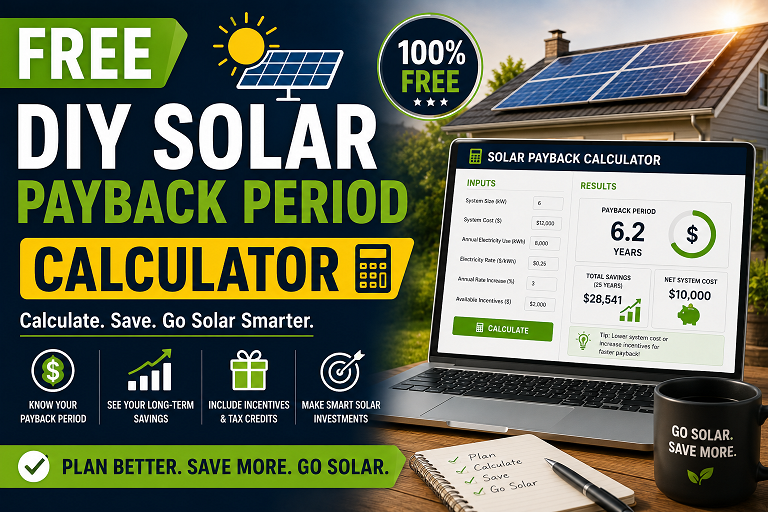
Free DIY Solar Payback Period Calculator
Use this free DIY solar payback period calculator to estimate how long it may take for your solar system to pay for itself. Enter your total DIY solar system cost, electricity rate, system size, and average peak sun hours to calculate your estimated monthly savings, payback period, and 25-year net savings.
This calculator is designed for homeowners, RV owners, cabin owners, and off-grid solar beginners who want a simple way to compare system cost against long-term electricity savings. It also includes the 30% federal solar tax credit in the calculation, so you can see your estimated cost after incentives.
How This DIY Solar Payback Calculator Works
The calculator estimates annual solar production by multiplying your system size by your average peak sun hours, then applying an 80% real-world system efficiency factor. It then multiplies your estimated annual production by your electricity rate to calculate yearly savings.
Your estimated payback period is calculated by subtracting the 30% federal solar tax credit from your system cost, then dividing the remaining cost by your estimated annual electricity savings.
What Is a Good Solar Payback Period?
For most DIY solar systems, a payback period of 4 to 8 years is considered strong. If you live in a state with high electricity rates, such as California, Hawaii, Massachusetts, Connecticut, or New York, your solar payback period may be faster. If your electricity rate is lower, your payback period may be longer, but the system can still provide large savings over 25 years.
Tips to Improve Your Solar Payback Period
- Choose the correct solar system size for your actual electricity usage.
- Install panels in a location with strong sunlight and minimal shade.
- Compare DIY solar kit prices before buying.
- Use the 30% federal solar tax credit if you qualify.
- Avoid oversizing your system unless you plan to add EV charging or battery backup.
This calculator gives an estimate only. Actual solar savings can vary based on your roof direction, shading, local utility rates, net metering rules, weather, and equipment performance.