Solar Panel Cleaning: How Often and What Method Actually Works (2026)
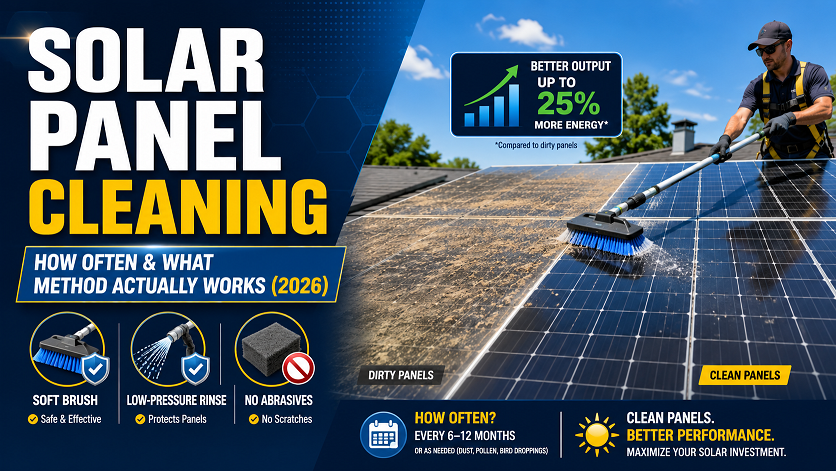
Clean solar panels 2-4 times per year for most US climates — more often (every 1-2 months) in dry, dusty regions like the Southwest, less often in areas with regular heavy rainfall. Plain water and a soft brush on an extension pole removes 95% of soiling buildup. Dirt typically costs 3-7% of annual output on average, but can reach 15-25% in heavy soiling conditions. Never use abrasive pads, pressure washers, or harsh chemicals — they can void your warranty.
Dirty solar panels are one of the most overlooked maintenance issues in residential and DIY solar — and one of the easiest to fix. Most people either ignore cleaning entirely (losing real output for years) or overdo it with pressure washers and harsh chemicals that risk damaging the panel surface. This guide gives you the real output-loss numbers, the cleaning method that’s actually proven to work, and a calculator to see if cleaning is worth your time.
Part of the Shalkot DIY Solar Series
For sizing your system correctly from the start, see How Many Solar Panels Do I Need?. For installation, see our DIY Solar Installation Guide. For cost tracking, see DIY Solar System Cost 2026.
How Much Does Dirt Actually Cost You?
The amount of output lost to dirt and soiling varies enormously based on climate, panel angle, and how long it’s been since the last cleaning or rainfall. Here’s what the real data shows.
| Soiling Level | Typical Output Loss | Visual Sign | Common Cause |
|---|---|---|---|
| Light dust | 2-5% | Thin film, barely visible | Normal airborne dust, 1-2 months no rain |
| Moderate buildup | 5-15% | Visible haze, dulled reflection | 3-6 months without rain or cleaning |
| Heavy soiling | 15-25% | Caked dirt, visible grime layers | Agricultural dust, long dry season, pollution |
| Bird droppings (localized) | Up to 30%+ on affected cells | Visible spots/streaks | Nearby trees, perching birds |
| Pollen season buildup | 8-12% | Yellow-green film | Spring pollen, especially pine/oak regions |
| Snow cover | 90-100% (until melted/cleared) | Obvious — fully covered | Winter snowfall on low-pitch roofs |
Bird Droppings Cause Disproportionate Damage
A single bird dropping covering even 5% of one cell’s surface can reduce that entire cell’s output far more than the covered area suggests, because solar cells are wired in series — one heavily shaded or blocked cell drags down the output of the whole string. If you have nearby trees or perching spots (antennas, nearby power lines), check panels more frequently and consider bird deterrent spikes near the array.
Cleaning Frequency by Climate Type
There’s no single right answer — your ideal cleaning schedule depends heavily on your local climate and what’s actually landing on your panels.
The Simplest Rule: Check Visually Every Month, Clean When Needed
Rather than following a rigid schedule, the most efficient approach is a 2-minute monthly visual check from the ground (binoculars help) combined with cleaning only when you actually see buildup. This avoids both under-cleaning (losing output) and over-cleaning (wasted effort, unnecessary panel handling). If your system has a monitoring app, a sudden unexplained dip in daily output compared to sunny-day history is often the clearest cleaning signal.
Tracks daily production trends so you can spot unexplained output dips caused by dirt buildup before they cost you months of lost generation. Pairs with most Renogy charge controllers.
Free Cleaning ROI Calculator
Find out exactly how much money soiling losses are costing you, and whether cleaning is worth the time investment.
The DIY Cleaning Method That Actually Works
Solar panel manufacturers and independent testing consistently point to the same simple method as the most effective and lowest-risk approach for residential panels.
Hard Water Leaves Mineral Spots That Reduce Output
If you have hard water, plain tap water rinsing can leave behind mineral deposits (calcium, magnesium) that create a hazy film over time — effectively replacing one form of soiling with another. A simple fix is a final rinse with deionized or distilled water, or using a water-fed pole system with a built-in filter, especially for the last pass.
Soft non-scratch bristles safe for anti-reflective coatings, telescoping pole reaches second-story panels from the ground, and a built-in water-fed connector for hose attachment. The most-recommended DIY kit in solar maintenance communities.
Best Tools for DIY Solar Panel Cleaning
| Tool | Purpose | Price Range | Buy |
|---|---|---|---|
| Soft-bristle brush (extension pole) | Primary cleaning tool — safe for panel coating | $25-$60 | Shop → |
| Squeegee attachment | Prevents hard water spots after rinsing | $15-$30 | Shop → |
| Water-fed pole system | For 2nd-story panels, connects to garden hose | $60-$150 | Shop → |
| Deionized water filter | Eliminates hard water spotting on final rinse | $35-$80 | Shop → |
| Solar panel monitoring app/device | Spot soiling losses before they cost months of output | $50-$90 | Shop → |
What to Avoid — Common Cleaning Mistakes
| Mistake | Why It's a Problem |
|---|---|
| Pressure washers | Can drive water into junction boxes and seals, force water under glass edges, and damage anti-reflective coating |
| Abrasive sponges/scrub pads | Scratches the anti-reflective coating, permanently reducing light absorption |
| Harsh chemicals/solvents | Can degrade sealants and frame coatings; most manufacturers explicitly void warranty for chemical cleaners |
| Cleaning in direct hot sun | Thermal shock from cold water on hot glass (panels can reach 150°F+) risks micro-cracking |
| Walking directly on panels | Can crack cells or damage the frame, even if the glass surface looks intact |
| Ignoring soap residue | Leftover soap film attracts more dust faster than a properly rinsed panel |
Check Your Warranty Before Cleaning
Most solar panel manufacturers specify acceptable cleaning methods in their warranty documentation — typically plain water, soft brushes, and mild non-abrasive soap only. Using a pressure washer or chemical cleaner, even once, can technically void coverage for a damaged panel even if the damage wasn't directly caused by that cleaning session. Check your specific panel manufacturer's care instructions before your first cleaning.
Safety Rules for Cleaning Your Own Panels
- Never clean roof panels by walking on the roof unless you're trained and equipped — use ground-based extension poles whenever your roof pitch or height makes this possible.
- Always use a secured, properly rated ladder for single-story access points, with a spotter present if possible.
- Never clean during or right before a storm — wet panels combined with electrical components is a shock risk, however minimal with grounded systems.
- Turn off the system at the disconnect switch before any cleaning that involves close contact with panel edges or wiring, as an extra safety margin.
- For steep roofs, multi-story homes, or commercial arrays — hire a professional. The cost of a fall far outweighs any cleaning savings.
When Professional Cleaning Is Worth It
| Situation | Recommendation |
|---|---|
| Single-story home, low-pitch roof, ground-accessible | DIY — extension pole kit pays for itself almost immediately |
| Two-story home, steep roof pitch | Professional — fall risk outweighs DIY savings |
| Ground-mount system | DIY — easiest and safest cleaning scenario |
| Commercial-scale array | Professional — specialized equipment and liability coverage needed |
| RV/van rooftop panels | DIY — typically small, lightweight, easy reach from a step ladder |
Perfect for ground-mount arrays, RV roofs, and van solar setups where a full extension pole is overkill. Same soft non-scratch bristle design, more affordable than the full telescoping kit.
Best Cleaning Tools and Products 2026
- Soft bristles specifically designed to be safe for anti-reflective coatings
- Telescoping pole reaches second-story panels safely from the ground
- Built-in water-fed connector works with any standard garden hose
- Pays for itself after just one cleaning at moderate soiling levels
- Most-recommended kit across solar DIY and maintenance communities
- Reaches second-story and steeper roof panels entirely from the ground
- Continuous water flow through the pole rinses while you brush
- Compatible with deionized water filter attachments to prevent spotting
- The same core technology professional window/solar cleaners use
- Right-sized for ground-mount arrays, RV roofs, and van solar setups
- Same safe, non-scratch bristle design as the full telescoping kit
- More affordable since you don't need the extension mechanism
- Easy to store in an RV or van compared to a full-length pole
- Tracks daily output so unexplained dips signal soiling before major loss
- Historical data lets you compare similar sunny days across months
- Removes the guesswork from "should I clean my panels yet?"
- Pairs with most Renogy charge controllers and inverters
Make Sure Your System Is Sized Right Before You Optimize Maintenance
Use our Solar Panel Calculator to confirm your system size matches your actual energy needs — maintenance only matters once sizing is correct.
Frequently Asked Questions
How often should you clean solar panels?
Most homeowners should clean 2-4 times per year. In dry, dusty climates like the Southwest, clean every 1-2 months using a soft brush extension kit. In rainy climates, twice a year is often sufficient since natural rainfall does most of the work. RV and van panels should be checked monthly.
How much does dirt actually reduce solar panel output?
Light dust reduces output by 2-5%. Moderate buildup over several months can cost 5-15%. Heavy soiling or bird droppings can reach 15-25% loss. US averages run 3-7% annually for most residential systems, with higher losses in dry regions. A monitoring system helps you catch these losses before they compound over months.
What is the best way to clean solar panels yourself?
Use plain water with a soft brush on an extension pole, cleaning in early morning or evening. Rinse first, brush gently in straight lines, then rinse again and squeegee to avoid hard water spots. Never use abrasive sponges, pressure washers, or harsh chemicals — they can scratch the coating and void your warranty.
Is it safe to clean solar panels yourself?
Ground-mounted panels and single-story roofs accessible by a secured ladder are generally safe to clean with proper precautions. Never clean in direct hot sun, never walk on panels, and always use a stable ladder. For steep roofs or multi-story homes, a water-fed pole system lets you clean from the ground, but hiring a professional is the safer choice for difficult access points.
Does rain clean solar panels effectively?
Light to moderate rain helps but doesn't fully clean panels — it washes away loose dust but often leaves streaks and doesn't remove sticky residues like pollen or bird droppings. Heavy sustained rain works better than light drizzle. In dry climates with infrequent rain, you can't rely on rainfall alone and need a regular cleaning schedule with a proper cleaning brush.
Is professional solar panel cleaning worth the cost?
Professional cleaning costs $150-$350 and is worth it for steep or multi-story roofs you can't safely access. For single-story homes with accessible roofs, a DIY cleaning kit accomplishes the same result for the one-time cost of the tools — and pays for itself almost immediately at moderate soiling levels.
Continue Your DIY Solar Build
- National Renewable Energy Laboratory (NREL) — Soiling Loss Studies for US Residential Solar, 2026
- Solar Energy Industries Association (SEIA) — Maintenance Best Practices Guide, 2026
- Renogy — Solar Panel Care and Cleaning Manufacturer Guidelines, 2026
- DIY Solar Power Forum — Community Cleaning Method Comparisons, 2026
- EnergySage — Solar Panel Cleaning Cost and ROI Analysis, 2026