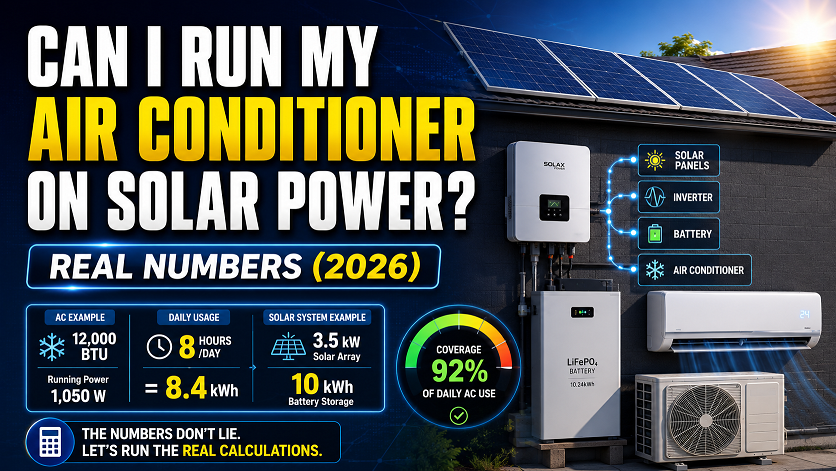
Can I Run My Air Conditioner on Solar Power? Real Numbers (2026)
Yes — but it requires a much larger system than most people expect. A 5,000 BTU window AC needs 800–1,200W of solar panels plus 400Ah of LiFePO4 battery for overnight operation. A 12,000 BTU mini-split needs 1,600–2,400W of panels. The most energy-efficient option is a purpose-built DC mini-split — it eliminates the inverter conversion loss and cuts panel and battery requirements nearly in half.
Air conditioning is the biggest power draw in most homes, RVs, and vans — which makes it the most common question people ask when planning a solar system. The short answer is that running AC on solar is absolutely possible, but the system size required surprises almost everyone who hasn’t done the math first. This guide gives you the real numbers, a free calculator, and the most cost-efficient setup for every AC type in 2026.
Article 13 in the Shalkot DIY Solar Series
This article covers solar-powered AC. For inverter sizing see What Size Inverter Do I Need?. For battery bank sizing see our Battery Bank Calculator. For RV-specific solar see DIY Solar for RV and Van Life.
AC Unit Watt Requirements — Every Type
Before sizing your solar system, you need to know exactly how much power your AC unit draws. The two numbers that matter are running watts (continuous draw while cooling) and startup surge (the brief spike when the compressor kicks on).
| AC Type | BTU Rating | Running Watts | Startup Surge | Hrs/Day Typical | Daily Wh |
|---|---|---|---|---|---|
| Window AC (small) | 5,000 BTU | 450–600W | 1,200–1,800W | 6–8 hrs | 2,700–4,800Wh |
| Window AC (medium) | 8,000 BTU | 700–900W | 1,800–2,700W | 6–8 hrs | 4,200–7,200Wh |
| Window AC (large) | 12,000 BTU | 900–1,200W | 2,500–3,600W | 6–8 hrs | 5,400–9,600Wh |
| Mini-split (standard) | 9,000–12,000 BTU | 700–1,200W | 2,000–3,500W | 6–10 hrs | 4,200–12,000Wh |
| Mini-split (DC inverter) | 9,000–12,000 BTU | 300–600W | 500–900W | 6–10 hrs | 1,800–6,000Wh |
| RV rooftop AC | 13,500–15,000 BTU | 1,300–1,500W | 2,800–3,500W | 4–6 hrs | 5,200–9,000Wh |
| Central AC (2 ton) | 24,000 BTU | 2,000–2,800W | 6,000–9,000W | 6–10 hrs | 12,000–28,000Wh |
| Central AC (3 ton) | 36,000 BTU | 3,000–4,500W | 10,000–15,000W | 6–10 hrs | 18,000–45,000Wh |
AC Compressor Startup Surge Is the Critical Number
The startup surge — 2–5× the running wattage — is what determines your minimum inverter size, not the running wattage. A 5,000 BTU window AC running at 500W surges to 1,500–1,800W every time the thermostat kicks the compressor on. Your inverter must handle that surge or it will trip its overload protection and cut power to your AC mid-cycle. Always size the inverter to the surge, not the running draw.
The minimum safe inverter for any 12,000 BTU AC or RV rooftop unit. 6,000W surge handles the compressor startup without tripping. Never use modified sine wave — it destroys AC compressor motors.
Free Solar AC System Size Calculator
Enter your AC unit details to get the exact solar panel wattage, battery bank size, and inverter requirement for your setup.
Window AC on Solar: Real Numbers
Window ACs are the most common starting point for solar cooling — they’re cheap to buy, easy to install, and the watt draw is well-documented. Here’s the exact system you need for each common size.
4,000W surge handles 5,000–8,000 BTU window AC startup without tripping. Remote on/off switch, 4× AC outlets, LCD display. The minimum inverter for any window AC solar install.
Mini-Split on Solar: The Smarter Choice for Homes
For a home or cabin, a standard ductless mini-split (the kind you buy at Home Depot) is more efficient than a window AC because modern inverter-driven mini-splits modulate compressor speed rather than cycling on and off at full power. That reduces average power draw significantly — but they still run on 120V or 240V AC, so you still need an inverter.
| Mini-Split Size | Running Watts | Daily Wh (8 hrs) | Solar Panels Needed | Battery @ 24V | Buy |
|---|---|---|---|---|---|
| 9,000 BTU | 700–900W | 5,600–7,200Wh | 1,400–1,800W | 280–360Ah | 400W Panel Kit → |
| 12,000 BTU | 900–1,200W | 7,200–9,600Wh | 1,800–2,400W | 360–480Ah | 400W Panel Kit → |
| 18,000 BTU | 1,400–1,800W | 11,200–14,400Wh | 2,800–3,600W | 560–720Ah | 3,000W Inverter → |
| 24,000 BTU | 2,000–2,500W | 16,000–20,000Wh | 4,000–5,000W | 800Ah+ | 3,000W+ Inverter → |
4,800Wh at 24V — the foundation of a 12,000 BTU mini-split solar system. Built-in BMS, 4,000+ cycle life, and a 24V design cuts current draw in half vs 12V for the same watt draw. Add a second unit for 400Ah and 2+ days of autonomy.
RV Rooftop AC on Solar: What It Actually Takes
Running a standard 13,500 BTU RV rooftop AC (Dometic, Coleman) on solar is one of the most asked-about and most misunderstood topics in the van life community. The raw numbers are sobering — but doable with the right system.
Starting point for any RV solar build — expandable to 800W on the same controller. For full AC capability you’ll need 3–4 of these kits (or equivalent). Compatible with LiFePO4 batteries. Most-documented van life panel kit.
Central AC on Solar: Is It Realistic?
Running central air conditioning entirely on solar and battery storage is technically possible but financially impractical for most households. Here’s why the numbers break down.
| Central AC Size | Running Watts | Daily Wh (8 hrs) | Solar Panels Needed | Battery Needed | Est. System Cost |
|---|---|---|---|---|---|
| 1.5 ton (18,000 BTU) | 1,500–2,000W | 12,000–16,000Wh | 3,000–4,000W | 600–800Ah @ 24V | $8,000–$15,000 |
| 2 ton (24,000 BTU) | 2,000–2,800W | 16,000–22,400Wh | 4,000–5,600W | 800Ah–1,200Ah @ 24V | $12,000–$22,000 |
| 3 ton (36,000 BTU) | 3,000–4,500W | 24,000–36,000Wh | 6,000–9,000W | 1,200Ah+ @ 48V | $20,000–$40,000 |
The Smart Approach for Whole-Home AC on Solar
Most homeowners running central AC with solar use a grid-tied or hybrid system — solar panels power AC during daytime peak sun, and the grid provides backup at night or on overcast days. This approach costs $8,000–$20,000 for a complete system (including installation) and typically pays back in 6–10 years through electricity bill savings. Pure off-grid AC at the central AC level requires battery banks so large that the battery cost alone exceeds most homeowners’ budgets.
DC Mini-Splits: The Most Efficient Option for Off-Grid AC
This is the option most solar AC guides miss entirely. A DC mini-split runs directly from your 12V, 24V, or 48V battery bank without an inverter — eliminating the 7–10% conversion loss of DC-to-AC inversion and the startup surge problem completely. The result is a system that achieves the same cooling with 40–60% less panel and battery capacity.
| Feature | Standard AC + Inverter | DC Mini-Split (direct) |
|---|---|---|
| Running watts (12,000 BTU) | 900–1,200W | 300–500W |
| Startup surge | 2,500–4,500W | 500–900W (soft start) |
| Inverter required? | Yes — $200–$460 | No |
| Solar panels needed (12,000 BTU, 8 hrs) | 1,800–2,400W | 800–1,200W |
| Battery needed (2-day autonomy) | 360–480Ah @ 24V | 140–220Ah @ 24V |
| Upfront cost of AC unit | $300–$700 | $800–$1,500 |
| Total system cost (panels + battery + inverter) | $4,500–$8,000 | $2,500–$4,500 |
Runs directly from 12V or 24V battery bank — no inverter needed. 9,000 BTU cooling at just 250–350W average draw vs 700–900W for a standard mini-split. Designed specifically for off-grid solar systems, vans, and RVs.
What Size Inverter Do You Need for AC?
| AC Unit | Running Watts | Startup Surge | Min Inverter | Buy Inverter |
|---|---|---|---|---|
| 5,000 BTU window AC | 450–600W | 1,200–1,800W | 2,000W PSW | Giandel 2000W → |
| 8,000 BTU window AC | 700–900W | 1,800–2,700W | 3,000W PSW | AIMS 3000W → |
| 12,000 BTU window AC | 900–1,200W | 2,500–3,600W | 3,000W PSW | AIMS 3000W → |
| 12,000 BTU standard mini-split | 900–1,200W | 2,500–4,000W | 3,000W PSW | AIMS 3000W → |
| 12,000 BTU DC mini-split | 300–500W | 500–900W (soft start) | No inverter needed | DC Unit → |
| RV rooftop AC (13,500 BTU) | 1,300–1,500W | 2,800–3,500W | 3,000W PSW | AIMS 3000W → |
Never Use Modified Sine Wave for Any Air Conditioner
Modified sine wave (MSW) inverters produce a stepped waveform that causes AC compressor motors to run hot, draw more current than rated, and fail prematurely. Air conditioner warranties are voided when damage from MSW inverters is detected. Always buy a pure sine wave inverter for any AC application — every inverter listed in this article is pure sine wave.
Full System Cost by AC Type (2026)
| AC Setup | Panels | Battery | Inverter | Total DIY Cost |
|---|---|---|---|---|
| 5,000 BTU window AC | 1,200W / ~$600 | 220Ah @ 24V / ~$1,100 | 2,000W PSW / ~$230 | $2,200–$3,500 |
| 12,000 BTU window AC | 2,000W / ~$1,000 | 440Ah @ 24V / ~$2,200 | 3,000W PSW / ~$420 | $4,500–$7,000 |
| 12,000 BTU DC mini-split | 1,000W / ~$500 | 180Ah @ 24V / ~$900 | None needed / $0 | $2,300–$3,800 |
| RV rooftop AC (13,500 BTU) | 1,600W / ~$800 | 440Ah @ 24V / ~$2,200 | 3,000W PSW / ~$420 | $4,000–$6,500 |
| Central AC 2 ton (hybrid grid-tied) | 4,000W / ~$2,000 | Grid-tied / backup only | Grid-tied inverter / ~$1,500 | $8,000–$20,000 installed |
Costs include panels, battery, and inverter only. Add $200–$400 for wiring, fuses, bus bars, and hardware. Battery costs based on 24V LiFePO4 pricing. The 30% federal tax credit applies if the system serves a primary or secondary US residence.
Best Products for Solar-Powered AC 2026
- 6,000W surge — handles any window, mini-split, or RV AC startup
- Pure sine wave output — safe for all AC compressor motors
- 30A L6-30 outlet for direct mini-split connection
- 6× standard outlets covers full system loads simultaneously
- The go-to inverter for off-grid homesteaders running AC
- 24V design cuts inverter current draw in half vs 12V for same wattage
- 4,800Wh per unit — add a second for 9,600Wh (2+ days of small AC)
- Best cost-per-Wh in the 24V LiFePO4 category for 2026
- Built-in BMS with short circuit and over-temperature protection
- Supports unlimited parallel expansion
- Buy 3–4 of these kits to reach the 1,200–1,600W needed for AC
- Expandable — each additional kit adds to the same charge controller
- Most documented RV and van life panel kit — community support
- Standard MC4 connectors — works with any MPPT controller
- Runs directly from 12V or 24V battery — zero inverter conversion loss
- 250–350W average draw vs 700–900W for equivalent standard mini-split
- Soft-start compressor — no startup surge, works with smaller battery banks
- Best choice for vans, RVs, tiny homes, and off-grid cabins
- Cuts required panel and battery capacity by 40–60% vs standard AC
Size Your Full Battery Bank for Your AC System
Use our Battery Bank Sizing Calculator to get exact Ah and kWh requirements based on all your daily loads — not just the AC unit.
Frequently Asked Questions
How many solar panels do I need to run an air conditioner?
A 5,000 BTU window AC needs at least 1,200W of solar panels for continuous daytime operation with battery buffer. A 12,000 BTU window AC or mini-split needs 1,800–2,400W. The most efficient option — a DC mini-split like the Fogatti 9,000 BTU — only needs 800–1,200W because it skips the inverter conversion entirely.
How many batteries do I need to run an AC unit overnight?
A 5,000 BTU window AC at 500W running for 8 hours needs 4,000Wh of storage. With LiFePO4 at 80% DoD you need 5,000Wh installed — roughly a 200Ah 24V LiFePO4 battery (4,800Wh). For a 12,000 BTU AC running 8 hours at 1,000W, you need ~10,000Wh — about two 200Ah 24V batteries in parallel.
What is the most energy-efficient way to run AC on solar?
A purpose-built DC mini-split like the Fogatti 9,000 BTU DC unit runs directly from your battery bank at 250–350W — compared to 700–900W for a standard mini-split of the same BTU rating. No inverter required, no startup surge, and 40–60% less panel and battery capacity needed.
Can I run central air conditioning on solar power?
Yes, but it requires a very large and expensive system — $12,000–$40,000 for a complete off-grid central AC setup. Most homeowners use a grid-tied or hybrid solar system instead, where solar offsets daytime AC usage and the grid covers the rest. Pure off-grid central AC is only practical for homes in very sunny climates with enough roof space for 4,000–9,000W of panels.
Can I run an RV air conditioner on solar?
Yes, but a standard 13,500 BTU RV rooftop AC requires a substantial system — 1,600W+ of panels, 400Ah+ at 24V, and a 3,000W pure sine wave inverter. Most full-time RVers supplement with shore power or a generator on hot days. For a fully off-grid solution, a DC mini-split is significantly more practical for the same cooling output.
What size inverter do I need to run an air conditioner on solar?
Always size by the startup surge, not the running wattage. A 5,000 BTU window AC surges to 1,600–1,800W — a 2,000W PSW inverter handles it. Any 8,000 BTU+ AC, mini-split, or RV rooftop unit surges above 2,500W — you need a 3,000W PSW inverter with 6,000W surge capacity.
Continue Your DIY Solar Build
- Energy Star — Room Air Conditioner Energy Use Database, 2026
- Renogy — Solar System Sizing Guide for High-Load Applications, 2026
- Fogatti — DC Solar Air Conditioner Technical Specifications and Field Test Data, 2026
- AIMS Power — Inverter Surge Capacity Guidelines for HVAC Loads, 2026
- DIY Solar Power Forum — Community Reports: Running AC on Off-Grid Solar, 2026
- Engineers Who Van Life — RV Air Conditioning on Solar: Real Power Measurements, 2026
- Off Grid Authority — DC Mini-Split vs Standard AC Unit Efficiency Comparison, 2026