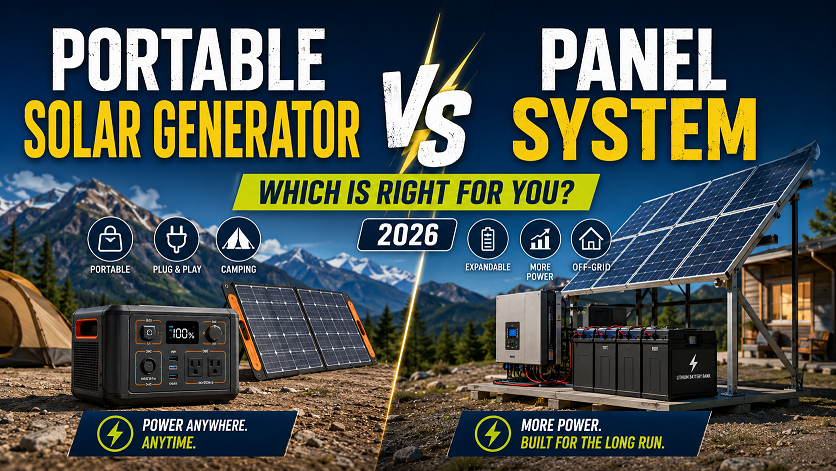
Portable Solar Generator vs Panel System: Which Is Right for You? (2026)
Choose a portable solar generator (power station) if you want zero installation, plug-and-play simplicity, and portability — best for renters, beginners, and emergency kits. Choose a DIY panel + battery system if you want 40-60% more capacity per dollar, full expandability, and a permanent install — best for vans, RVs, cabins, and long-term off-grid use. Portable generators cost $0.80-$1.40 per Wh of storage; DIY systems cost $0.40-$0.65 per Wh.
This is one of the most common questions for anyone starting their off-grid power journey: buy an all-in-one portable solar generator, or build your own system from individual panels, batteries, controllers, and an inverter? Both can deliver the same end result — usable AC and DC power from sunlight — but they differ enormously in cost, flexibility, and effort.
This guide breaks down the real 2026 numbers so you can decide which path fits your budget, timeline, and use case.
Article 13 in the Shalkot DIY Solar Series
For a complete DIY build, see our DIY Solar for RV and Van Life guide. For inverter sizing math, see What Size Inverter Do I Need?. For battery sizing, see our Battery Bank Sizing Calculator.
What Is a Portable Solar Generator vs a DIY Panel System?
A portable solar generator (also called a power station) is a sealed, all-in-one unit containing a battery, built-in inverter, charge controller, and multiple output ports — AC outlets, USB, and DC. You connect a compatible solar panel and it charges automatically. Brands like Jackery, EcoFlow, Bluetti, and Anker dominate this category.
A DIY panel system means you buy components separately: solar panels, an MPPT charge controller, a LiFePO4 battery, a separate pure sine wave inverter, and the wiring and fuses to connect them. You design the system to your exact needs and wire it yourself, or have it professionally installed.
1,002Wh LiFePO4 capacity, 1,500W AC output, recharges from empty to full in 1.8 hours via wall outlet or 4-5 hours via included solar panel. Zero wiring — plug and play out of the box.
Side-by-Side Comparison
Cost Per Watt-Hour Breakdown
The clearest way to compare these two paths is cost per watt-hour (Wh) of usable storage — this strips away brand marketing and shows you the real value.
| System | Capacity | Total Cost | Cost per Wh | Buy |
|---|---|---|---|---|
| Jackery Explorer 300 | 300Wh | $280-$330 | $0.93-$1.10 | Check Price → |
| Jackery Explorer 1000 v2 | 1,002Wh | $700-$800 | $0.70-$0.80 | Check Price → |
| EcoFlow Delta 2 | 1,024Wh | $850-$950 | $0.83-$0.93 | Check Price → |
| Bluetti AC200L | 2,048Wh | $1,400-$1,600 | $0.68-$0.78 | Check Price → |
| DIY: 1× 100Ah 12V LiFePO4 | 1,200Wh | $280-$380 | $0.23-$0.32 | Check Price → |
| DIY: Full system (panel+batt+MPPT+inverter) | 1,200Wh | $550-$750 | $0.46-$0.63 | Check Price → |
| DIY: 2× 100Ah 12V LiFePO4 + components | 2,400Wh | $950-$1,300 | $0.40-$0.54 | Check Price → |
Which Should You Choose? Decision Tool
Answer these questions honestly about your situation and timeline to get a clear recommendation.
Best Choice by Use Case
| Use Case | Recommended | Why | Top Pick |
|---|---|---|---|
| Emergency home backup | Portable Generator | Ready instantly, no installation, store-and-forget | EcoFlow Delta 2 → |
| Weekend camping / tailgating | Portable Generator | Lightweight, portable, no setup at the campsite | Jackery 300 → |
| Renting an apartment | Portable Generator | No permanent wiring possible or desired | Jackery 1000 v2 → |
| Full-time van life | DIY System | Permanent install, max capacity per dollar, expandable | Renogy 100Ah → |
| RV / travel trailer | DIY System | Larger roof space supports bigger arrays at lower cost/Wh | Battle Born 100Ah → |
| Off-grid cabin | DIY System | Permanent structure, needs the most capacity per dollar | Battle Born 100Ah → |
| Workshop / job site power | Portable Generator | Needs to move between locations frequently | Bluetti AC200L → |
| First-time solar buyer (any use) | Portable Generator | Learn how solar works before committing to a DIY build | Jackery 1000 v2 → |
Expandability and Long-Term Value
This is where the two paths diverge most sharply over time. A portable generator’s expansion options are locked to its own brand’s ecosystem and pricing. A DIY system can grow with literally any compatible component from any manufacturer.
The Hybrid Approach: Start Portable, Migrate to DIY
Many people start with a portable solar generator to learn the basics, then migrate to a DIY system once they understand their actual power needs. The good news: most portable generator batteries (like a Jackery or EcoFlow unit) can be repurposed as a backup power bank even after you build a separate DIY system, so the initial investment isn’t wasted.
Unlimited parallel expansion — buy one now, add more anytime without replacing existing batteries. 10-year warranty, 3,000-5,000 cycle life. The standard expansion battery for growing DIY systems.
Best Portable Solar Generators 2026 — Ranked
- Fastest wall recharge in class — 0-80% in 1 hour
- App control via Bluetooth — monitor and schedule charging remotely
- LiFePO4 cells rated for 3,000+ cycles (10 years of daily use)
- Compatible with SolarSaga panels for solar recharge in 4-5 hours
- Best-known brand — huge resale value and community support
- X-Stream fast charging — 0-80% in just 50 minutes via wall outlet
- Expandable up to 3,040Wh with EcoFlow Delta 2 extra battery
- 500W max solar input — fastest solar recharge in this size class
- App-based remote monitoring and firmware updates
- Best for users who anticipate needing more capacity later
- Lightest practical entry point at just 7.1 lbs
- Charges phones 20+ times or a laptop 6+ times on one charge
- Pure sine wave output built-in — safe for all electronics
- Compact size fits in a backpack or car trunk easily
- Best gateway product for first-time solar buyers
- Largest expansion ceiling in class — up to 8,192Wh with battery packs
- Dual charging (wall + solar simultaneously) for fastest possible recharge
- 2,400W continuous handles power tools and small appliances
- Best option for those eventually wanting whole-home partial backup
- Built-in wheels and handle despite the larger 62 lb weight
Best DIY System Components 2026 — Ranked
If the decision tool above pointed you toward DIY, here are the core components to start with.
| Component | Recommended Product | Price | Buy |
|---|---|---|---|
| Battery (start here) | Renogy 100Ah 12V LiFePO4 | $280-$380 | Check Price → |
| Battery (premium) | Battle Born 100Ah 12V LiFePO4 | $850-$950 | Check Price → |
| Solar panel kit | Renogy 200W 12V Panel Kit | $180-$280 | Check Price → |
| MPPT charge controller | Victron SmartSolar 100/30 | $190-$220 | Check Price → |
| Inverter (1,000W) | Renogy 1,000W Pure Sine Wave | $120-$150 | Check Price → |
| Wiring + ANL fuse kit | Windy Nation 4 AWG Inverter Cable Kit | $28-$45 | Check Price → |
Already Decided on DIY? Size Your Inverter First
Use our free Inverter Size Calculator to find the right inverter wattage based on your actual AC loads before buying any DIY components.
Frequently Asked Questions
Is a portable solar generator better than a DIY solar panel system?
It depends on your priorities. Portable solar generators like the Jackery Explorer 1000 v2 cost more per watt-hour but require zero installation and work in under 5 minutes. DIY systems built around something like a Renogy 100Ah LiFePO4 battery cost 40-60% less per kWh and are fully expandable, but require basic wiring knowledge. Renters and beginners should lean portable; permanent installs and vans should lean DIY.
How much does a portable solar generator cost compared to a DIY system?
A 1,000Wh portable solar power station with a 200W panel costs $800-$1,400 in 2026. A comparable DIY system with 200W panels, a 100Ah LiFePO4 battery, MPPT controller, and inverter costs $500-$750 in parts — roughly 60-90% cheaper per watt-hour of capacity.
Can you expand a portable solar generator like a DIY system?
Limited expansion is possible. Most portable generators allow extra solar panels within their max input wattage, and some like the EcoFlow Delta 2 allow proprietary expansion batteries at a steep price premium. A DIY system has no such limitation — you can add any compatible battery from any brand wired in parallel.
Which is better for emergency home backup, a solar generator or DIY system?
For most homeowners, a portable solar generator in the 2,000-3,600Wh range like the Bluetti AC200L is the better choice — no electrical work, ready to use immediately during an outage. A DIY system with a larger battery bank is more cost-effective for true whole-home backup but requires proper electrical installation, often with a transfer switch.
Do portable solar generators last as long as DIY LiFePO4 systems?
Most 2026 portable generators use LiFePO4 cells rated for 2,500-3,500 cycles, comparable to DIY systems. However, DIY batteries like Battle Born’s 100Ah LiFePO4 are rated for 3,000-5,000 cycles with 10-year warranties versus 3-5 years for most portable units. DIY components can also be replaced individually when they fail, while a portable generator is a sealed, non-repairable unit.
What size portable solar generator do I need?
For weekend camping and device charging, a 300Wh unit like the Jackery Explorer 300 is sufficient. For van life or extended camping with a small fridge, look at 1,000-1,500Wh units like the Jackery 1000 v2. For home backup, 2,000-3,600Wh units like the Bluetti AC200L are the practical range.
Continue Your DIY Solar Build
- Jackery — Explorer Series Product Specifications and Cycle Life Data, 2026
- EcoFlow — Delta 2 Technical Documentation and Expansion Battery Pricing, 2026
- Bluetti — AC200L Specifications and Modular Expansion Guide, 2026
- Renogy — DIY Solar Component Pricing and LiFePO4 Battery Specifications, 2026
- Battle Born Batteries — Cycle Life and Warranty Documentation, 2026
- DIY Solar Power Forum — Community Cost Comparisons: Power Stations vs DIY Builds, 2026
- Wirecutter — Best Portable Power Stations Tested, 2026