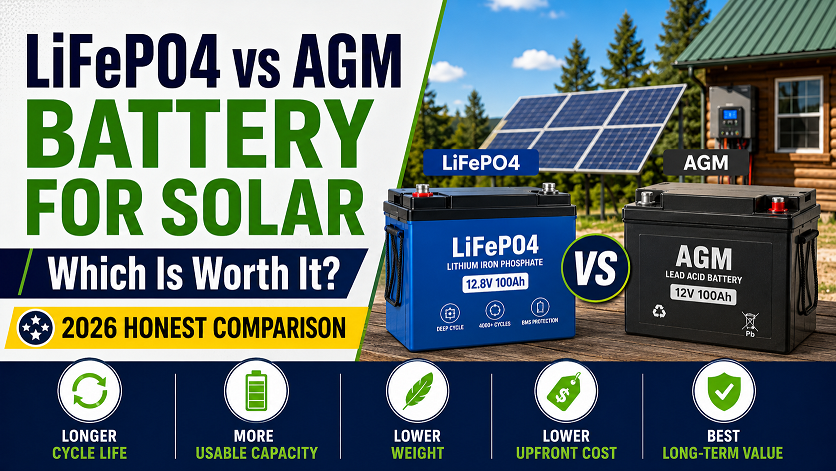
LiFePO4 vs AGM Battery for Solar: Which Is Worth It? (2026 Honest Comparison)
LiFePO4 wins for almost every solar application in 2026. It delivers 2,000–6,000 cycles vs 300–600 for AGM, offers 80% usable capacity vs 50% for AGM, charges at 95–99% efficiency vs 80–85% for AGM, and weighs 50–60% less. The cost-per-cycle math makes LiFePO4 cheaper over any 5+ year period in daily-use systems. AGM only wins on upfront cost and cold-weather charging below 32°F. For full-time off-grid, RV, van, or cabin builds — buy LiFePO4 once and stop replacing batteries.
AGM vs LiFePO4 is the most common battery question in the DIY solar community — and the answer has shifted dramatically over the past three years. In 2022, LiFePO4 carried a steep premium that made AGM competitive for budget builds. In 2026, LiFePO4 prices have dropped 40–50% while performance data from real-world installations consistently shows a clear winner.
This guide gives you the honest numbers — cycle life, usable capacity, cost-per-cycle math, charge efficiency, weight, cold weather performance, and safety. No brand sponsorships. No fluff. Just the data you need to make the right decision for your specific build.
Part of the Shalkot DIY Solar Series
Already sized your system? This is Article 5. See Article 4 — How to Size Your Solar Battery Bank for the sizing formula and calculator, then return here to choose your battery chemistry. To connect it all to your panels, see our Best Solar Charge Controller guide.
Head-to-Head Scorecard
Cycle Life — The Biggest Practical Difference
Cycle life is where the LiFePO4 advantage is most dramatic and most important for solar applications. Every day your battery cycles — charges from solar and discharges to power your loads — counts as one cycle. How many of those cycles a battery can handle before significant capacity degradation determines how long it lasts and how often you replace it.
| Battery | Cycles at Rated DoD | Years at 1 Cycle/Day | Years at 0.5 Cycles/Day |
|---|---|---|---|
| LiFePO4 (quality brands) | 2,000–6,000 cycles | 8–16 years | 16–32 years |
| LiFePO4 (budget brands) | 1,500–3,000 cycles | 5–8 years | 10–16 years |
| AGM (quality brands) | 400–600 cycles at 50% DoD | 1.5–2.5 years | 3–5 years |
| AGM (budget brands) | 300–400 cycles | 1–1.5 years | 2–3 years |
| Flooded Lead Acid (FLA) | 500–800 cycles at 50% DoD | 1.5–3 years | 3–6 years |
| Gel battery | 500–700 cycles at 50% DoD | 1.5–2 years | 3–4 years |
What “Capacity Degradation” Actually Means
Battery cycle life ratings typically describe when the battery reaches 80% of its original rated capacity — not when it stops working entirely. A LiFePO4 battery rated for 3,000 cycles will still function at 80% capacity after 3,000 cycles and continue operating (at reduced capacity) well beyond that. An AGM battery reaching end-of-life becomes progressively less usable faster — capacity often drops sharply after the rated cycle count rather than gradually.
Usable Capacity — Why You Need Twice as Much AGM
The rated capacity on a battery label is not the energy you can safely use. The percentage you can safely discharge — depth of discharge (DoD) — determines your real usable energy. This difference is larger than most buyers realize when comparing price tags.
From an identical 100Ah battery, LiFePO4 gives you 60% more usable energy than AGM.
To match LiFePO4’s usable energy, AGM buyers need 60% more rated capacity — closing the upfront price gap significantly.
The Real 10-Year Cost Math
The upfront price comparison — LiFePO4 at $250–$450 per 100Ah vs AGM at $150–$250 per 100Ah — makes AGM look cheaper. But the upfront price is only part of the story. For daily-cycling solar applications, the 10-year total cost of ownership tells a completely different story.
The scenario below uses a real-world 10 kWh battery bank (equivalent to approximately two 48V 100Ah LiFePO4 or four 48V 100Ah AGM needed to deliver the same usable energy) cycled daily over 10 years:
When AGM Is Still the Right Financial Choice
The 10-year math flips for low-cycle applications. If you use a weekend cabin battery that cycles only 50–80 times per year, that same AGM bank could last 5–8 years before needing replacement — making it financially competitive with LiFePO4. The break-even point: if you cycle your batteries fewer than 100 times per year and plan to replace in 5+ years anyway, AGM upfront savings can outweigh lifecycle cost. For daily-use systems — full-time off-grid, van life, continuous cabin use — LiFePO4 wins decisively.
Charge Efficiency — What You Actually Get From Your Solar Panels
Round-trip efficiency measures how much energy you get back out of a battery for every unit of energy you put in. This directly affects how much of your solar production actually powers your loads versus being wasted as heat.
AGM wastes 1.3 kWh more per day than LiFePO4. Over a year that’s 475 kWh of solar energy converted to heat instead of powering your home.
The efficiency gap matters most on partly cloudy days when every watt of solar energy is precious. LiFePO4 batteries have an efficiency of over 95%, while AGM batteries are typically around 80–85%. This 10–15% difference means less solar energy is wasted during charging. On days with limited sun, that extra efficiency can be the difference between your battery reaching a full charge or falling short.
Weight — Why It Matters More Than Most People Think
| Battery | 12V 100Ah LiFePO4 | 12V 100Ah AGM | Difference |
|---|---|---|---|
| Typical weight | 24–30 lbs | 60–70 lbs | LiFePO4 is 55–65% lighter |
| Weight for 10 kWh usable (LiFePO4 at 80% DoD) | ~150–190 lbs total | ~480–560 lbs total | ~330–370 lbs difference |
For RV and van builds, LiFePO4 batteries are roughly 50–60% lighter than AGM batteries of equivalent capacity. For a van build, that weight difference is significant — both for your payload and for fuel efficiency. A 10 kWh AGM bank weighs roughly 500 lbs. The equivalent LiFePO4 bank weighs under 200 lbs — a 300-lb difference that meaningfully affects vehicle handling, fuel economy, and floor structure requirements.
For fixed off-grid cabin and home installations, weight matters less — though 500 lbs of batteries in a basement or outbuilding is still a real structural consideration. For roof-mount or loft installations, LiFePO4 becomes practically necessary.
Cold Weather Performance — AGM’s Only Real Advantage
Cold weather is where AGM has a genuine, meaningful advantage over LiFePO4 — and it’s important to understand it precisely rather than dismissing it.
| Temperature | LiFePO4 Discharge | LiFePO4 Charging | AGM Discharge | AGM Charging |
|---|---|---|---|---|
| 77°F (25°C) — Ideal | 100% capacity | Full charge current | 100% capacity | Full charge current |
| 32°F (0°C) — Freezing | ~80% capacity | ❌ BMS cuts charging | ~80% capacity | Reduced but functional |
| 14°F (-10°C) | ~70% capacity | ❌ BMS cuts charging | ~60–70% capacity | Slow charge, reduced |
| -4°F (-20°C) | ~60% capacity | ❌ BMS cuts charging | ~40–50% capacity | Very slow, limited |
The Cold Weather Solution for LiFePO4
The charging limitation below 32°F is a real issue for outdoor battery enclosures in cold climates — but it is solvable. Most quality LiFePO4 batteries built in 2026 include a BMS with a low-temperature charge cutoff that protects cells automatically. The practical solutions: (1) Install batteries in a conditioned space or insulated box — even an insulated enclosure with a small heat pad keeps temps above freezing in most US climates. (2) Buy a LiFePO4 battery with a self-heating BMS (Battle Born 100Ah, EcoFlow batteries, Ampere Time Plus series) — these use a small amount of battery power to warm cells before charging. (3) For truly extreme cold climates (Alaska, northern Minnesota winters), consider a small hybrid system where AGM handles sub-freezing charging and LiFePO4 handles the primary load bank.
Safety — Is LiFePO4 Safe for Indoor and Vehicle Use?
Safety is the most common concern for buyers new to lithium batteries, and it deserves a direct, factual answer.
LiFePO4 does not suffer from thermal runaway. Thermal runaway — the dangerous chain reaction that causes lithium-ion batteries in phones, laptops, and some EVs to catch fire or explode — is driven by unstable cathode chemistry in NMC (nickel manganese cobalt) and NCA (nickel cobalt aluminum) cells. LiFePO4 uses an iron-phosphate cathode that is inherently thermally stable. Even when physically punctured, overcharged, or exposed to high heat, LiFePO4 cells release oxygen much more slowly and at higher temperatures than NMC cells, preventing the dangerous runaway condition.
| Safety Factor | LiFePO4 | AGM Lead-Acid |
|---|---|---|
| Thermal runaway risk | None — inherently stable chemistry | None from thermal runaway |
| Fire risk (properly installed) | Very low — no flammable electrolyte | Low — sealed, no acid spill |
| Hydrogen gas emission | None during normal operation | Slight during charging — ventilate flooded LA |
| Acid spill risk | None | Sealed AGM: minimal; FLA: real risk if tipped |
| Safe for indoor / enclosed vehicle use | Yes — with BMS protection | AGM: yes; FLA: needs ventilation |
| BMS overcharge protection | Yes — built into quality units | No BMS — requires properly set charge controller |
Which Battery Is Right for Your Setup?
Top Brands to Buy in 2026 — LiFePO4 and AGM
Best LiFePO4 Batteries for Solar (12V 100Ah)


Best AGM Batteries for Solar (12V 100Ah) — When AGM Is the Right Choice


One More Thing: Your Charge Controller Must Match Your Battery
LiFePO4 batteries require a charge controller that supports a LiFePO4 charging profile — specifically, no absorption phase float voltage that exceeds 14.6V on a 12V bank. Most modern MPPT controllers support this. For the full guide on which charge controllers work best with LiFePO4, see our Best Solar Charge Controller guide. Once you have your battery sorted, use our Battery Bank Calculator to confirm your capacity is right for your daily usage and climate.
Know How Many Batteries You Actually Need
Use our free Solar Battery Bank Calculator to size your bank exactly — enter your daily usage, climate, and battery chemistry to get your kWh and Ah requirements.
Frequently Asked Questions
Is LiFePO4 worth it over AGM for solar?
Yes, for the vast majority of solar applications in 2026. LiFePO4 delivers 2,000–6,000 cycles vs 300–600 for AGM, offers 80% usable capacity vs 50% for AGM, charges at 95–99% efficiency vs 80–85% for AGM, and requires zero maintenance. The 10-year total cost of ownership consistently favors LiFePO4 for daily-use systems — even though upfront cost is higher. AGM only wins on upfront cost and cold-weather charging below 32°F (0°C).
How long do LiFePO4 batteries last compared to AGM?
LiFePO4 batteries are rated for 2,000–6,000+ cycles, with quality batteries often quoted at 10+ years of service life. For a full-time van dweller cycling their batteries every day, this is the difference between replacing your battery bank every 2–3 years with AGM versus a battery bank that outlasts your entire build. AGM typically delivers 300–600 cycles at 50% DoD — about 1–3 years of daily cycling at 1 cycle per day.
What is the real cost difference between LiFePO4 and AGM over 10 years?
For a 10 kWh battery bank cycled daily: LiFePO4 costs approximately $5,000 upfront for one set lasting the full 10 years. AGM costs $4,000 upfront but requires 3 replacements over the same period — totaling approximately $16,000 including energy efficiency losses. To equal the expected 15-year lifespan of a single LiFePO4 battery, you might have to purchase and replace AGM batteries three to five times. When you add up the purchase price of four AGM replacements plus the cost of your initial purchase, the total money spent far exceeds the one-time cost of the lithium battery.
Can LiFePO4 batteries be used in cold weather?
LiFePO4 batteries discharge effectively down to -4°F (-20°C) with some capacity reduction. The key limitation is charging — most LiFePO4 batteries cannot safely accept a charge below 32°F (0°C) without risking lithium plating damage. The solutions: keep batteries in a conditioned or insulated space, or buy LiFePO4 with a self-heating BMS (Battle Born, EcoFlow). AGM can accept a charge below freezing, which is its primary advantage in extreme cold climates.
How much does a 100Ah LiFePO4 cost vs AGM in 2026?
In 2026, a 12V 100Ah AGM costs approximately $150–$250. A 12V 100Ah LiFePO4 costs approximately $250–$450 for quality brands (Ampere Time, SOK, Renogy Smart). However, since AGM provides only 50Ah of usable capacity vs 80Ah for LiFePO4, you need 1.6× more AGM to match LiFePO4’s usable energy — which closes the price gap significantly at the point of purchase.
Is LiFePO4 safe for indoor and vehicle use?
Yes. LiFePO4 is one of the safest battery chemistries available specifically because it does not suffer from thermal runaway — the dangerous condition that causes NMC lithium batteries in phones and laptops to catch fire. The iron-phosphate cathode is inherently thermally stable. Quality LiFePO4 batteries include a BMS that prevents overcharge, over-discharge, and short circuit. They emit no hydrogen gas during normal operation and contain no liquid acid — making them safe for indoor, van, RV, and marine applications.
Which battery is better for RV or van — LiFePO4 or AGM?
LiFePO4 is the clear winner for RV and van builds. The weight difference alone is decisive — a 100Ah LiFePO4 weighs 24–30 lbs vs 60–70 lbs for AGM. For a van needing 200–300Ah of usable capacity, that saves 100–200+ lbs of battery weight. Add daily cycling (where LiFePO4’s 5,000-cycle life matters most), faster solar charging, and 60% more usable capacity per battery, and LiFePO4 is the only reasonable choice for full-time van and RV builds in 2026. The only exception is a tight initial budget for an occasional-use weekend camper.
Continue Your DIY Solar Build
- GridWright — LiFePO4 vs AGM for Solar Storage: Complete Comparison (2026), February 2026
- Light Harvest Solar — LiFePO4 vs AGM Batteries for Off-Grid Solar: Honest Comparison (2026), March 2026
- The Green Watt — Lithium (LiFePO4) vs AGM vs Lead-Acid Solar Batteries, April 2026
- AvePower — AGM Battery vs Lithium: Which Is Best for Your Solar System?, October 2025
- Anern Store — LiFePO4 vs AGM: Which Deep Cycle Battery Is Best for Solar?, October 2025
- Anern Store — LiFePO4 vs AGM: Which Battery Wins for Multi-Day Autonomy?, September 2025
- Anern Store — LiFePO4 vs AGM: Choosing the Right RV Deep Cycle Battery, October 2025
3 thoughts on “LiFePO4 vs AGM Battery for Solar: Which Is Worth It? (2026 Honest Comparison)”