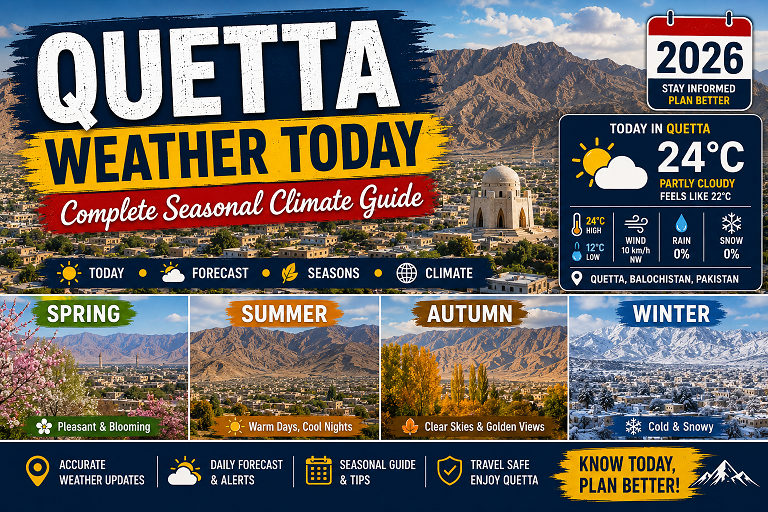
This article explains Quetta’s climate and seasonal planning; it does not display a hard-coded live temperature. For today’s official forecast, warnings, wind, humidity and expected rain, open the Pakistan Meteorological Department service.
Open official PMD forecastQuetta has a dry, high-valley climate with strong seasonal contrasts. Winters can be sharply cold with frost and occasional snowfall, while summer afternoons can be hot and sunny. Spring and autumn are often comfortable, but daily temperature swings, wind, dust and sudden weather systems mean travellers should check the forecast rather than relying only on the month.
The city lies around 1,600–1,700 metres above sea level, depending on the measurement point, and is surrounded by the Chiltan, Takatu, Zarghoon and Murdar ranges. Elevation and dry air help nights cool quickly. Conditions on a mountain road, in Urak Valley or on the city floor can differ at the same time.
Cold nights, frost and possible snow; heating and road checks matter.
Changeable temperatures, blossom season, wind and occasional rain.
Hot sunny days, dry air and cooler evenings than many lowland cities.
Often pleasant days followed by progressively colder nights.

How to understand Quetta weather today
Quetta Weather Today
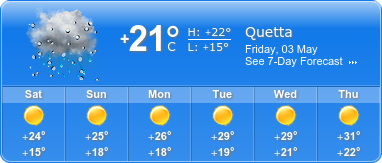
A useful forecast contains more than one temperature. The daily maximum suggests afternoon heat; the minimum usually represents the coldest overnight or early-morning period. Wind speed affects comfort and dust, humidity changes how dry the air feels, and precipitation probability indicates likelihood—not guaranteed duration or amount.
Check the issue time. A screenshot sent in the morning may have been generated the previous day, while a search result can display cached data. PMD operates the National Weather Forecasting Centre and Balochistan regional services. Its Balochistan district forecast is more appropriate for official planning than an unattributed social post.
City forecast versus exact location
“Quetta” is a broad forecast label. Hanna, Urak, Kuchlak, Panjpai, an airport, a mountain slope and central Quetta can experience different wind, temperature and precipitation. Confirm the exact route when conditions could affect safety.
Quetta weather by season
Winter: December to February
Winter brings the city’s coldest conditions. Nights can fall below freezing during cold spells, creating frost and icy surfaces. Snowfall is possible but not guaranteed on fixed dates or every year. Mountain areas may receive or retain snow when central streets remain wet or dry.
Hotels should be asked specifically about heating, hot water, backup power and room ventilation. Gas heaters, charcoal and generators can create carbon-monoxide risk; never use cooking equipment as an indoor heater. For detailed snow planning, use Shalkot’s Quetta snowfall guide.
Spring: March to April
Spring can bring pleasant afternoons, cold mornings, blossom season and rapidly changing weather. Wind and dust are possible, while western weather systems can produce rain, thunder, hail or late snow over higher ground. Pack layers rather than assuming one daytime temperature describes the full day.
Summer: May to August
Quetta’s summer can be hot, bright and dry. The high elevation often allows evenings to cool more than in humid lowland cities, but afternoon heat and strong ultraviolet exposure still matter. Drink water regularly, use shade and sun protection, and avoid scheduling strenuous outdoor work in the hottest hours.
Monsoon influence is less regular than in eastern Pakistan, but thunderstorms or heavy spells can still create urban flooding, hill torrents or difficult roads. “Dry climate” does not mean flash-flood risk is zero.
Autumn: September to November
Early autumn can remain warm by day, followed by increasingly crisp evenings and cold nights. This is often a practical period for sightseeing, but daily forecasts remain necessary. By late autumn, travellers should confirm hotel heating and prepare for winter-like mornings.
Month-by-month Quetta planning guide
| Months | Typical planning expectation | What to pack or verify |
|---|---|---|
| December–February | Cold nights, frost; rain or snow during suitable systems | Insulated layers, waterproof shoes, heating, road and flight status |
| March–April | Changeable spring weather, wind and occasional rain | Layered clothing, light rain protection, allergy medication if prescribed |
| May–June | Hot sunny afternoons and dry air | Water, sunscreen, hat and shaded activity times |
| July–August | Summer heat with possible thunderstorm spells | Heat plan plus current rain/flood advisories |
| September–October | Often comfortable days with cooler nights | Light layers and sun protection |
| November | Rapid transition toward colder nights | Warm evening layer and verified room heating |
This table is a planning summary, not a forecast or climate guarantee. Weather varies from year to year, and climate averages do not tell you what will happen during a particular booking.
Rain, snowfall, dust and weather hazards
Rain and flash flooding
Heavy rain can overwhelm drainage, fill low-lying roads and activate streams or hill torrents. Never drive into moving water merely because another vehicle crossed. Water depth, current and road damage are difficult to judge. Follow district administration, PDMA/NDMA and road-authority instructions.
Snow, frost and black ice
Snow attracts visitors, but frost may be the more common road hazard. Bridges, shaded bends and mountain approaches can freeze. Reduce speed, increase following distance and avoid sudden braking. Four-wheel drive improves traction in some conditions but cannot eliminate skidding on ice.
Wind and dust
Dry ground and wind can reduce visibility and irritate eyes and lungs. Close windows when dust is severe, secure loose outdoor objects and avoid unnecessary road travel if visibility deteriorates. People with asthma or other respiratory conditions should follow their clinician’s plan and keep prescribed medication available.
Drought and water scarcity
Quetta and wider Balochistan face recurring drought and groundwater stress. PMD’s National Drought Monitoring Centre issues bulletins based on rainfall and related indicators. Visitors and businesses should conserve water and avoid assuming that one rainy spell resolves long-term scarcity.

Health, clothing and air-quality precautions
Quetta’s dry air can contribute to dehydration, dry skin, irritated lips and nasal discomfort. Drink water regularly and use moisturiser or lip protection if helpful. High elevation and cold can affect some visitors; people with heart, lung or other medical conditions should seek individual advice from a qualified clinician.
Layering works across seasons. Use a light base and removable outer layer during spring and autumn. In winter, add insulation and wind protection; in summer, choose breathable clothing, a hat and sunscreen. Children, older adults and outdoor workers need closer monitoring during temperature extremes.
Weather and air quality are related but not identical. A clear sky does not prove clean air, and visible dust is not the only pollutant. If an official air-quality source reports unhealthy conditions, reduce strenuous outdoor activity according to the health category. A generic weather application should not be treated as a medical diagnosis.
Seek urgent help for severe symptoms
Confusion, fainting, severe breathing difficulty, chest pain, inability to wake normally, signs of heat stroke or suspected carbon-monoxide exposure need urgent medical attention. Move away from the exposure when safe and contact emergency services.
Weather effects on flights, roads and hotel bookings
Quetta flight schedules can be affected by poor visibility, wind, storms or operational factors. Check directly with the airline before leaving for the airport. A forecast alone cannot confirm whether a specific flight will operate. If arranging a Quetta airport transfer, ask how the driver handles delays and parking charges.
Intercity travellers should check the entire route. Quetta may be clear while roads toward Ziarat, Chaman, Zhob, Karachi, Lahore or Islamabad face separate conditions. A private car with driver should include a vehicle suitable for the planned route, but the driver must still obey closures and warnings.
For Quetta hotel booking, compare more than the room photograph. Ask about heating or air conditioning, hot water, backup electricity, parking, taxes, cancellation and road access. Flexible cancellation is especially valuable during a winter storm or major rain warning.
Better value than chasing the cheapest rate
Choose refundable transport and accommodation when a weather system is possible. A slightly higher flexible price may cost less than losing a non-refundable booking after a flight cancellation or road closure.
Which Quetta forecast should you trust?
- PMD first: use weather.gov.pk for Pakistan’s official daily forecasts, warnings, press releases and regional products.
- NDMA/PDMA for impacts: read disaster-management advisories when heavy rain, snow, flood, heat or wind may affect people and infrastructure.
- Transport operator for operations: airlines and road operators confirm a specific service, not the weather app.
- Recent local confirmation: a hotel or trusted person can describe conditions at an exact street, but official warnings still take priority.
- Avoid old screenshots: confirm issue date, time, location and units before sharing.
Third-party weather apps are useful for comparison, but model output can differ. Do not average several apps yourself during a serious warning; follow the responsible Pakistani authority.
Weather planning for farmers, shops and outdoor work
Quetta’s weather affects more than tourism. Orchard owners, farmers, construction teams, delivery businesses and market traders may need decisions based on frost, wind, rain, hail and heat. PMD’s National Agromet Centre provides agricultural weather information, but a general city forecast cannot replace crop-specific local advice.
Late cold or frost can affect blossoms and young growth, while hail and strong wind may damage fruit. Growers should use current agricultural advisories, observe conditions in the exact valley and consult qualified local agriculture staff. An online article should not tell a farmer to irrigate, spray or harvest on a fixed date without field information.
Construction and outdoor businesses should secure sheets, signs and loose materials before strong wind. Employers need drinking water, shade and rest arrangements during heat, and warm dry protective clothing during winter. Lightning is a reason to suspend exposed outdoor work; a vehicle or substantial building is safer than standing under an isolated tree.
Understanding weather units and app readings
Pakistan normally reports temperature in degrees Celsius. Wind may appear in kilometres per hour, metres per second or knots, so check the unit before comparing two services. Relative humidity is a percentage, while atmospheric pressure may be shown in hectopascals or other units. Visibility is often expressed in kilometres.
A “feels like” value is calculated from factors such as temperature, humidity and wind; it is not a separate thermometer observation. Precipitation probability describes the chance of measurable precipitation for the forecast area and period. It does not mean that rain will fall for that percentage of the day.
Daily minimum and maximum values also need context. The maximum usually occurs in the afternoon and the minimum around night or early morning, but cloud, wind and an incoming system can shift the timing. Travellers arriving before sunrise should prepare for conditions closer to the minimum, not the afternoon headline.
Weather differences within the Quetta region
The broad Quetta forecast cannot describe every microclimate. Dense urban surfaces can retain warmth, exposed outskirts may experience stronger wind, and valleys can collect cold air overnight. Mountain elevation generally lowers temperature, but sun exposure, slope direction and wind can produce sharp local differences.
Hanna and Urak conditions may differ from central Quetta, while Kuchlak and Panjpai require their own road and local checks. Ziarat, Chaman, Pishin and Mastung are separate destinations and should never be assigned Quetta’s forecast merely because they are regionally close. Check every city or district involved in a journey.

Frequently asked questions
What is Quetta’s weather today?
Open weather.gov.pk for the current official forecast. This evergreen guide does not hard-code a temperature that becomes outdated.
What is the coldest month in Quetta?
January is generally considered the heart of winter, but individual cold spells can occur in December or February. Check daily forecasts for actual travel dates.
Does Quetta receive snowfall?
Yes, snow is possible in winter, but frequency, location and accumulation vary. Higher surrounding ground may receive snow when central Quetta does not.
Is Quetta very hot in summer?
Summer afternoons can be hot and sunny, although dry air and elevation often allow cooler evenings than many lowland cities. Heat precautions remain necessary.
When is the best weather for visiting Quetta?
Many visitors find spring and autumn comfortable, but preferences differ and weather is variable. Read Shalkot’s detailed best-time guide and check PMD before booking.
Can rain cause flooding in dry Quetta?
Yes. Intense rain can affect low-lying roads, drains and hill torrents even in an arid region. Follow warnings and never drive into floodwater.
Why do different apps show different temperatures?
They may use different observation stations, forecast models, update times or rounding. Compare issue times and use PMD for official Pakistan warnings.
Related guides
Bottom line
Quetta’s high-valley climate brings cold winters, hot dry summer days and large differences between sun and shade, day and night, and city and mountain locations. Seasonal knowledge helps, but only a current forecast can guide today’s decision.
Use PMD first, follow official impact warnings and keep travel bookings flexible. That approach is more reliable than any fixed temperature table copied into a permanent webpage.
No snow here in Nova Scotia. Let’s follow each other. Anita
I have followed you already
Thanks 😊