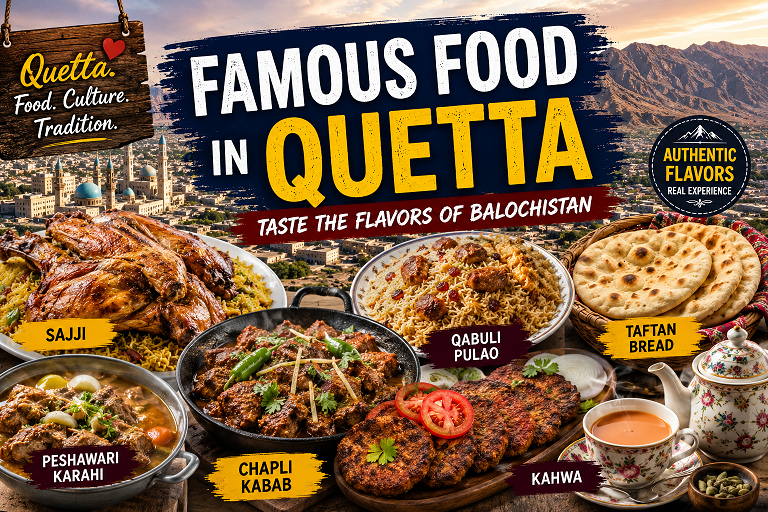
The most famous food in Quetta includes Balochi Sajji, mutton Rosh, Dampukht, Landhi, Kaak, Khaddi Kebab and grilled meat. Quetta’s diverse food culture also includes Afghan-style Kabuli Pulao, Pashtun dishes, Pakistani karahi, barbecue, bakeries, tea and dry-fruit sweets. For a first meal, order by portion rather than dish name alone, ask whether the price is per person, kilogram, piece or full platter, and confirm meat type, preparation time and final bill before ordering.
Quetta’s food reflects Balochistan’s geography, pastoral traditions, trade routes and mixed communities. Some dishes are closely associated with Balochi hospitality; others reached the city through Afghan, Pashtun, Persian, Central Asian or wider Pakistani influences. That diversity is part of Quetta’s identity, so an accurate guide should not label every popular local meal as having originated inside the city.
This article explains dishes, ordering terms, restaurant-price checks, family dining, delivery and hygiene. It does not rank one restaurant as “the best” without a current transparent comparison. Shalkot.com does not own a restaurant, book tables, take food orders or collect payments.
Sajji: slowly roasted meat with relatively simple seasoning.
Rosh: tender slow-cooked meat with a light broth or juices.
Kaak or stone-cooked bread served with meat and tea.
Confirm portion, weight, meat, sides, tax and total price.
15 famous foods to try in Quetta
1. Balochi Sajji
Sajji is the dish most strongly associated with Balochistan in popular Pakistani food culture. Traditionally, lamb or goat is seasoned simply and slowly roasted near an open fire. Restaurants also sell chicken Sajji, rice-filled versions and spiced adaptations.
Authenticity arguments vary because families and businesses prepare it differently. Ask whether you are ordering chicken, mutton or lamb; a leg, portion, half, whole bird or weight-based serving; and whether rice, Kaak, naan, salad and chutney are included. Traditional simplicity does not mean meat can be undercooked—ensure it is cooked through and served hot.
2. Mutton Rosh
Rosh is a slow-cooked meat dish commonly made with bone-in mutton or lamb. Its appeal comes from tenderness and clean meat flavour rather than a thick tomato-heavy masala. Depending on the restaurant, it may arrive with broth, potatoes, vegetables or minimal seasoning.
Rosh is often sold by plate, portion or weight. Ask how many people the serving normally feeds and whether bread, salad and broth are included. Bone weight can affect perceived value, so compare portions rather than price alone.
3. Dampukht
Dampukht refers to slow cooking in a sealed pot so meat and other ingredients cook in retained steam and juices. Quetta versions can differ in meat cut, potatoes, tomatoes, chillies and seasoning.
Because preparation may take time, groups should ask whether advance ordering is required. Confirm pot or platter size, serving estimate and whether the quoted amount includes rice or bread.
4. Khaddi Kebab
Khaddi Kebab is associated with whole or large portions of goat or lamb cooked slowly, traditionally using a pit or enclosed heat method, sometimes with rice. It is generally a group meal rather than a quick single serving.
Advance booking may be necessary. Agree on animal or meat weight, rice quantity, number of guests, preparation time, deposit, cancellation and final cost. Do not assume every business uses the same technique merely because the menu says Khaddi.
5. Landhi
Landhi is preserved meat traditionally salted and dried for winter, then cooked into a broth or meal. It developed in a context where preserving meat through cold and dry conditions was practical. Availability is seasonal and it is less common on ordinary restaurant menus than Sajji or Rosh.
Preserved meat requires careful hygiene, curing, drying and storage. Try it only from a source with reliable handling, and ask how it was preserved. People limiting sodium should remember that salted dried meat can be high in salt.
6. Kaak or stone bread
Kaak is a firm traditional bread associated with Baloch and Pashtun food traditions. A form of dough is cooked using heated stone and fire, producing a dense bread suited to eating with meat, broth or tea.
Fresh Kaak may be hard or chewy by design rather than stale. Ask how it is traditionally eaten and whether the restaurant bakes it on site. Anyone with difficulty chewing or swallowing should choose carefully.
7. Tabaheg
Tabaheg is a Balochi preserved-meat preparation in which meat is salted and dried, traditionally with sour pomegranate and other regional methods, then cooked and commonly served with rice. Practices vary across the wider Balochistan region.
Because it is cured and dried, source and storage matter. A menu may use the name for a modern interpretation. Ask how the meat was prepared rather than expecting one fixed recipe.
8. Kabuli Pulao
Kabuli Pulao is an Afghan dish deeply embedded in Quetta’s food scene. It generally combines long-grain rice with meat, carrots, raisins and a gently aromatic flavour profile. Restaurant recipes differ in sweetness, fat, meat portion and toppings.
Ask whether the plate includes a separate meat piece, which meat is used and whether the serving is single or family size. Quetta’s popularity for Kabuli Pulao reflects the city’s Afghan cultural links; it should not be relabelled as an originally Balochi dish.
9. Dumba Karahi
Dumba Karahi uses meat from fat-tailed sheep and is valued by diners who prefer rich mutton flavour. It may be cooked with tomatoes, green chillies, salt and spices, but recipes range from minimal to heavily seasoned.
Clarify whether the rate is based on raw weight or finished serving, whether fat and bone are included, and what oil or animal fat is used. Rich dishes can be heavy; share portions and consider dietary needs.
10. Balochi tikka and barbecue
Quetta offers skewered or grilled mutton, beef and chicken under several names. “Balochi tikka” may describe a simple salt-forward style, but the label is not standardized across restaurants.
Ask for meat type, cut, skewer count and whether the price includes naan, chutney or salad. Minced kebabs and poultry should be thoroughly cooked, while raw meat must be kept separate from ready-to-eat foods.
11. Mutton or chicken karahi
Karahi is popular throughout Pakistan and widely available in Quetta. It is not uniquely a Quetta dish, but local restaurants often specialize in fresh meat, tomato, green chilli and ginger preparations.
Menus may quote half-kilogram or kilogram rates. Confirm raw versus cooked weight, meat cut, cooking fat, waiting time and sides. A lower price may reflect a different cut or portion.
12. Sheer chai and local tea culture
Tea is central to hospitality and social life. Depending on the café or household, diners may encounter green tea, black tea, milk tea or salt-influenced regional styles. “Sheer chai” can refer to different preparations across communities.
Ask whether sugar is added and whether milk is fresh or powdered if that matters to you. Tea is inexpensive relative to full meals, but cafés may charge more for seating and location.
13. Quetta bakery items
The city has a strong bakery and tea-snack culture, with biscuits, rusks, cakes, breads and savoury items. These are not all indigenous Balochi foods, but they are part of everyday urban eating.
Choose shops with good turnover, covered displays and clear packing or expiry information. Cream products require dependable refrigeration.
14. Dry fruits, dates and nut mixtures
Quetta is famous as a dry-fruit trading centre. Almonds, raisins, walnuts, pistachios, dried apricots, dates and pine nuts appear as snacks, tea accompaniments and gifts. Not every item is grown in Balochistan.
Read the guides to the dry fruit market in Quetta and Balochistan dry fruits for origin and quality checks. People with nut allergies should consider cross-contact from open bins and shared utensils.
15. Seasonal fruit and desserts
Apples, grapes, pomegranates, apricots and other produce reach Quetta from provincial growing districts at different times. Restaurants may also serve ice cream, halwa, kheer and broader Pakistani sweets.
Ask whether juices contain added sugar or ice and choose fruit that is freshly cut and hygienically handled. Gwadari halwa belongs to the coastal Balochistan tradition rather than Quetta specifically, even if it is sold in the city.
Balochi, Pashtun, Afghan and Pakistani influences
A useful Quetta food guide should identify dishes respectfully. Balochi cuisine includes strong traditions of meat, preserved foods, breads and hospitality, but Balochistan itself contains multiple cultures and climates. Pashtun communities contribute their own meat, bread and tea traditions. Afghan migration and trade have made Kabuli Pulao and Afghan-style dining prominent. Pakistani urban dishes, Chinese food, pizza, burgers and cafés are also part of modern Quetta.
Food changes through families and restaurants. There is rarely one universally “authentic” recipe. The better question is whether a restaurant describes its method honestly and prepares the dish well.
Editorial distinction: “Popular in Quetta,” “Balochistan traditional food” and “originated in Quetta” are different claims. This article uses them separately to avoid erasing the Afghan, Pashtun, Balochi and wider Pakistani origins of individual dishes.
Where to eat traditional food in Quetta
Traditional meat restaurants, family dining rooms, hotels, roadside establishments, cafés and modern food streets operate across the city. Areas and individual businesses change, and public review pages often contain old hours or subjective rankings. Instead of declaring one permanent winner, choose according to dish specialization, hygiene, recent local recommendations, seating and verified opening status.
| Restaurant type | Usually suitable for | What to verify |
|---|---|---|
| Traditional Sajji/Rosh restaurant | Signature meat dishes and local-style meals | Meat type, portion, cooking time, seating and total bill. |
| Afghan/Pashtun restaurant | Kabuli Pulao, Rosh, kebabs and bread | Single versus family plates and included meat. |
| Family restaurant | Mixed groups, indoor seating and broader menus | Family area, reservation, service charge and parking. |
| Hotel restaurant | Business meals and more formal service | Taxes, buffet inclusions, reservation and security access. |
| Street or roadside food | Quick local experience and lower-cost dishes | Turnover, hot holding, water, utensils and covered food. |
| Delivery kitchen | Home/office convenience | Verified address, packaging, delivery fee and complaints policy. |
Check the related restaurant guide for Quetta for category-based selection. A business mentioned online may close, move or change ownership; call its official number before travelling.
Quetta restaurant prices and how to order
There is no accurate citywide Quetta food price list. Meat prices, portion sizes, rent, cooking method, service and taxes differ. Menu photographs can be outdated. Searches such as Sajji price in Quetta, Rosh price per kg, family platter price Quetta and cheap restaurants in Quetta require a dated quote from the chosen restaurant.
Ask these questions before confirming
- Is the price per plate, kilogram, piece, skewer, person or full dish?
- Is weight measured before or after cooking?
- Which meat and cut are included?
- Are rice, bread, salad, raita and drinks separate?
- Are tax and service charges included?
- How many adults does the restaurant estimate the portion serves?
- Does the dish require advance booking or a deposit?
- What is the cancellation rule for a whole-goat or group order?
For a fair comparison, request the complete payable amount for the same serving specification. The cheapest kilogram can provide less edible meat if it includes more bone or fat. Conversely, premium pricing does not guarantee better hygiene or service.
Family dining, children and group meals
Families should confirm indoor seating, separate family space where desired, toilets, parking, accessibility and reservation policy. Large meat dishes are easier to manage when the group agrees on portion, rice, bread and side orders beforehand.
For children, request less spicy food and ensure meat is tender, boneless where possible and cut into safe pieces. Keep young children away from open fires, hot skewers and floor-level serving pots. Older adults may prefer lower-fat portions and easier-to-chew dishes.
Traditional dishes can be high in animal fat or salt. People with diabetes, heart disease, kidney disease, food allergy or a prescribed diet should choose portions and ingredients according to professional advice. A local dish is not automatically healthy or unhealthy; preparation and quantity matter.
Food delivery, takeaway and catering
Commercial searches include Quetta food delivery, Sajji home delivery Quetta, online restaurant order Quetta, wedding catering Quetta price and corporate lunch catering. Verify the restaurant through its official channel rather than sending payment to a number copied from an old post.
Delivery checklist
- Confirm branch, address and official order number.
- Write the exact dish, portion, sides and spice level.
- Confirm food price, packaging, delivery and tax separately.
- Ask estimated preparation and delivery time.
- Use sealed or tamper-evident packaging where available.
- Check hot food on arrival and report damaged or incorrect orders promptly.
- Keep electronic payment evidence and order messages.
For wedding or corporate catering, approve a tasting and written menu. Record guest count, portion assumptions, serving staff, dishes, crockery, transport, setup, cleanup, deposit, balance and cancellation. Confirm whether meat quantity is raw or cooked weight.
Food-safety checklist for diners
Food safety is more important than a viral recommendation. Choose businesses where raw and cooked food appear separated, staff use clean utensils, ingredients are covered and hot dishes are served steaming hot. Avoid food with an unusual smell, signs of repeated reheating or poor temperature control.
| Food type | Main concern | Safer choice |
|---|---|---|
| Roasted/grilled meat | Undercooked centre or cross-contamination | Cooked through, hot, cut with clean utensils. |
| Rice dishes | Long holding at unsafe temperature | Fresh hot batch with good turnover. |
| Salad/chutney | Unsafe water or poor refrigeration | Freshly prepared by a trusted establishment. |
| Dairy desserts | Broken cold chain | Properly refrigerated and within date. |
| Dry fruits | Mould, rancidity, insects and allergens | Fresh-smelling stock in clean, dry storage. |
| Delivery meals | Delay and damaged packaging | Sealed packaging and prompt consumption. |
Allergy warning: Restaurants may share grills, oil, utensils and preparation areas. If an allergy can cause a serious reaction, do not rely only on “this dish has no nuts.” Ask about cross-contact and follow the emergency plan provided by your clinician.
A practical one-day Quetta food plan
- Breakfast: fresh bread, egg or local breakfast from a busy, clean establishment, with tea.
- Midday: Kabuli Pulao or a moderate Rosh portion, allowing time to assess serving size.
- Afternoon: tea with a bakery item or carefully chosen dry fruits.
- Dinner: pre-ordered mutton or chicken Sajji shared with Kaak/naan, salad and a light side.
This is a planning example, not a dietary recommendation. Avoid ordering several rich meat dishes for one person simply to complete a checklist. Sharing portions reduces cost and waste and allows comparison without overeating.
If you are visiting from outside the city, read the best time to visit Quetta and things to buy from Quetta guides for seasonal and market planning.
Frequently asked questions
What is the most famous food of Quetta?
Sajji is the best-known signature dish associated with Balochistan and Quetta dining. Rosh, Dampukht, Kaak and Kabuli Pulao are also popular.
Is Sajji from Quetta?
Sajji is broadly associated with Balochi and Balochistan food tradition. Quetta is one of its best-known restaurant centres, but the tradition is wider than the city.
What is Rosh?
Rosh is slow-cooked bone-in mutton or lamb valued for tender meat and relatively simple seasoning, sometimes served with broth or vegetables.
Is Kabuli Pulao a Balochi dish?
No. Kabuli Pulao is Afghan in origin but is highly popular in Quetta because of the city’s cultural and trade links.
How much does Sajji cost in Quetta?
There is no single current rate. Confirm meat, portion, weight basis, rice, bread, tax and final total directly with the restaurant.
Which food is best for a family in Quetta?
A shared Sajji, Rosh, Kabuli Pulao or mixed platter can work, depending on dietary needs. Confirm seating and portion size before visiting.
Can I order Quetta traditional food online?
Many restaurants offer takeaway or delivery. Verify the official branch, number, total cost, delivery area and replacement policy.
Is traditional Quetta food spicy?
Many traditional meat dishes use simpler seasoning than heavily spiced curries, but restaurant recipes vary. Ask before ordering.
Does Shalkot recommend or take orders for restaurants?
No. Shalkot.com provides independent information and does not book tables, deliver meals or collect restaurant payments.
Final dining checklist
- Dish origin and preparation understood.
- Meat type, portion and weight basis confirmed.
- Sides, drinks, taxes and service charges included in estimate.
- Restaurant identity and current opening status verified.
- Group dish booked in advance where necessary.
- Hot food served hot and hygiene assessed.
- Allergy, salt, fat and dietary needs considered.
- Delivery or catering terms saved in writing.
Related Quetta guides
Sources and verification notes
- Traditional Food Delicacies across Balochistan—ethnographic research overview
- Associated Press of Pakistan—Kabuli Pulao’s Afghan identity and popularity in Quetta
- Public restaurant listing used only to confirm Sajji restaurant presence, not as an endorsement
- Local 2026 guide used to cross-check current Sajji dining interest