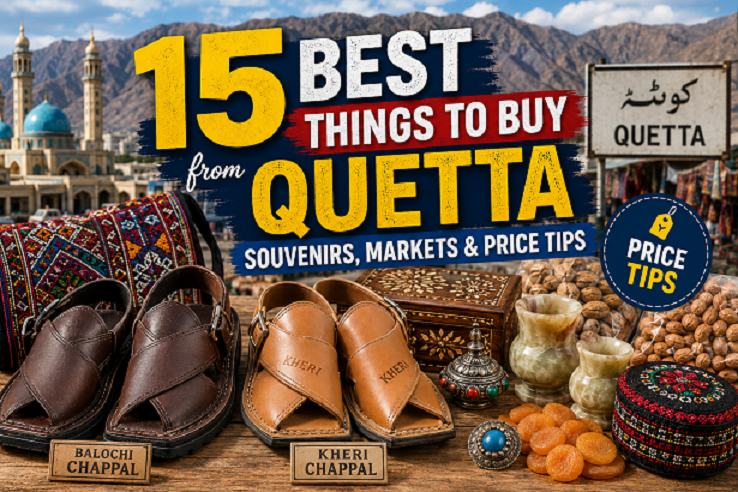
The most meaningful things to buy from Quetta include hand-embroidered Balochi clothing and accessories, woollen carpets and rugs, shawls, leather crafts, traditional caps, dry fruits, dates, raisins and carefully packed local gifts. For authenticity, ask who made or grew the item, where it came from, what materials were used and whether the seller can record those details on a receipt. Quetta is also a trading city, so not everything sold there is locally made or grown.
Shopping in Quetta can be more than buying a souvenir. A well-chosen textile, carpet, food gift or handmade accessory can represent Balochistan’s craft traditions and support skilled workers. But regional labels are sometimes used loosely. Machine embroidery can be sold as handwork; imported rugs can be presented as local; and dry fruit stocked in Quetta may come from Afghanistan, Iran, other Pakistani provinces or international suppliers.
This independent guide explains what to look for, where to start, how to compare quality and what costs to clarify. Shalkot.com does not operate a shop, certify products, arrange orders or receive payment from the markets mentioned.
Balochi embroidery, dresses, panels, bags and shawls.
Hand-knotted carpets, rugs, cushion covers and wall pieces.
Dry fruits, dates, raisins, nuts and regional gift boxes.
Compare material, origin, workmanship, weight and final price.
15 best things to buy from Quetta
1. Hand-embroidered Balochi dress
A traditional Balochi dress is one of the most distinctive purchases associated with the province. Detailed needlework may cover the front panel, sleeves, cuffs and pocket. Designs, colours and stitches vary across communities and areas, while completion can require substantial skilled labour.
Before buying: ask whether it is fully hand-embroidered, machine-assisted or machine-made; whether the price covers a complete stitched dress or only embroidery panels; what fabric is used; and whether alteration is included. Examine the reverse of the embroidery, stitch consistency and finishing. A complex handmade piece should not be judged by price alone.
2. Balochi embroidery panels and patches
Travellers who cannot carry a complete dress can buy an embroidered front panel, sleeve set, neckline, patch or border. These are easier to pack and can later be applied to clothing, framed as art or used in a bag.
Money check: confirm the number and dimensions of all pieces, base fabric, thread type, handwork percentage and whether tailoring is separate. Photograph the approved set before it is packed.
3. Embroidered handbags, purses and clutches
Balochi embroidery appears on modern accessories such as shoulder bags, clutches, wallets and mobile pouches. Mirror work, geometric stitching and colourful panels can turn a useful item into a compact gift.
Inspect the zip, lining, handles and seam strength in addition to decorative work. A beautiful front panel does not compensate for weak construction. Ask whether the embroidery was created for the product or cut from an older textile, particularly when the seller calls it “vintage.”
4. Traditional Balochi shawls and woollen cloth
Balochistan’s Small Industries information identifies wool as an important provincial raw material and refers to woollen blankets, tweed cloth and Balochi or Makrani shawl-related handloom products. Shawls vary by fibre, weave, weight and origin.
Quality check: ask whether the item is pure wool, blended, acrylic or another fibre; inspect edges and loose threads; and request care instructions. “Pashmina” should not be accepted as a guarantee without reliable material evidence.
5. Hand-knotted carpets and rugs
Quetta has a long association with woollen carpets, rugs and regional trade. Genuine hand-knotting is labour-intensive, while cheaper machine-made rugs may be imported or produced elsewhere. Both can be useful, but they should be described honestly.
Turn the carpet over to inspect the structure, measure exact dimensions and ask about knotting method, fibre, dye, age, repair and place of production. For an expensive purchase, request a written invoice and never rely only on a dramatic “antique” story.
6. Kilims, runners and small floor pieces
A flat-woven kilim, prayer-size rug, runner or small mat is easier to transport than a room-size carpet. Designs may reflect Baloch, Afghan, Persian or Central Asian traditions because Quetta is a trading hub.
Check whether the edges lie flat, whether colours transfer to a damp white cloth and whether repairs are disclosed. Ask for the origin rather than assuming every geometric rug is Balochi.
7. Embroidered cushion covers and wall hangings
Cushion covers, table pieces and wall hangings bring traditional needlework into modern homes. Coin work, mirror work and embroidery can be decorative, but loose mirrors, sharp pieces or unsecured coins need careful handling.
Confirm whether a cushion insert is included, check dimensions, inspect the backing and closure, and ask how the textile should be cleaned. Delicate handwork may require spot cleaning rather than machine washing.
8. Balochi caps and traditional headwear
Embroidered caps make compact gifts, but size, regional style and cultural context matter. Some items in Quetta shops may reflect Pashtun, Afghan or other traditions rather than Balochi design.
Measure the wearer’s head, check lining and stitching, and ask the seller to identify the style accurately. Avoid presenting one community’s item under another community’s name.
9. Handmade leather goods
The province’s craft information describes leather embroidery and artisans associated particularly with Turbat and Lehri. Quetta shops may stock leather sandals, belts, bags, wallets and decorative work from multiple sources.
Check leather type, stitching, sole attachment, hardware and colour transfer. A leather smell is not proof of full-grain or genuine handmade construction. For footwear, confirm size, exchange terms and whether the pair is intended for regular use or display.
10. Traditional jewellery and decorative accessories
Jewellery sold as Balochi may use metalwork, beads, coins, mirrors or colourful elements. Some pieces are traditional, some are contemporary interpretations and some are mass-produced.
Ask whether metal is silver, silver-plated or base metal and obtain purity details for high-value pieces. Test clasps and check for sharp edges. Antique or tribal provenance should require stronger evidence than a seller’s verbal claim.
11. Dry fruits and nuts
Almonds, walnuts, pistachios, raisins, dried apricots, dates, figs, cashews and pine nuts are common in Quetta. Some are connected with Balochistan agriculture, while others arrive through national and international trade.
Use the separate guides to the dry fruit market in Quetta and the dry fruits of Balochistan. Compare identical origin, crop, grade and weight; reject rancid, mouldy, damp or infested products.
12. Panjgur and Makran dates
Dates from Makran, including Panjgur and Kech/Turbat, can be a regionally meaningful food gift. Varieties differ in texture, moisture and flavour, and retail packs may contain local or imported dates.
Ask for the variety, district, crop, packing date and storage guidance. Soft dates may not travel well in heat without suitable packaging. Check whether syrup or glucose has been added.
13. Balochistan raisins and dried apricots
Raisins can be linked to highland grape-growing areas, while dried apricots come from suitable orchard zones. Colour alone does not prove freshness: bright products may be sulphur-treated and darker products may be naturally dried.
Ask about origin, drying method, oil, sulphites and added sugar. Inspect for stones, stems, insects, fermentation odour and excessive moisture.
14. Regional food gift boxes
A mixed box of almonds, raisins, dates, dried apricots and other products can be convenient for family, wedding or corporate gifts. The packaging, however, can hide small food quantities or low-cost filler.
Request the name and net weight of every item, the empty-box weight, packing date, allergen warning and courier charge. Approve one finished sample before ordering many boxes.
15. Books, photographs and locally made cultural art
Books about Quetta, Balochistan’s history, languages, landscapes or culture can be thoughtful gifts. Locally produced artwork and photography may also support regional creators.
Buy authorized editions and original or properly licensed prints. Ask the artist’s name, medium, size and whether the work is an original or reproduction. Do not purchase archaeological objects, protected antiquities, wildlife products or items of uncertain legal origin.
Where to shop in Quetta
Quetta’s traditional commercial centre contains several connected bazaars and shopping streets rather than one souvenir mall. Stock and shop locations change, so confirm a named business before making a special journey.
| Shopping area | Useful for | Practical advice |
|---|---|---|
| Liaquat Bazaar | Clothing, textiles, dry fruit and general traditional shopping | Compare several sellers and keep belongings secure in crowded lanes. |
| Kandahari Bazaar | Traditional trade, clothing, household goods and regional products | Ask for exact shop location and product origin. |
| Suraj Ganj Bazaar | Broad local shopping and price comparison | Quality varies; inspect the actual item before paying. |
| Tula Ram Road/central area | Dry fruits and nearby market access | Confirm current shop pin and opening hours. |
| Handicraft centres/exhibitions | Artisan products and documented craft initiatives | Check whether the event is current and whether sales support makers directly. |
| Modern retail and hotel gift shops | Packaged gifts and easier fixed-price shopping | Convenience and presentation may increase the price. |
Opening hours vary with season, Friday prayer, Ramadan, Eid and individual businesses. Visit in daylight, allow time for comparison and ask permission before photographing people or shops.
How to identify authentic handmade products
Handmade does not mean every stitch must be irregular, but small variations are common. Machine production can be precise and affordable; the problem arises only when it is falsely sold as handwork.
- Ask who made it: artisan, household, workshop, village or brand.
- Ask where it was made: Quetta sale location is not proof of production origin.
- Inspect both sides: reverse embroidery and carpet backs reveal construction.
- Check materials: wool, cotton, silk, synthetic fibre, leather and metal should be identified.
- Compare similar items: perfectly identical pieces may indicate standardized production.
- Request written details: especially for expensive carpets, jewellery or “antique” goods.
- Respect labour: complex handwork taking weeks or months cannot realistically cost the same as mass production.
Authenticity warning: “Balochi,” “tribal,” “vintage,” “organic,” “pure wool” and “handmade” are commercial claims unless supported by product evidence. Shalkot does not certify any seller or item.
Quetta souvenir prices and bargaining
There is no dependable universal Quetta handicraft price list. A Balochi dress price depends on embroidery density, labour, fabric and stitching. A carpet price depends on dimensions, knots, fibre, dye, origin, condition and age. Dry-fruit prices change with variety, crop, grade, imports and season.
Use this comparison method:
- Request the price for the exact displayed item—not “starting from.”
- Clarify whether tailoring, lining, frame, cushion insert or packaging is included.
- For carpets, record dimensions in feet/centimetres and calculate area.
- For foods, calculate price per kilogram using net edible weight.
- For delivery, include packing, insurance, courier and cash-on-delivery fee.
- Ask for an invoice before paying a large advance.
- Negotiate respectfully and compare like-for-like quality.
A fixed price may be reasonable in formal stores, while negotiation may be common in traditional markets. Do not pressure an artisan below a fair labour cost merely to obtain a tourist bargain.
Buying Quetta products online
Searches for buy Balochi handicrafts online, Quetta dry fruits delivery, Balochi dress online price and handmade carpet delivery Pakistan have strong commercial intent. Online buying is convenient, but the buyer cannot inspect the item directly.
Before paying, verify the business name, address, working phone number, exact product photos, material, measurements, origin, dispatch time, courier, tracking and return policy. For customized clothing, agree on body and finished-garment measurements in writing. For carpets, request clear front, back, edge and repair photographs. For food, request current batch and expiry details.
Use a traceable payment method and retain the invoice, messages and parcel video. A social-media follower count, copied photograph or “limited offer” does not prove authenticity.
How to pack Quetta purchases for travel
| Item | Packing method | Travel issue |
|---|---|---|
| Embroidery/clothing | Clean tissue or breathable bag; avoid crushing mirrors | Sharp mirrors, coins or decorations can damage fabric. |
| Carpet/rug | Roll when appropriate; use protective wrap and label | Airline size/weight and customs documentation. |
| Jewellery | Separate padded compartments with receipt | Metal-value declarations and sharp edges. |
| Dry fruits | Sealed, labelled, food-grade packs | Destination-country food and agricultural restrictions. |
| Dates | Leak-resistant packaging; temperature appropriate to type | Soft dates can crush or ferment in heat. |
| Artwork | Rigid protection, corner guards and provenance receipt | Fragility, copyright and antiquity concerns. |
Domestic travellers should still protect food and fragile goods. International travellers must check the destination country’s customs and biosecurity rules before buying. Shalkot cannot confirm whether a particular food, plant material, leather item or cultural object will be admitted.
Responsible and culturally respectful shopping
Good shopping supports makers and represents products accurately. Ask permission before photographing artisans. Credit the craft and community when giving or reselling an item. Avoid claiming a design as your own, and do not remove labels identifying the maker.
When possible, choose sellers who can explain who produced the work and how makers are paid. A “women-made” claim should not be used only as marketing; the business should have a real relationship with artisans. Sponsorship, commission and reseller margins should be disclosed where relevant.
Never buy wildlife skins, feathers, protected plants, archaeological material or suspected antiquities. If an object appears genuinely old or culturally sensitive, obtain expert legal guidance rather than relying on a market story.
Frequently asked questions
What is Quetta famous for buying?
Quetta is known for Balochi embroidery, carpets and rugs, woollen items, traditional clothing and accessories, dry fruits, dates and regional gifts.
Which market is best for shopping in Quetta?
Liaquat Bazaar is a useful central starting point. Kandahari Bazaar, Suraj Ganj and nearby streets also offer broad shopping, but stock varies.
What is the best souvenir from Quetta?
A small handmade embroidery piece, documented locally made accessory, regional book or sealed food gift can be meaningful and easy to carry.
Are all carpets sold in Quetta handmade locally?
No. Quetta markets also sell machine-made and imported rugs. Ask for construction, fibre and production origin in writing.
How much does a Balochi dress cost in Quetta?
There is no single price. Cost depends on handwork, design density, materials, number of panels, fabric, stitching and alterations.
Can I buy Quetta products online?
Yes, many sellers advertise delivery. Verify identity, exact product, measurements, final cost, courier and replacement policy before payment.
Are dry fruits sold in Quetta grown in Balochistan?
Some are, while others come from Afghanistan, Iran, other Pakistani regions or international suppliers. Confirm origin by batch.
Can tourists bargain in Quetta markets?
Negotiation may be possible in traditional markets, but compare equivalent products and bargain respectfully. Formal shops may use fixed prices.
Does Shalkot sell or deliver these products?
No. Shalkot.com is an independent information website and does not take orders, payments or delivery bookings.
Final shopping checklist
- Product’s maker, growing origin or source clarified.
- Handmade, machine-assisted or machine-made status confirmed.
- Material, measurements, condition and care understood.
- Actual item inspected rather than only a sample.
- Total price includes alterations, packing and delivery.
- Invoice and return conditions saved.
- Travel and customs restrictions checked.
- No protected wildlife, antiquities or uncertain legal objects purchased.
Related Quetta shopping guides
Sources and verification notes
- Government of Balochistan Small Industries—carpets, embroidery, leather craft and handloom information
- Arab News—Quetta hand-knotted carpet tradition and machine-made competition
- Arab News—Quetta dry-fruit market, winter demand and mixed sourcing
- Balochistan Agriculture Department—provincial fruit research and orchard context
Great