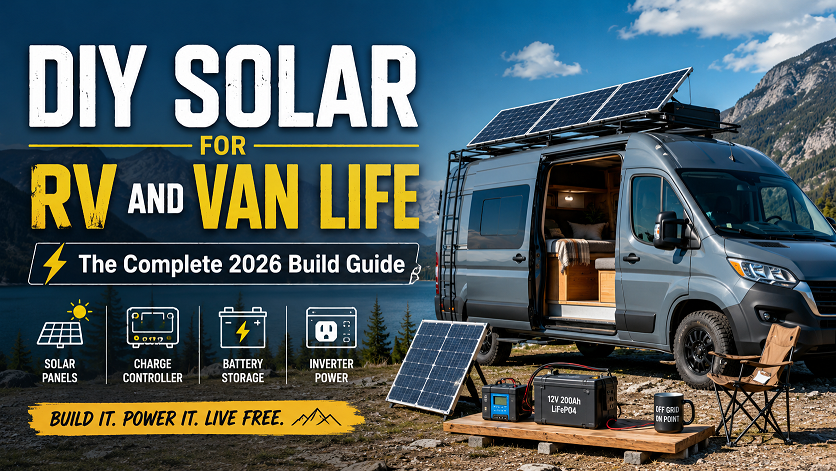
DIY Solar for RV and Van Life: The Complete 2026 Build Guide
400W of solar with 200Ah LiFePO4 is the sweet spot for full-time van life in 2026 — it runs a 12V fridge, laptops, lights, and phone charging without campground hookups. Cost: $1,800–$3,200 DIY, paying for itself in 8 months through campground savings alone. Use rigid panels on flat roofs (Class A, fifth wheels), flexible panels on curved surfaces (vans, Airstreams). Always pair with an MPPT charge controller — never PWM. Pure sine wave inverter only if you need AC power.
A properly sized 400–600-watt setup with lithium batteries costs $2,500–$4,000 upfront. That sounds like a lot until you do the math — this system pays for itself in exactly 8 months through savings alone. After that, every night you boondock instead of paying $25–$50 for a campground hookup goes straight into your pocket.
But “solar for my RV” means something very different depending on whether you’re a weekend warrior in a Class A motorhome or a full-timer converting a Ford Transit. The roof shape, weight limits, power needs, and budget are completely different. This guide covers every scenario with real 2026 pricing and clear recommendations.
Article 6 in the Shalkot DIY Solar Series
This article focuses on RV and van-specific solar. For home solar, see our Solar Panel Calculator. For detailed charge controller comparisons, see Article 03. For battery sizing math, see our Battery Bank Calculator.
Step 1 — Choose Your System Size
Your system size should match how you actually live and travel — not what looks impressive. Here are the four real-world tiers for 2026:
The 400W Rule for Full-Time Van Life
200W systems can’t power much. You’ll still need campgrounds for heavy power days. 400W is the sweet spot for full-time van life — it runs laptops, fans, lights, and a small fridge. You can skip most campgrounds. 600W systems work even better in winter or cloudy weather. The extra power cuts your campground days to almost zero.
Step 2 — Do Your Power Audit (Free Calculator)
Before buying anything, list every device you plan to run. This takes 20 minutes and prevents buying the wrong system size. Here is a typical full-time van life load:
| Device | Watts | Hours/Day | Wh/Day |
|---|---|---|---|
| 12V Compressor Fridge (ARB, BougeRV) | 45W avg | 24 hrs | 45 Wh/hr × run cycle = ~360 Wh |
| Laptop (15-inch) | 65W | 4 hrs | 260 Wh |
| LED lighting (6 strips) | 30W total | 4 hrs | 120 Wh |
| Phone + tablet charging | 30W | 2 hrs | 60 Wh |
| Diesel heater fan (Webasto/Espar) | 10W | 8 hrs | 80 Wh |
| MaxxAir fan (medium speed) | 35W | 6 hrs | 210 Wh |
| Camera/drone charging | 25W | 1 hr | 25 Wh |
| WiFi router / hotspot | 12W | 10 hrs | 120 Wh |
| Total Daily Usage | 1,235 Wh = 1.24 kWh/day | ||
With 1.24 kWh/day and 5 peak sun hours (Texas, Colorado, Southeast), you need:
Step 3 — Rigid vs Flexible Solar Panels for RV and Van
The best RV roof solar panel in 2026 depends on your roof — not on any universal ranking list. Flat roof with space: rigid monocrystalline (21–24% efficiency, 25+ year lifespan). Curved or contoured roof: ETFE flexible panels (16–21%, 15–20 years). The decision hinges on roof shape, load capacity, and shade exposure — not efficiency numbers alone.
The #1 Flexible Panel Mistake: Flat Gluing Without an Air Gap
Some flexible panels lose 30% of their output within weeks due to heat buildup when mounted flush to the roof with no air gap. Solar panels generate heat as a byproduct and need airflow underneath to shed it. If you glue flexible panels completely flat, operating temperatures can exceed 70°C — degrading cells rapidly. Use 3M VHB tape strips along the edges only, leaving the center area slightly raised for airflow. This single installation detail separates a 15-year panel from one that fails in 2 years.
| RV Type | Recommended Panel Type | Mounting Method | Notes |
|---|---|---|---|
| Class A Motorhome | Rigid | Rail-mount system | Large flat roof, strong structure — rigid is ideal |
| Class B / Camper Van | Flexible | VHB tape + edge fasteners | Curved or limited roof — flexible wins on weight and ease |
| Class C Motorhome | Rigid or Flexible | Z-brackets or VHB tape | Depends on roof condition and available space |
| Fifth Wheel | Rigid | Rail-mount or Z-brackets | Large flat roof area — maximize wattage with rigid |
| Travel Trailer | Rigid (or hybrid) | Z-brackets | Usually flat enough for rigid; add portable for shade sites |
| Airstream | Flexible | VHB tape | Curved aluminum shell — flexible panels only practical option |
| Teardrop / Small Trailer | Flexible | VHB tape | Limited area and weight budget — lightweight flexible essential |
Step 4 — Size Your Battery Bank for RV Solar
Your battery bank is the most critical and expensive single component. It stores everything your panels produce and delivers it when you need it — at night, on cloudy days, and during high-draw activities. In 2026, the battery question for van life is settled. LiFePO4 is the only serious choice for full-time RV and van use.
| Daily Usage | System Size | LiFePO4 Battery (12V) | Usable Capacity | Autonomy |
|---|---|---|---|---|
| Weekend camper (~400 Wh/day) | 200W | 100Ah | 80Ah / 960 Wh | 2.4 days |
| Part-time van lifer (~800 Wh/day) | 200–300W | 100–200Ah | 80–160Ah | 1.2–2.4 days |
| Full-time van life (~1,200 Wh/day) | 400W | 200Ah (2 × 100Ah parallel) | 160Ah / 1,920 Wh | 1.6 days |
| Remote worker (~1,800 Wh/day) | 600W | 200–300Ah | 160–240Ah | 1–1.6 days |
| Heavy user with AC (~3,500 Wh/day) | 1,000W+ | 400Ah | 320Ah / 3,840 Wh | ~1.1 days |
Never Run an RV/Van System Without a Battery Monitor
You cannot tell how much power is left in a lithium battery by voltage alone. A $70 battery monitor tells you exact state of charge, power in, power out, and estimated time remaining. This single purchase changes how you manage your system. Without a shunt-based battery monitor (Victron BMV-712 or Renogy RNG-BT-RVB), you are flying blind — you will either over-discharge your batteries or be surprised when they cut off under load. Never skip the battery monitor.
Step 5 — Choose Your MPPT Charge Controller
A PWM controller simply clamps panel voltage to battery voltage, throwing away the excess as heat. On a $2,500–$4,000 solar system, spending an extra $100–$150 on an MPPT controller is not optional — it is financially irrational to skip it.
For RV and van systems, the most common MPPT options in 2026:
| Controller | Max Solar | Best For | Price | Bluetooth |
|---|---|---|---|---|
| Victron SmartSolar 100/30 | 400W @ 12V | 400W van builds, premium monitoring | ~$200 | Built-in |
| Victron SmartSolar 100/50 | 700W @ 12V | 600W+ systems, full-time boondockers | ~$280 | Built-in |
| Renogy Rover Li 40A | 520W @ 12V | 400W systems, best value | ~$180 | BT-1 add-on (+$30) |
| EPEver Tracer 3210AN 30A | 390W @ 12V | Budget 200–300W builds | ~$80 | Unreliable dongle |
Why Van Lifers Love the Victron SmartSolar
The Victron SmartSolar line dominates the van life market for good reason. Bluetooth monitoring through the VictronConnect app, outstanding MPPT tracking algorithm, and rock-solid reliability. The 100/30 handles up to 400W on a 12V system. The 100/50 handles up to 700W. The app gives you real-time solar production, battery state of charge, historical yield data, and full charging curve customization — all from your phone while sitting in the driver’s seat.
Step 6 — Do You Need an Inverter?
Many successful van builds run entirely on 12V DC and never need an inverter. Before buying one, ask yourself what AC devices you actually need:
| Device | 12V DC Option Available? | AC Inverter Needed? |
|---|---|---|
| Fridge | Yes — 12V compressor fridge | No inverter needed |
| Laptop charging | Yes — 12V car charger or USB-C PD | No inverter needed for most laptops |
| LED lighting | Yes — 12V LED strips | No inverter needed |
| Phone/tablet | Yes — 12V USB charger | No inverter needed |
| CPAP machine | Some models have 12V DC adapter | Check your model — many need AC or specific DC adapter |
| Power tools (drill, saw) | No — most are AC only | Yes — 1,000–2,000W pure sine wave |
| Blender, coffee grinder | No — AC appliances | Yes — 1,000W+ pure sine wave |
| Hair dryer | No — high draw AC appliance | Yes, but a single use drains 1,200Wh — avoid |
Modified Sine Wave Inverters Will Damage Your Devices
The $40 inverter on Amazon will damage your CPAP machine, confuse your laptop charger, and shorten the life of variable-speed motors. Modified sine wave (MSW) inverters produce a rough approximation of AC power that causes overheating in sensitive electronics, hum in audio equipment, and malfunction in CPAP machines. Always buy a pure sine wave inverter — they cost $20–$50 more but protect your equipment. Recommended: Renogy 1,000W PSW, Giandel 2,000W PSW, or Victron Phoenix 800W.
Step 7 — Wiring Your RV Solar System
RV solar wiring follows the same rules as home solar wiring, with one key difference: everything runs at lower voltage (12V or 24V), which means higher current and the need for thicker wire runs between battery and inverter.
Step 8 — Roof Installation Tips for Van and RV
Van Roof (Flexible Panels — No Drill Method)
- Clean the roof thoroughly — degrease with isopropyl alcohol (90%+). Any grease or wax under the tape kills adhesion. Give it 30 minutes to fully dry.
- Use 3M VHB 5952 tape — the industrial-grade black foam tape that bonds to metal and HDPE van roofs. Apply along the perimeter and long edges only — leave center open for airflow.
- Add mechanical corner fasteners — one user reported a panel lifting in 65-knot wind when mounted with insufficient adhesive. Use VHB tape across the full perimeter plus mechanical corner fasteners.
- Leave 1–2 inch air gap at edges — if your panel design allows, prop the edges slightly to maintain airflow under the panel.
- Route cables through existing roof penetrations — use Heng’s roof vents or existing wire chase runs before drilling new holes. Every roof penetration is a potential leak point.
- If you must drill — use a 3/8″ hole saw, apply butyl tape around the penetration, use a weatherproof cable entry plate (Heng’s or Maxxair), and apply self-leveling lap sealant around the entire fitting.
RV Roof (Rigid Panels — Z-Bracket Mount)
- Check roof load rating first — most Class A and C RV roofs handle 3–5 lbs/sq ft safely. 400W of rigid panels (4 × 100W) weighs about 50 lbs total including Z-brackets and hardware.
- Use self-tapping screws into metal ribs — not into the rubber membrane alone. Locate the metal structural ribs by tapping and use 1.5″ stainless steel self-tapping screws.
- Seal every penetration — use Dicor self-leveling lap sealant (the RV industry standard) around every screw and cable entry. Recheck seals annually.
- Position panels for shade avoidance — AC units and roof vents cast shadows. On partly cloudy days these shadows kill series strings. Position panels where they get unobstructed sky from 9am–3pm.
- Check your warranty — some RV manufacturers void the roof membrane warranty if you install panels without using a certified installer. Check your documentation before drilling.
Best RV and Van Solar Kits 2026 — Ranked
- Most proven van life kit — huge community support, thousands of builds
- Expandable to 800W on same controller without upgrades
- Li version supports LiFePO4 natively
- Compatible with Renogy Rover BT-1 Bluetooth module
- Best resale value of any solar kit
- 23% efficiency — highest flexible panel in class for 2026
- 270° bend radius — handles all van and Airstream curves
- ETFE surface coating — UV stable for 15–20 years
- VHB tape + adhesive mount — zero roof penetrations
- Anti-shading N-type cells — better partial shade performance
- VictronConnect app — best solar monitoring experience available
- Real-time power, historical data, battery trends from phone
- 1–3 sec cloud event tracking — fastest MPPT in class
- 5-year warranty — longest of any controller tested
- Perfect pairing for Renogy 400W panel kits
- Best cycle life warranty of any van life battery (10 years)
- US-based customer support — not shipping back overseas
- Self-heating BMS option for cold climate builds
- Drop-in replacement for group 24/27/31 lead-acid
- Unlimited parallel expansion — buy one now, add more later
Full DIY RV/Van Solar Cost by System Size (2026)
An RV solar system in 2026 costs $640 to $4,500 DIY and $1,200 to $7,500 professionally installed, depending entirely on how much battery storage you buy and how off-grid you want to live.
| System | Panels | Battery (LiFePO4) | Controller | Total DIY | After 30% Credit* |
|---|---|---|---|---|---|
| 200W Basic | $180–$280 | 100Ah ($280–$380) | 30A MPPT $80 | $640–$1,000 | $448–$700 |
| 400W Full-Time | $360–$560 | 200Ah ($560–$760) | 40–50A MPPT $180–$280 | $1,500–$2,500 | $1,050–$1,750 |
| 600W Remote Work | $540–$840 | 200–300Ah ($760–$1,140) | 50A MPPT $280 | $2,200–$3,500 | $1,540–$2,450 |
| 1,000W Power User | $900–$1,400 | 400Ah ($1,500–$2,000) | 60–80A MPPT $350–$500 | $3,800–$5,500 | $2,660–$3,850 |
*30% federal tax credit applies if RV is your primary or secondary US residence. Add $200–$400 for wiring, fuses, bus bars, and miscellaneous hardware not shown above.
Does the 30% Tax Credit Apply to RV Solar?
Yes — if your RV or van is your primary or secondary US residence, the 30% federal Investment Tax Credit applies to your solar system purchase including panels, MPPT controller, battery storage, and wiring costs. This can save $450–$1,650 depending on system size. Full-time van lifers who claim the vehicle as their primary residence qualify. Weekend RV users using a home as primary residence may still qualify by claiming the RV as a secondary residence. Consult a tax professional for your specific situation. See our complete Federal Solar Tax Credit guide.
Size Your Battery Bank Before You Buy
Use our Solar Battery Bank Calculator — enter your daily RV/van usage to get your exact kWh and Ah requirements, plus a battery brand suggestion.
Frequently Asked Questions
How much solar do I need for full-time van life?
400W is the sweet spot for full-time van life. It runs laptops, fans, lights, and a small fridge. You can skip most campgrounds. 600W systems work even better in winter or cloudy weather — the extra power cuts your campground days to almost zero. For remote workers running multiple screens or anyone traveling regularly in the Pacific Northwest or New England, 600W is the better starting point. Pair your panel array with at least 200Ah of LiFePO4 for a full-time build.
Should I use rigid or flexible solar panels for my RV?
The best RV roof solar panel in 2026 depends on your roof — not on any universal ranking list. Flat roof with space: rigid monocrystalline (21–24% efficiency, 25+ year lifespan). Curved or contoured roof: ETFE flexible panels (16–21%, 15–20 years). For vans specifically, flexible panels mounted with VHB tape are the standard — they avoid drilling, are 70% lighter than rigid, and the BougeRV Arch Pro now reaches 25% efficiency, matching many rigid panels.
How much does a DIY RV solar system cost in 2026?
An RV solar system in 2026 costs $640 to $4,500 DIY and $1,200 to $7,500 professionally installed, depending entirely on how much battery storage you buy and how off-grid you want to live. A basic 200W system for weekend camping: $640–$1,000. A 400W full-time van life system with 200Ah LiFePO4: $1,500–$2,500. A 600W remote-work build: $2,200–$3,500. The 30% federal tax credit applies if the RV is your primary or secondary US residence.
What size battery do I need for RV solar?
A good rule of thumb for 12V LiFePO4: 1Ah of battery for every 2W of solar panel. A 400W panel system pairs well with 200Ah LiFePO4 (two 100Ah batteries in parallel). At 80% DoD this gives 160Ah or 1,920 Wh of usable storage — enough to cover 1.5 days of typical van life loads (fridge, laptop, lights, fan) without any solar input. Never go below 100Ah if you have any refrigeration.
Do I need an inverter for RV solar?
Not necessarily. Many van builds run entirely on 12V DC — 12V compressor fridge, 12V LED lighting, 12V USB chargers for phones and laptops. No inverter needed. You only need an inverter if you want to run AC appliances: power tools, a standard blender, microwave, or any appliance with a standard 3-prong plug. If you do buy an inverter, always buy pure sine wave — the $40 modified sine wave inverter on Amazon will damage your CPAP machine, confuse your laptop charger, and shorten the life of variable-speed motors.
Can I install solar on my RV roof myself?
Yes — DIY RV solar installation is one of the most accessible solar projects available. Rigid panels on flat RV roofs mount with Z-brackets and self-tapping screws into roof ribs. Flexible panels on van roofs mount with 3M VHB tape and mechanical corner fasteners — zero drilling required. The 12V DC electrical work is straightforward: panels to MPPT controller, controller to battery, battery to loads. Main caution: if your RV is under manufacturer warranty, verify that roof penetrations don’t void the warranty before drilling.
What is the best solar kit for van life in 2026?
The Renogy 400W 12V RV Kit with 40A MPPT Rover Controller is the best overall van life kit for 2026 — proven reliability, expandable to 800W without controller upgrade, native LiFePO4 support (Rover Li version), and thousands of documented van builds to reference. For curved roofs requiring flexible panels, the BougeRV Arch 200W (23% efficiency) is the top flexible panel choice. For the best monitoring experience, buy any panel kit and replace the included controller with the Victron SmartSolar 100/30 — the VictronConnect app is genuinely best-in-class.
Complete Your Van Life Solar Build
- CaptionsGenius — The Van Life Solar Setup That Pays For Itself In 8 Months (2026 Guide), February 2026
- SolarRVTips — RV Solar System Cost 2026: Real Prices Nobody Tells You, March 2026
- Off Grid Authority — Van Life Solar System: The Complete Build Guide (2026), March 2026
- Sungold Solar — Best Solar Panels for RV Roof 2026: Rigid vs Flexible, May 2026
- SolarRVPanels — Best Flexible Solar Panels for RV (2026): Tested & Compared, March 2026
- ACFC — 10 Best Flexible Solar Panels for RV Roofs (June 2026), April 2026
- Engineers Who Van Life — Solar Power for Van Life: A Complete Guide, May 2026
- The Van Smith — How Many Solar Panels for a Camper Van? (Wattage Calculator)
- RV Cost Calculator — RV Solar Power Complete Guide: System Sizing, Costs & Installation (2026)
2 thoughts on “DIY Solar for RV and Van Life: The Complete 2026 Build Guide”