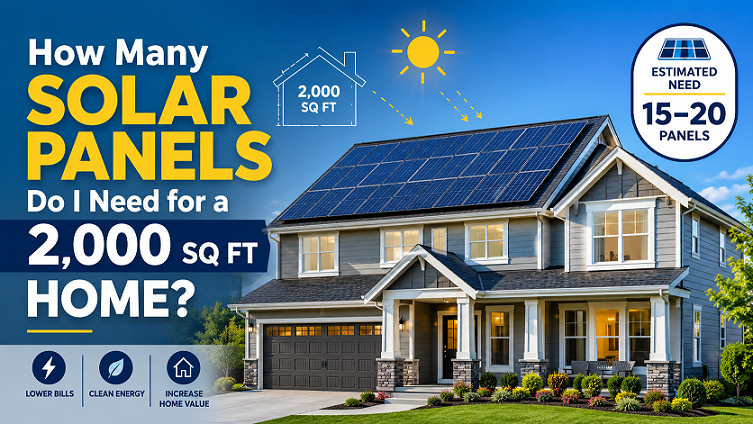
How Many Solar Panels Do I Need for a 2,000 Sq Ft Home? (2026 Guide)
When you first start researching how to transition your home to solar energy, it is incredibly easy to fall into a common mental trap. You grab your phone, look at your home’s floor plan, and type a seemingly simple question into your search engine: “How many solar panels do I need for a 2,000-square-foot home?”
It sounds like a logical starting point, but it actually exposes the single most common mistake homeowners make when planning a solar installation. Your home’s square footage is almost entirely irrelevant to your solar array’s size. Two homes can share an identical 2,000-square-foot footprint yet have completely distinct energy requirements, requiring wildly different solar configurations.
What truly dictates your panel count is a combination of your annual electrical energy consumption, your geographic location, and the specific wattage of the panels you select. As a general benchmark, most 2,000-square-foot homes in the United States require between 15 and 22 solar panels rated at 400 watts each to achieve a full 100% energy offset.
Why does that range exist? How do state-by-state sunlight variations change the math? And more importantly, how can you determine your own precise requirements? In this comprehensive guide, we will break down the exact formulas, explore real-world scenarios, and introduce our interactive sizing tool so you can plan your self-installed solar project with absolute confidence. Plus, with the 30% Federal Residential Clean Energy Tax Credit firmly locked in for 2026, understanding this math right now can save you thousands of dollars in upfront hardware costs.

The Quick Answer: How Many Panels for a 2,000 Sq Ft Home?
If you are looking for a baseline estimate to jumpstart your planning, the sweet spot for a typical 2,000-square-foot property lands right between 15 and 22 premium 400W monocrystalline panels. This array size translates directly to a total system capacity of roughly 6.0 kW to 8.8 kW.
Because energy behavior and climate conditions vary drastically across the country, we have mapped out four distinct residential profiles in the table below to show you where your property might fit:
| Home Profile & Location | Typical Annual Consumption | Estimated 400W Panels Needed | Estimated System Size |
|---|---|---|---|
| Modern & Energy-Efficient: Southwest US (e.g., Arizona, New Mexico) with optimized insulation, LED lighting, and newer appliances. | 7,500 – 9,000 kWh | 15 – 17 panels | 6.0 kW – 6.8 kW |
| Average Consumer: Midwest or Southeast US (e.g., Ohio, Georgia) with standard modern appliances and moderate seasonal HVAC usage. | 10,000 – 11,500 kWh | 17 – 20 panels | 6.8 kW – 8.0 kW |
| Older/Historic Construction: Northeast or Pacific Northwest (e.g., Pennsylvania, Washington) with older insulation, drafts, and reliance on electric baseboard heat. | 12,000 – 14,000 kWh | 19 – 22 panels | 7.6 kW – 8.8 kW |
| High-Demand Property: Any region featuring high-draw luxury loads, such as a heated swimming pool, a hot tub, or daily Level 2 Electric Vehicle (EV) charging. | 14,500 – 18,000 kWh | 22 – 28 panels | 8.8 kW – 11.2 kW |
While these brackets are excellent for initial budgeting, they are still approximations. To contextualize these figures, the U.S. Energy Information Administration (EIA) tracks national residential electricity data closely, noting that the average American household consumes approximately 10,791 kWh of electricity per year—roughly 900 kWh per month. However, your personal lifestyle habits, home design, and geographic latitude are what ultimately transform these national averages into a tailored, functional DIY solar array.

Why Square Footage Doesn’t Tell the Full Story
Relying solely on your home’s square footage to size a solar array is a lot like trying to buy a pair of shoes based entirely on a person’s height. While there might be a loose correlation, you are missing the precise measurements required for a perfect fit.
To see this phenomenon in action, let us look at a real-world comparison of two real estate properties that look identical on paper but have completely different energy footprints:
Example A: The Desert Modernist
A 2,000-square-foot home built in Phoenix, Arizona in 2022. It features double-pane low-E windows, R-60 attic insulation, a high-efficiency variable-speed heat pump, and a family of two who work away from home during the day. Because they live in a hyper-arid climate with abundant sun, and have minimal daytime internal loads, their net electricity consumption hovers around a modest 700 kWh per month.
Example B: The Coastal Heritage Home
A 2,000-square-foot home built in mid-coast Maine in 1985. It houses a family of four, features original wood-frame windows, standard fiberglass insulation that has settled over forty years, a traditional electric resistance water heater, and an active family routine. Between cold regional winters, older heating mechanisms, and higher hot water needs, this household consumes an average of 1,400 kWh per month.
Look at the staggering difference. Both structures encompass exactly 2,000 square feet of living space, yet Example B consumes double the electricity of Example A. If the Maine homeowner installed the same 15-panel system that satisfies the Phoenix home, they would be left with a massive uncovered utility bill. Conversely, if the Phoenix homeowner built an array for the Maine home’s needs, they would overspend on unnecessary hardware.
The Three Pillars of Solar Sizing
To size a system accurately, you must shift your focus away from square footage and concentrate heavily on three core factors:
- Your Total Annual Electricity Usage (kWh): This represents the raw amount of electricity your home demands over a full 365-day cycle.
- Your Local Peak Sun Hours: This does not mean the total time between sunrise and sunset; rather, it measures the duration where solar irradiance averages 1,000 watts per square meter (the intensity needed for panels to produce at full capacity).
- Your Chosen Module Wattage: The rated power output of individual solar panels, which impacts how efficiently you can convert available sunlight into usable household electricity.
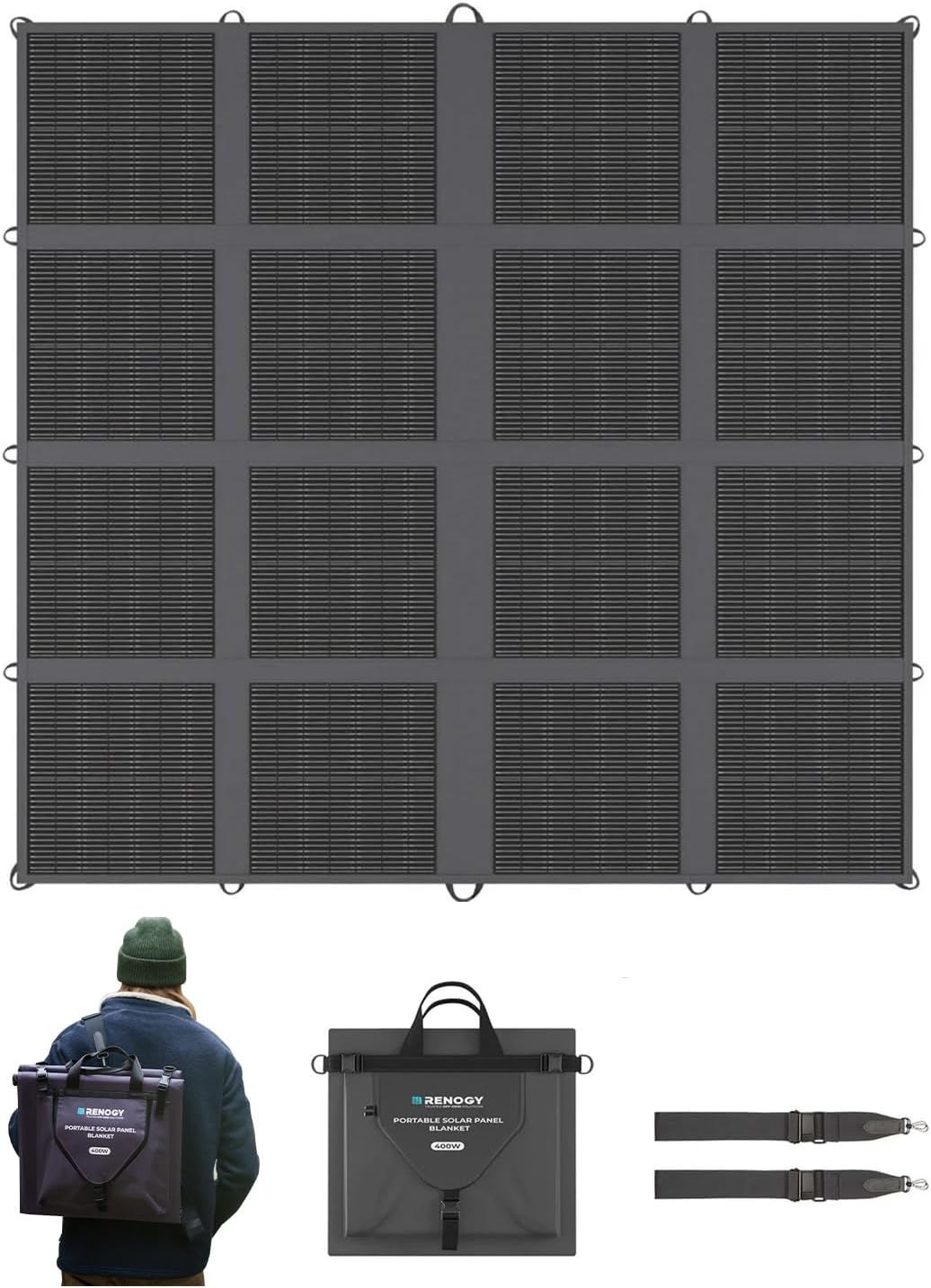
Step-by-Step: How to Calculate Your Exact Panel Count
Sizing your own system might seem like advanced engineering, but it boils down to straightforward math. By following these three structured steps, you can calculate your exact panel count manually before cross-checking it with our automated sizing calculator.
Step 1 — Find Your Annual kWh Usage
To discover your real historical energy usage, avoid looking at just a single month’s bill. Heating demands spike in the winter, and air conditioning surges in the summer. Instead, log in to your online utility account and download your billing statements for the last 12 consecutive months.
Look for a metric labeled “Total Kilowatt-Hours (kWh) Used.” Add these twelve monthly numbers together to get your true annual baseline. If you do not have access to a full year of data, you can look up your general household profile in the reference table below:
| Household Dynamic | Estimated Annual Consumption |
|---|---|
| Minimalist Lifestyle (2 People, Energy-Star Appliances, Gas Cooking) | 7,000 – 8,500 kWh |
| Standard Suburban Home (4 People, Typical Appliance & Electronics Usage) | 10,000 – 11,500 kWh |
| Older Construction (Electric Space Heating, Older HVAC Systems) | 13,000 – 16,000 kWh |
| High-Tech Home (Daily Commuter EV Charging, Variable-Speed Pool Pumps) | 14,000 – 18,000 kWh |
Step 2 — Look Up Your State’s Peak Sun Hours
A peak sun hour is equal to one hour of solar radiation streaming at an intensity of $1,000 \text{ W/m}^2$. Naturally, states closer to the equator or with fewer cloud-heavy weather patterns receive significantly more peak sun hours per day than northern or cloudier states.
For highly precise engineering data, you can consult tools like the National Renewable Energy Laboratory (NREL) PVWatts Calculator. For a streamlined planning baseline, use these reliable state-level daily averages:
| Geographic Region | Average Daily Peak Sun Hours |
|---|---|
| Sun Belt / Desert Southwest: Arizona, New Mexico, Southern Nevada | 6.0 – 6.5 Hours |
| West Coast / Mediterranean: California, Central Nevada, Utah | 5.2 – 6.0 Hours |
| Southern Plains & Gulf: Texas, Florida, Louisiana, Georgia | 4.8 – 5.5 Hours |
| Midwest / Central Plains: Illinois, Ohio, Missouri, Indiana | 4.2 – 4.8 Hours |
| Northeast / Mid-Atlantic: New York, Pennsylvania, Massachusetts | 3.8 – 4.5 Hours |
| Pacific Northwest: Washington, Oregon, Northern Idaho | 3.5 – 4.0 Hours |
Step 3 — Run the Core Sizing Formula
Now that you have gathered your raw consumption and localized environmental data, you can apply the foundational equation used by solar professionals worldwide. Because real-world solar equipment experiences mild efficiency drops due to wiring resistance, inverter heat conversion, and dust accumulation, we integrate a standard system loss factor of **0.85** into our calculation:
Number of panels = Annual kWh ÷ (365 × Peak Sun Hours × Panel Wattage in kW × 0.85)
Let us walk through a complete, real-world example to see exactly how this works out mathematically:
- Home Profile: A 2,000-square-foot home situated in Dallas, Texas.
- Annual Consumption: 10,500 kWh per year (derived from utility statements).
- Local Sun Availability: 5.0 peak sun hours per day.
- Hardware Choice: Premium 400W panels (expressed as 0.40 kW).
First, calculate the total annual energy production expected from just one single kilowatt of installed capacity under the Texas sun, factoring in our system losses:
$$365 \text{ days} \times 5.0 \text{ PSH} \times 0.40 \text{ kW} \times 0.85 = 620.5 \text{ kWh per panel annually}$$
Next, divide the home’s total yearly energy demand by the output of a single panel:
$$\frac{10,500 \text{ kWh}}{620.5 \text{ kWh/panel}} = 16.92 \text{ panels}$$
Since you cannot buy a fraction of a solar module, you round up to the nearest whole integer. This family requires exactly 17 panels to cover their entire power bill.
Let’s run another full example together.
Meet Sarah in Dallas, TX. Her 2,000 sq ft home uses 10,500 kWh per year. Dallas gets 5.0 peak sun hours. She’s looking at 400W panels, which is 0.4 kW.
Math time:
- 365 days × 5.0 sun hours × 0.4 kW × 0.85 = 620.5
- 10,500 ÷ 620.5 = 16.9
Round up. Sarah needs 17 panels.
What if she chose 450W panels instead? 0.45 kW in the formula gives 620.5 × 1.125 = 698. Then 10,500 ÷ 698 = 15.0. She’d only need 15 panels. That’s why wattage matters.
Don’t want to do math? I get it. Use the calculator below.
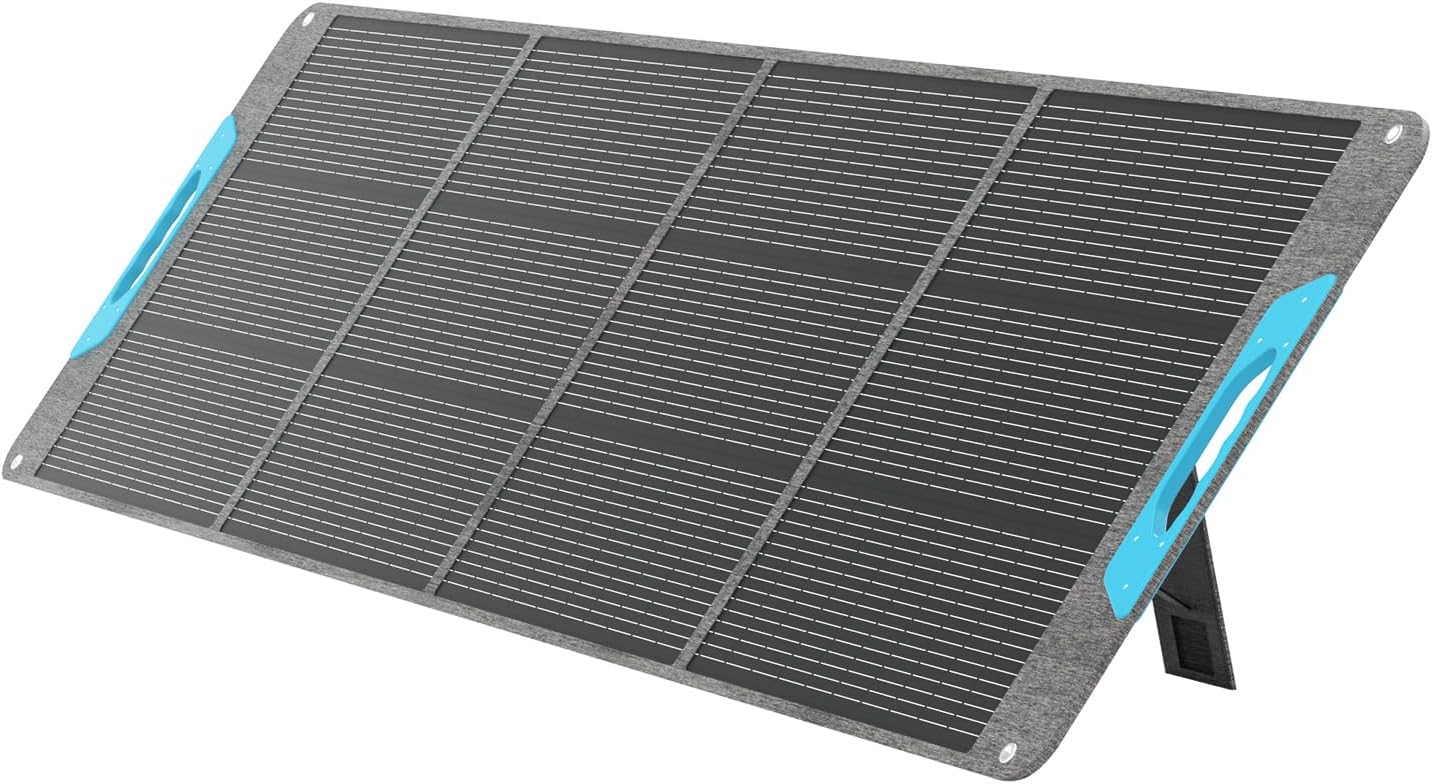
For a detailed breakdown of which charge controller to pair with your system, see our Best Solar Charge Controller for 400W guide .
⚡ Live Solar Panel Sizing Calculator
Skip the manual scratch paper. Use our interactive calculation module to instantly size your optimal DIY solar array based on live geographic parameters.
What Type of Solar Panels Should You Choose?
When selecting your solar hardware, individual panel wattage plays a massive role in determining your system’s overall footprint. If you opt for lower-wattage, budget-oriented panels, you will need a higher physical quantity to hit your energy target. If you pick cutting-edge, high-wattage modules, you can significantly shrink the number of physical panels required on your roof.
The solar market in 2026 offers several primary technologies, each tailored to different project goals, physical spaces, and budgets:
| Panel Category | Average Wattage | Efficiency Rating | Ideal Application |
|---|---|---|---|
| Standard Monocrystalline | 380W – 420W | 20% – 22% | The absolute best choice for standard residential roof installations, balancing high power density with affordable pricing. |
| Premium High-Efficiency (N-Type/TOPCon) | 420W – 480W | 22% – 24% | Perfect for homes with highly constrained roof space or complex architectural roof lines that limit layout options. |
| Budget Polycrystalline | 300W – 360W | 17% – 19% | Best for massive open layouts or ground-mounted configurations where physical square footage is unlimited and upfront costs are primary. |
| Bifacial Solar Modules | 400W – 450W | 21% – 23% | Optimized for high-reflectivity environments, ground-mount racking over gravel/snow, or flat commercial roof installations. |
For DIY builders looking for the perfect middle ground, 400-watt monocrystalline modules represent the industry sweet spot in 2026. They offer incredible performance metrics, extensive warranties from top-tier manufacturers like Qcells, REC, Silfab, and Jinko, and excellent pricing per watt due to massive manufacturing scale.
If you are exploring advanced setups, you might want to look into whether bifacial solar panels are worth the extra cost in 2026, particularly if you are considering a ground mount or have a light-colored metal roof that can catch reflected light on the backside of the modules.
How Much Roof Space Do You Actually Need?
Once you figure out your total panel count, you need to verify if your roof has enough clear, unshaded surface area to accommodate the physical footprint of the array.
A standard 400W residential solar panel measures roughly 65 inches long by 40 inches wide, which works out to about 18 square feet of surface area per module. When you add a bit of spacing for mounting rails and mid-clamps, it is best to budget an even 20 square feet of roof space per panel during your preliminary planning.
Let us see how that space requirement scales based on your total system size:
- 15-Panel Array: Requires approximately 300 square feet of dedicated roof space.
- 20-Panel Array: Requires approximately 400 square feet of dedicated roof space.
- 25-Panel Array: Requires approximately 500 square feet of dedicated roof space.
A standard single-story or two-story 2,000-square-foot home typically has a total roof footprint between 1,000 and 1,500 square feet. At first glance, it looks like you would have plenty of room. However, you cannot just place panels anywhere on a roof. Real-world architectural limits will quickly shrink your usable roof area:
First, local fire codes and building regulations usually demand 1.5-foot to 3-foot safety setbacks along the roof hips, ridges, and valleys so emergency personnel can walk the roof safely. Second, roof space is often cut up by plumbing vents, exhaust hoods, chimneys, and dormers. Finally, if you want your system to produce at peak efficiency, you should place your panels on unshaded, south- or west-facing roof slopes.
If your primary roof face is too small or highly shaded, you still have excellent alternative paths forward. You can utilize high-efficiency panels to generate more power from fewer modules, opt for a clear backyard ground-mount system, or accept a partial energy offset—designing a smaller, 70% system that slashes your bill even if it cannot eliminate it.
How Much Will a 2,000 Sq Ft Home Solar System Cost?
Investing in energy independence requires some upfront capital, but equipment prices have dropped significantly over the last decade. In 2026, the national average gross cost for residential solar equipment sits between $2.80 and $3.20 per watt** installed.
For a typical 2,000-square-foot home requiring a system size anywhere from 6 kW to 10 kW, upfront gross installation costs usually range from $16,800 to $32,000. However, the true out-of-pocket cost drops sharply once you apply the federal incentive program:
| System Total Capacity | Physical Panel Count | Gross Hardware/Install Cost | Net Cost (After 30% Tax Credit) |
|---|---|---|---|
| 6 kW Array | 15 Panels (400W) | $16,800 – $19,200 | $11,760 – $13,440 |
| 7 kW Array | 18 Panels (400W) | $19,600 – $22,400 | $13,720 – $15,680 |
| 8 kW Array | 20 Panels (400W) | $22,400 – $25,600 | $15,680 – $17,920 |
| 10 kW Array | 25 Panels (400W) | $28,000 – $32,000 | $19,600 – $22,400 |
Thanks to the Federal Residential Clean Energy Credit, you can claim a dollar-for-dollar tax credit equal to 30% of your total solar project costs. This credit applies directly to your federal income tax liability, cutting your real net investment considerably. If you plan to manage the installation yourself, learning the ins and outs of the federal solar tax credit in 2026 is essential to ensure you file the right paperwork and maximize your savings.
What can you expect from this investment over the long haul? For a typical system sized for a 2,000-square-foot home, the average payback period runs between 6 and 9 years. Once your system pays for itself, it will generate clean, free electricity for the remainder of its 25-to-30-year operational lifespan, delivering direct monthly utility savings of $80 to $180 depending on your local grid rates. For a complete breakdown of what a DIY system costs at your panel count, see DIY Solar System Cost guide for 2026. to calculate your exact savings and how to claim it on your taxes.
DIY vs. Professional Installation for a 2,000 Sq Ft Home
When looking at ways to make solar more affordable, the choice between handling the installation yourself or hiring a full-service professional installer is often the biggest factor. In typical solar installations, labor, overhead, and corporate marketing costs make up nearly half of your final invoice. By taking the DIY route, you can keep **$5,000 to $10,000** in your pocket.
A self-installed solar project involves sourcing your own main components: the solar modules, structural roof racking, electrical inverters (either a central string inverter or individual microinverters), overcurrent protection devices, and exterior-rated wiring runs. If you consider yourself a handy homeowner who is comfortable working on a roof, measuring structural rafters, and running outdoor conduit, a DIY solar project is a highly achievable, rewarding undertaking.
However, going DIY does not mean you can bypass standard regulations. Even if you buy and mount every piece of hardware yourself, you must still apply for and secure standard electrical and structural building permits from your local city or county authority. Furthermore, you will need to submit a formal interconnection application to your local utility company before hookup. This process ensures your system complies with local grid safety codes and qualifies you for net metering credits.
For a thorough look at the tools, safety gear, and step-by-step structural workflows required to mount your first solar module safely, check out our comprehensive DIY solar panel installation beginner guide for 2026. Once you have a handle on the physical installation steps, you can dive into our technical deep-dive on electrical configuration to learn the performance differences between solar panel wiring in series vs parallel.
.
Frequently Asked Questions
Can solar panels power a whole house?
Yes, solar panels can absolutely power a whole house, provided the system is sized correctly. A properly designed solar array can offset 95% to 100% of your home’s annual electricity usage, allowing you to rely entirely on solar energy during daylight hours and net metering or battery storage at night.
How many solar panels to run a house off-grid?
To run a house completely off-grid, you typically need to add 20% to 30% more solar panels than a standard grid-tied calculation requires. This extra capacity ensures you can generate enough power during consecutive cloudy days while simultaneously charging a dedicated solar battery bank for nighttime use. To understand how to store this extra energy safely, take a look at our guide on how to size a solar battery bank for off-grid living.
How many solar panels do I need for 1,000 kWh per month?
For a home consuming 1,000 kWh per month (12,000 kWh per year) in a location with an average of 5.0 peak sun hours per day, you will need approximately solar panels rated at 400W each to achieve a 100% energy offset.
That’s slightly above average. Let’s run it for 5.0 peak sun hours with 400W panels:
12,000 ÷ (365 × 5.0 × 0.4 × 0.85) = 12,000 ÷ 620.5 = 19.3 panels. Round up to 20 panels.
In a sunny state like Arizona at 6.2 PSH, you’d only need 16 panels. In Washington at 3.6 PSH, you’d need 27 panels. Location matters.
Do I need a battery with my solar system?
If you are installing a standard grid-tied solar system, a battery is not strictly required because the utility grid acts as your backup. However, without a battery, your system will shut down during a power outage for safety reasons. For true off-grid setups, a deep-cycle battery bank is completely essential. If you are comparing storage options, read through our detailed breakdown of LiFePO4 vs AGM batteries for solar to find the best chemistry for your project.
Will solar panels work in cloudy states?
Yes, solar panels work in cloudy states. While cloud cover reduces a solar panel’s output to about 20% to 50% of its maximum capacity, regions like the Pacific Northwest still benefit immensely from solar installations due to high local electricity rates and long summer days.
Conclusion
Figuring out how many solar panels you need for a 2,000-square-foot home ultimately comes down to knowing your personal energy usage and your local weather patterns. While the national average points to a system size of 15 to 22 panels (400W each), your custom DIY setup should be built around your historical electrical consumption and your specific geographic location.
By moving past simple square footage estimates and calculating your actual energy demands, you can build a highly efficient system that maximizes your long-term return on investment. Take a look at your recent utility statements, run your location data through our sizing tool, and take full advantage of the 30% federal tax credit while planning your project.
Ready to start your DIY solar project? Read our complete step-by-step installation guide → DIY Solar Panel Installation: Complete Beginner Guide 2026
Affiliate Disclosure: This article contains affiliate links. We may earn a commission if you purchase through links on our site, at no extra cost to you. We only recommend products we’ve tested.
7 thoughts on “How Many Solar Panels Do I Need for a 2,000 Sq Ft Home?”