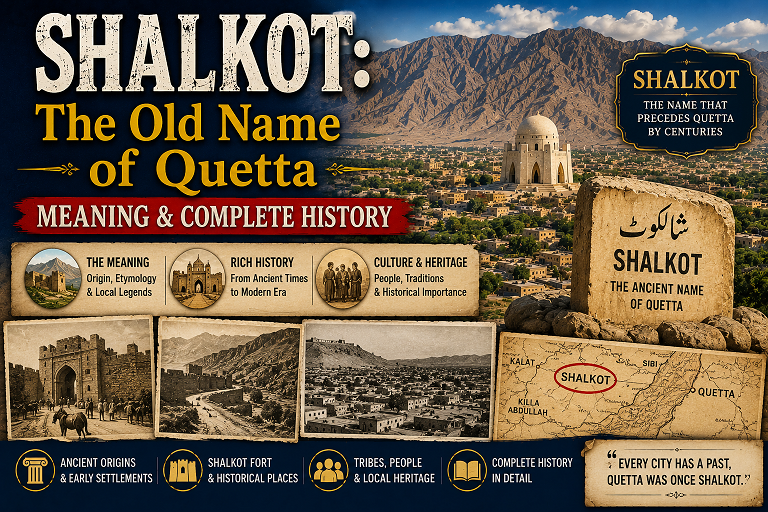
Shalkot is a historical name associated with present-day Quetta. Older sources also use Shal or Shawl for the valley and settlement. “Kot” commonly means a fort or fortified place in South Asian place names, while “Quetta” is generally linked with a Pashto form such as kwatta/kota, also carrying the sense of a fort or enclosed place. Spellings changed as local names were written in Persian, Urdu and English.
The name Shalkot is more than a curiosity. It connects modern Quetta with an older valley settlement, agricultural communities, karez irrigation, trade routes and a fort-centred urban landscape that existed before the large colonial cantonment and railway city.
It is also the reason this website is called Shalkot.com. The name reflects a local identity and a commitment to useful information about Quetta and Balochistan. That does not mean every historical source used the exact modern spelling “Shalkot,” or that one simple translation settles every linguistic question.
- Shal, Shawl, Shalkot and Quetta
- What the names may mean
- Early historical references
- People, land and karez systems
- The fort and old settlement
- How colonial development changed Quetta
- The 1935 earthquake and rebuilt city
- Why Shalkot still matters
- How to research family and property history
- Frequently asked questions
Historical forms used for the valley and older settlement in several sources.
A name combining Shal with “kot,” commonly understood as fort or fortified place.
The modern name, usually connected with a Pashto term referring to a fort.

Shal, Shawl, Shalkot and Quetta: are they the same place?
They refer to overlapping historical geography, but context matters. Shal can refer to the valley or older territorial area. English colonial documents may spell it Shawl. Shalkot identifies the settlement or fortified place of Shal in later and popular usage. Quetta became the dominant modern official name as the city expanded.
Old place names rarely move through history as perfectly fixed labels. A name spoken locally is written by administrators, travellers and mapmakers who hear different sounds and follow different spelling systems. Quetta itself appears in historical English materials with variant spellings.
| Name | Common context | Editorial caution |
|---|---|---|
| Shal | The valley, locality or older regional name | Do not assume every use refers to the exact modern municipal boundary. |
| Shawl | English transliteration of Shal in older texts | It is not necessarily related to the English garment “shawl.” |
| Shalkot | Historical/popular name for the fortified settlement of Shal | Spellings may include spacing or transliteration variations. |
| Quetta | Modern city and administrative name | Modern district boundaries have changed, most recently in 2026. |
What does Shalkot mean?
The second element, kot, is widely used across South Asian place names for a fort, fortified settlement or enclosed stronghold. That makes “fort of Shal” or “fortified place of Shal” a reasonable working explanation for Shalkot.
The origin of Shal is less safely reduced to one translation. Popular explanations circulate online, but they often provide no early text, linguistic method or source. It is better to acknowledge uncertainty than invent a confident meaning.
The name Quetta is commonly connected with a Pashto word rendered in English as kwatta, kota or a related form meaning a fort or fortified place. This fits the old settlement’s defensive geography and its association with a mud-walled fort. However, pronunciation and transliteration differ by language and dialect.
The safest one-line explanation
Shalkot was a historical name of Quetta, built from the older name Shal and “kot,” meaning a fort or fortified settlement; Quetta’s modern name is also generally linked with a Pashto word for a fort.
Early history of the Shal valley
The Quetta–Pishin region stood on routes connecting Kandahar, the Bolan corridor, Kalat and the wider northwestern subcontinent. Control and influence changed across centuries. Historical summaries associate the region with Ghaznavid, Ghurid, Mongol, Timurid/Arghun, Mughal, Safavid, Afghan and Kalat-linked political histories, but a simple list of dynasties can hide how local landholding and daily life continued.
The Ain-i-Akbari is often cited for mentioning Shal and Pishin in the Mughal administrative world. Later records describe changing relations among Afghan rulers, the Khanate of Kalat, local tribal authorities and eventually British power. Terms such as “ruled,” “held,” “granted” and “leased” can refer to different kinds of sovereignty, revenue or administration; they should not automatically be read as proof that all private land changed ownership.
The 1907 Quetta–Pishin District Gazetteer remains an important public-domain source. Like every colonial document, it reflects the categories and interests of its authors. It should be compared with local oral histories, Persian/Urdu records, archaeological evidence and later scholarship rather than treated as a neutral final word.
Communities, orchards and karez irrigation
The older Shal valley depended on land and water. Historical records commonly identify the Kasi/Kansi community as important cultivators and proprietors in the valley, while other Pashtun, Baloch, Brahui and mobile communities formed part of the wider regional history. Modern Quetta is far more diverse, and historical landholding should not be simplified into a claim about the identity of every present resident.
Karez systems carried groundwater through gently sloping underground channels, supporting settlement and agriculture in an arid environment. Constructing and maintaining a karez required knowledge, labour and rules for sharing water. Roads, urban expansion, groundwater pumping and drought later altered many traditional systems.
Quetta’s reputation for fruit and dry fruits grows from this valley-and-orchard history. Apples, grapes, almonds and other produce are associated with Quetta and northern Balochistan, though not every product sold in a city market is grown inside modern Quetta boundaries.
Miri Fort and the old fortified settlement
Accounts of early nineteenth-century Quetta describe a mud-walled fort with a relatively small settlement around it. The Miri or Miri Qila is central to explanations of Quetta as a fortified place. Its commanding position and the mountain-enclosed valley help explain why “fort” appears in discussions of both Shalkot and Quetta.

The visible fort landscape has changed through military use, rebuilding and modern city development. Visitors should not assume unrestricted public access or photography. Confirm current rules, avoid photographing sensitive installations and do not enter restricted areas for a historical image.
From Shalkot settlement to colonial Quetta
British strategic interest grew because of Quetta’s position near routes toward Afghanistan. During the nineteenth century, military occupation and political arrangements with the Khan of Kalat led to effective British administration. In 1883, Quetta and related areas were organised into a more formal administrative charge under a lease arrangement.
The British developed a cantonment, civil station, roads, railway connections and administrative buildings. This did not create the settlement from nothing; it transformed an existing valley community into a rapidly expanding frontier city. The distinction matters because phrases such as “Quetta was established in 1876” can refer to a colonial administrative phase, not the first human settlement in Shal.
Railway and military growth attracted workers, traders, officials and families from many regions. The city’s population, languages and built form changed. “Quetta” became increasingly dominant in official maps and institutions, while Shal/Shalkot continued in historical memory and local usage.

The 1935 earthquake and the rebuilt city
The devastating earthquake of 31 May 1935 destroyed much of Quetta and killed tens of thousands across the affected region. Reconstruction altered streets, buildings and planning rules, further separating the visible modern city from the older built environment.
Yet place memory survived. Families retained neighbourhood histories, land records, photographs and stories. For a full evidence-based account, read Shalkot’s 1935 Quetta earthquake guide, which explains why magnitude and casualty figures appear as ranges.
Why the name Shalkot still matters
A historical name can carry belonging without rejecting the modern one. Quetta is the legal and internationally recognised city name; Shalkot connects residents with older geography and memory. Both can be used accurately when the context is clear.
For this website, Shalkot is a commitment to local focus: Quetta services, Balochistan travel, history, education, transport, food and practical information. It should not become a pretext for publishing unrelated international topics merely because the domain has accumulated them.
Businesses may use Shalkot in a hotel, restaurant, housing, tour or product name. The historical word does not prove official endorsement, age or authenticity. Before paying for a “Shalkot heritage tour,” old-map print, antique or property service, verify the provider, item provenance, total price and refund terms.
Researching old Quetta family, land and building history
- Start with names and dates: record spelling variants, neighbourhoods, occupations and family relationships.
- Use primary records: seek revenue documents, municipal files, maps, directories, photographs, newspapers and cemetery records where lawfully accessible.
- Compare editions: a gazetteer, census and map may cover different boundaries and years.
- Preserve oral history: record elders with consent, but label memories as testimony rather than verified statistics.
- Digitise carefully: scan both sides, retain captions and file provenance, and store backups.
- Respect privacy: do not publish living people’s identity documents, addresses or disputed ownership claims.
For land, an old map or family story cannot replace the current certified revenue record. Quetta’s July 2026 division into Quetta East and Quetta West also means older district labels may no longer describe the responsible office. Use an independent lawyer and qualified surveyor for high-value property questions.
Beware of “antique” claims
A seller’s statement that a map, photograph, coin or document is “original Shalkot history” is not proof. Ask about provenance, material, date, reproduction status and return terms. Do not export protected cultural property without checking applicable law.
How to read historical spellings without getting confused
People researching Quetta often assume that every different spelling must identify a different settlement. Historical records are rarely that tidy. A British officer, Persian-language clerk, Pashto speaker, Balochi speaker and modern English editor could hear the same local name and write it differently. Transliteration standards also changed over time. This is why Shal, Shawl and related forms can appear in maps, gazetteers and travel accounts without proving that the valley repeatedly changed its name.
Context is more reliable than spelling alone. Check whether a document is describing the valley, the fortified settlement, a military station, a district or the expanding municipality. Also note its publication date and original language. A map labelled “Quetta” may focus on the cantonment, while a local narrative using “Shalkot” may emphasise the older inhabited landscape. Both can be historically useful, but they answer different questions.
A practical source-checking method
- Record the exact form: copy the spelling as printed instead of silently modernising it.
- Identify the place type: determine whether the name refers to a valley, fort, village, city or administrative unit.
- Compare dates: a contemporary record generally provides stronger evidence for its own period than a recent unsourced blog.
- Use two independent sources: compare an official gazetteer or map with a local history, archive photograph or scholarly work.
- Separate evidence from tradition: oral history preserves valuable community memory, but uncertain etymologies should be presented as interpretations rather than settled facts.
This method is especially important when buying an old map, commissioning a family-history search or paying for a property-record investigation in Quetta. Before spending money, ask the seller or researcher for the document title, date, archive reference and a sample image. A decorative reproduction may be attractive, but it is not automatically reliable historical evidence.
Frequently asked questions
What was the old name of Quetta?
Shalkot is widely recognised as a historical name, while older sources also use Shal or Shawl for the valley and settlement.
What does Shalkot mean?
It is commonly explained as the fort or fortified settlement of Shal because “kot” often means fort. The origin of “Shal” itself is less certain.
What does Quetta mean?
The name is generally linked with a Pashto form such as kwatta or kota meaning a fort or fortified place. English spellings vary.
Is Shalkot still an official city name?
Quetta is the modern official city name. Shalkot survives as a historical, cultural and commercial name.
Was Quetta founded by the British?
No. An older settlement already existed in the Shal valley. British rule transformed it into a larger cantonment, railway and administrative city.
Where was old Shalkot located?
It was associated with the older fortified settlement in the Quetta/Shal valley. Modern metropolitan boundaries are much larger and should not be projected backward unchanged.
Why is this website named Shalkot?
The name reflects Quetta’s historical identity and the website’s focus on useful local Quetta and Balochistan information.
Related Shalkot guides
Bottom line
Shalkot is a historically meaningful name for Quetta, rooted in the older Shal valley and its fortified settlement. Shal, Shawl, Shalkot and Quetta appear in different languages, periods and administrative contexts, so they should not be forced into one oversimplified spelling story.
The modern city grew through local agriculture, trade, political change, colonial development, migration, earthquake reconstruction and post-1947 expansion. Remembering Shalkot restores the older settlement to that longer history.
3 thoughts on “Shalkot: The Old Name of Quetta—Meaning & Complete History”