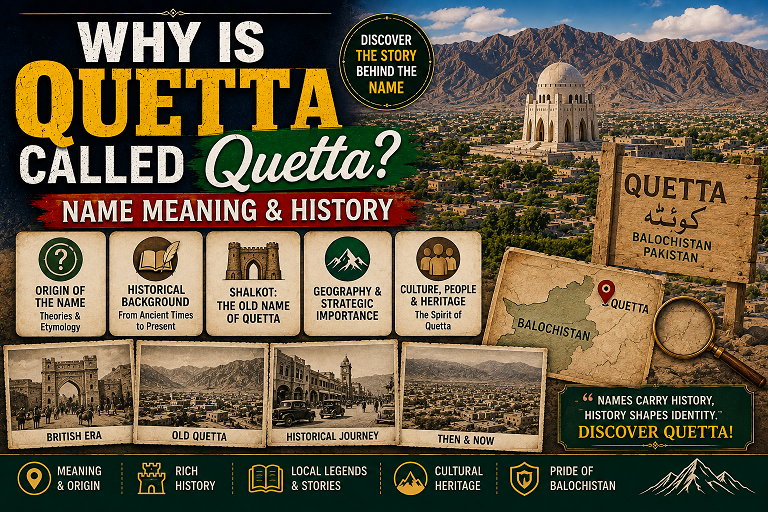
Quetta is called Quetta because its name comes from a Pashto word commonly transliterated as Kwatta, meaning a fort or fortified place. The 1907 Quetta–Pishin District Gazetteer says that Kwatta—now spelled Quetta—was the name given to the fort within whose walls the old town stood. The surrounding mountains reinforce Quetta’s fortress-like appearance, but the historical record connects the name directly with the old fort.
Quetta’s name looks simple, yet it opens a much larger story about language, geography and the development of Balochistan’s capital. Online explanations often reduce that story to one sentence: “Quetta means fort.” That answer is broadly correct, but it leaves out the old settlement, its historic name Shal or Shalkot, the Miri fort, and the way Pashto words were converted into English spellings.
This guide separates documented evidence from popular interpretation. It also explains why “Quetta,” “Kwatta,” “Kuwatah,” “Shal,” “Shawl” and “Shalkot” can all appear in discussions of the same valley without every term having exactly the same historical function.
Kwatta is recorded as a Pashto word referring to a fort.
The name was associated with the fort enclosing the old town.
Quetta became the established English and official form.

What does the name Quetta mean?
The safest concise meaning is fort or fortified place. Historical English sources render the relevant Pashto form in several ways, including Kwatta. Modern writers may also use spellings such as Kota or Kuwatah when trying to represent local pronunciation in Latin letters.
A place name is not always a dictionary label applied to an entire modern city. In this case, the old word was linked to a particular fort and the settlement within or around its walls. As that settlement expanded and gained administrative importance, the name came to represent the larger town and ultimately the metropolitan city known today.
This distinction matters. Saying “Quetta means fort” does not imply that the modern city is literally one fort, nor does it prove that the surrounding mountains alone produced the name. It means that the city’s established name grew from the fortified core of an older settlement.
Pronunciation and spelling note
Pashto, Urdu, Persian and English do not represent every sound in the same way. Kwatta, Kuwatah and Quetta can therefore be attempts to write a related spoken name rather than evidence of three unrelated places.
What does the historical Gazetteer say?
The Quetta–Pishin District Gazetteer of 1907 is one of the most useful historical references for this question. In its discussion of the district name, it states that Kwatta, now spelled Quetta, means a fort in Pashtu and was the name given to the fort within whose walls the old town was situated.
That statement is valuable because it records both the linguistic meaning and the physical place to which the word referred. It is stronger evidence than a modern travel page repeating an unattributed story. The Gazetteer is still a colonial-era document, however, and should be read critically alongside local histories, linguistic knowledge, maps and other records.
The volume was compiled in the early twentieth century from administrative material and local information. Its spelling conventions reflect its period. Readers should not assume that “Pashtu” in the old text and “Pashto” in modern English indicate different languages; they are alternative English spellings.
| Claim | Evidence level | How to present it |
|---|---|---|
| Quetta comes from Kwatta | Recorded in the 1907 Gazetteer | Present as the principal historical explanation. |
| Kwatta means a fort | Explicitly stated in the Gazetteer | Use “fort” or “fortified place” in plain English. |
| The name referred to the old town’s fort | Explicitly stated in the Gazetteer | Connect the name with the fortified settlement. |
| Four mountains independently created the name | Popular geographical interpretation | Do not present as the only proven etymology. |
How did Kwatta become Quetta?
Quetta did not necessarily “change” from Kwatta in one official ceremony. The difference largely reflects transliteration: turning a spoken or written word from one language system into English letters. Nineteenth- and early-twentieth-century surveyors, soldiers, administrators and mapmakers often standardised local names for reports, postal services, railways and maps.
English spelling also tends to become fixed once a place appears repeatedly in official correspondence and printed cartography. “Quetta” ultimately became the familiar form used for the city, cantonment, railway station, district and later the provincial capital. Local pronunciation naturally remained more varied than official English paperwork.
The letters “Qu” should therefore not be used to invent a Latin or European origin. They are part of the conventional English spelling. The underlying explanation remains connected to the regional word for a fort.

Was Quetta named because four mountains form a natural fort?
A widely repeated explanation says that Quetta’s surrounding mountains form a natural fortress. The Balochistan High Court’s district history page mentions both the fortress meaning and the belief that the four imposing hills surrounding the city create a natural bulwark.
The valley is indeed encircled by major ranges and peaks commonly identified with Chiltan, Takatu, Zarghoon and Murdar. To a traveller entering the basin, the mountains can make the city appear enclosed and defensible. This geography helps explain why the fortress idea feels convincing and why the location had strategic value.
Still, geography should support rather than replace the more specific Gazetteer evidence. The old source says the name was given to the fort within whose walls the town stood. A careful article can therefore say that Quetta’s mountainous setting reinforces its fortress character, while the documented name origin points to the actual fortified settlement.
Avoid the “four” myth
Some unsourced posts try to connect “Quetta” with the English word “four” because four mountains are named. There is no sound linguistic basis for that claim. The number of surrounding peaks and the meaning of Kwatta are separate questions.
The old fort, Miri Qila and the early town
The old town developed around a fortified nucleus. Miri Qila—also written as Miri Fort or Quetta Fort—is an important physical reminder of this landscape. Forts were not merely military monuments. They could protect authority, stores, routes and nearby residents, while markets, houses, cultivated land and irrigation systems extended beyond their immediate walls.
It is tempting to imagine one unchanged fort surviving from the first use of the name until today. The historical site, however, passed through rebuilding, political change, military use and urban transformation. Photographs of a later structure should not automatically be labelled as the exact original form that generated the place name.
The broader valley was sustained by communities, orchards and karez irrigation long before modern pipelines and road networks. Quetta’s history is therefore not only the story of a fort. The fort supplied a durable name, but everyday settlement depended on water management, cultivation, trade and connections with neighbouring valleys.

How are Quetta, Shal and Shalkot connected?
Shal—also written as Shawl in older English texts—was associated with the valley and older locality. Shalkot is commonly understood as the fortified place or fort of Shal because kot is widely used for a fort or fortified settlement in regional place names. Quetta came from the related fortress idea expressed through the Pashto form Kwatta.
These names overlap, but they should not be forced into a simplistic sequence in which a whole city woke up one day with a new name. Different communities and documents could use names for the valley, old town, fort, cantonment or administrative district at overlapping times.
For a fuller discussion, read our separate guide to Shalkot as the historical name of Quetta. Keeping the two articles distinct helps searchers: this page answers why the modern city is called Quetta, while the other examines the older Shal and Shalkot identity in greater depth.
How Quetta became the dominant city name
During the late nineteenth century, British strategic interest transformed the settlement into a major cantonment and administrative centre. Roads, rail connections, military facilities, offices and planned neighbourhoods expanded the urban footprint. As “Quetta” appeared on official maps, railway timetables, postal systems and government records, it became the dominant English name.
The catastrophic earthquake of 31 May 1935 destroyed much of the city and killed many thousands of people. Reconstruction changed the built environment again, but the name Quetta remained. After Pakistan’s independence in 1947 and the development of Balochistan’s provincial administration, Quetta became firmly established as the capital’s official name.
Modern Quetta is vastly larger and more diverse than the old walled settlement. Its name now represents a provincial capital, education and healthcare centre, military city, trade hub and home to communities speaking Pashto, Brahui, Balochi, Urdu, Persian varieties and other languages. Historical meaning remains important, but it does not limit the identity of present residents.
What does the name Quetta represent today?
For residents, Quetta is not simply a translated word. It represents neighbourhoods, markets, educational institutions, orchards, cuisine, sport, migration and shared memories. The older fortress association survives in history, while the modern name carries a much broader civic identity.
Shalkot also remains visible in business names, cultural references and local conversation. A company using “Shalkot” or “Quetta heritage” in its name is not automatically old, government-approved or historically authentic. Names can be meaningful branding, but customers should still verify registration, reviews, prices and terms before making a booking or purchase.
This is especially relevant for a Quetta heritage tour, local guide, hotel booking, antique map, history book or property research service. Ask what is included, whether transport and entry fees are separate, and whether historical claims are sourced. Never pay a large advance merely because a provider uses a trusted local name.
How to explore Quetta’s name and history responsibly
- Begin with primary sources: consult the 1907 Gazetteer scan and compare its wording with later histories.
- Study maps by date: boundaries, road names and built-up areas changed considerably, especially after 1935.
- Check image licences: an old photograph being online does not automatically make it free for commercial reproduction.
- Use a knowledgeable local guide: confirm credentials, total tour price, transport arrangement and cancellation conditions.
- Respect restricted sites: some historic or military areas may not be open for casual photography or entry.
- Preserve oral histories: record elders with consent and distinguish personal memory from verified archival fact.
If you plan to buy an old Quetta map or photograph, request a high-resolution sample, the creator or publisher, approximate date, dimensions, condition and reproduction status. For property or inheritance matters, historical maps are contextual material—not a substitute for current certified revenue records, legal advice and a qualified survey.
Frequently asked questions
Why is Quetta called Quetta?
The name comes from Kwatta, recorded as a Pashto word meaning a fort. The 1907 district Gazetteer connects it specifically with the fort inside which the old town stood.
Does Quetta mean fort?
Yes. “Fort” or “fortified place” is the accepted concise meaning, although English transliterations of the original form vary.
What was Quetta’s old name?
Shal, Shawl and Shalkot are historical forms associated with the valley and older settlement. Their use depended on language, period and context.
Is Quetta named after four mountains?
The surrounding mountains create a natural fortress and support the imagery, but the documented explanation links the name to Kwatta and the old town’s actual fort—not to the English number four.
Which mountains surround Quetta?
Chiltan, Takatu, Zarghoon and Murdar are commonly named in descriptions of Quetta’s mountainous enclosure. The valley also connects with a wider and more complex mountain landscape.
Is Miri Fort the reason for Quetta’s name?
The name is historically connected with the fortified old settlement. Miri Qila represents that fort-centred past, although surviving structures have changed and should not be assumed to preserve the earliest fort unchanged.
Is Shalkot still Quetta’s official name?
No. Quetta is the official modern name. Shalkot remains a historical and cultural name used by local organisations, businesses and residents.
Related Shalkot guides
Bottom line
Quetta is called Quetta because the name developed from Kwatta, a Pashto term recorded as meaning a fort. The strongest historical account says it named the fort within whose walls the old town stood. Quetta’s enclosing mountains make the fortress description visually appropriate, but they are supporting geography rather than a replacement for the documented etymology.
The name survived colonial expansion, railway development, the 1935 earthquake, reconstruction and the city’s growth into Balochistan’s capital. Understanding it properly means respecting both the old fortified settlement and the multilingual communities that shaped modern Quetta.