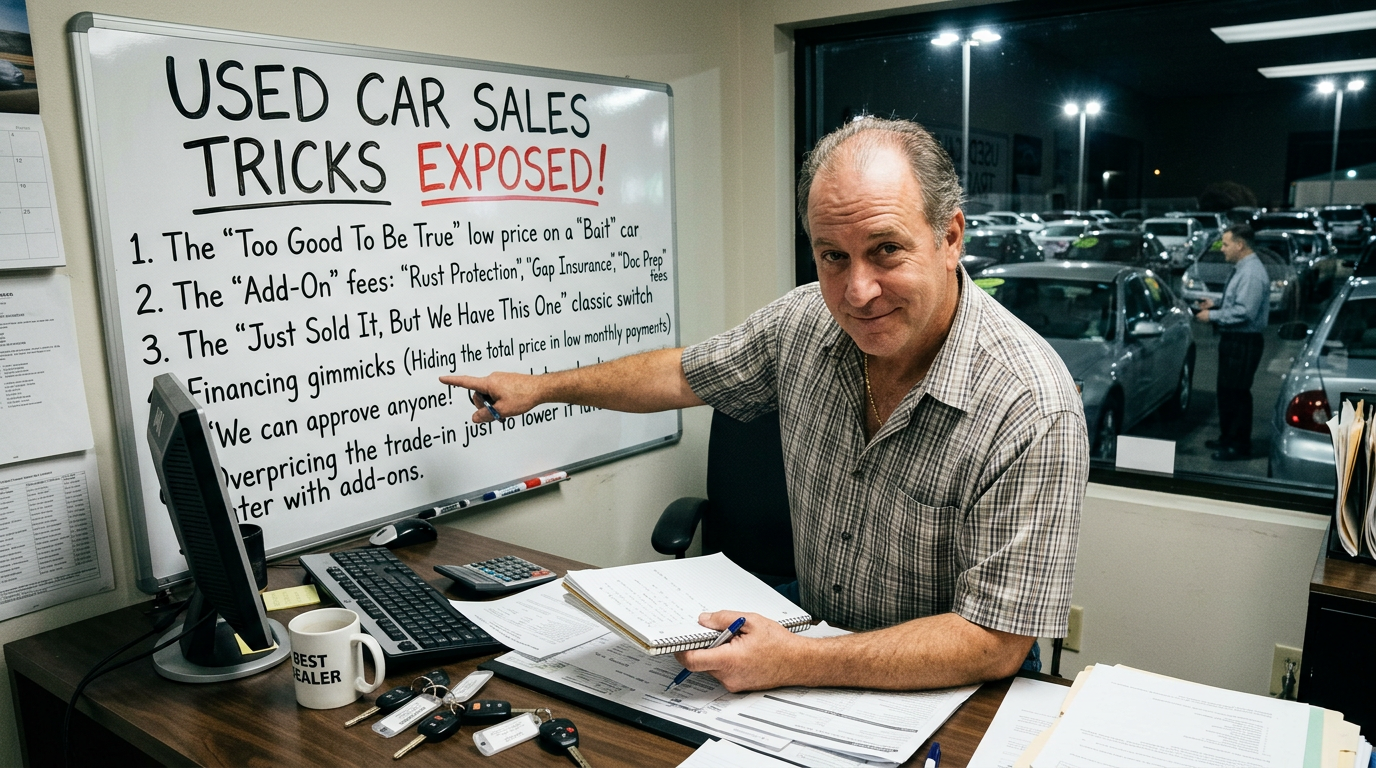
Used Car Dealer Sales Tricks Exposed: How Dealerships Rip You Off & How to Win
Walking onto a used car lot without proper preparation is like sitting down at a poker table full of professional card sharps. The average car buyer purchases a vehicle once every five to seven years; sales managers and Finance & Insurance (F&I) representatives close five to ten deals every single day. They are master negotiators trained in behavioral psychology, high-pressure persuasion tactics, and mathematical sleight of hand.
If you have ever walked out of a dealership feeling like you got a decent monthly payment, only to realize later that you paid $4,000 more than the vehicle’s market value, you were the victim of classic dealership sales tricks. In this breakdown, we pull back the curtain on the auto industry. From the infamous “Four-Square” sheet to sneaky financing markups, fake dealer fees, and title-washing schemes, here is every dirty trick used car dealers play—and the exact scripts you need to protect your hard-earned money.
Table of Contents
- 1. The “Monthly Payment” Trap: Mathematical Sleight of Hand
- 2. The Infamous “Four-Square” Worksheet Decoded
- 3. Phantom Add-Ons & Junk Fees: The $2,500 Inflation
- 4. The F&I Room Ambush: Extended Warranties & GAP Insurance
- 5. Interest Rate Markup: The Dealer’s Secret Profit Center
- 6. “Yo-Yo” Financing & Spot Delivery Scams
- 7. Trade-In Lowballing & The “Key Hostage” Tactic
- 8. Title Washing, Odometer Rollbacks & Hidden Accidents
- 9. Legitimate vs. Fake Dealership Fees Comparison Matrix
- 10. The Ultimate Counter-Strategy: How to Buy Like a Pro
- 11. Frequently Asked Questions (FAQs)
1. The “Monthly Payment” Trap: Mathematical Sleight of Hand
The moment you step onto a car lot, the salesperson will invariably ask one friendly, innocent-sounding question: “What kind of monthly payment are you looking to stay under today?”
If you answer this question, you have already lost the negotiation.
Shifting the conversation toward a monthly payment allows the salesperson to hide the actual purchase price of the vehicle. If you state that you can afford $400 a month, the sales team won’t try to get you a $20,000 car for a fair price. Instead, they will put you in a $26,000 car, stretch your loan term from 48 months to 72 or 84 months, tack on thousands in interest, and pack the contract with high-margin add-ons. You get your $400 payment, but you end up paying $8,000 more over the life of the loan.
The Rule: Never discuss monthly payments. Negotiate one thing and one thing only: the total Out-The-Door (OTD) Price. Tell the salesperson: “We can discuss financing terms once we agree on the total vehicle price including taxes and fees.”
2. The Infamous “Four-Square” Worksheet Decoded
If you negotiate in person, the salesperson will eventually pull out a single sheet of paper divided into four quadrants. This is the dreaded Four-Square Sheet, a psychological tool designed to confuse buyers by mixing four distinct financial variables:
- Box 1: Purchase Price (The price of the used car)
- Box 2: Trade-In Value (What they offer for your old car)
- Box 3: Down Payment (How much cash you put upfront)
- Box 4: Monthly Payment (The calculated loan installment)
How the Manipulation Works
If you complain that the purchase price in Box 1 is too high, the salesperson will cross out a number, walk to the sales manager’s desk, come back, and magically drop your monthly payment in Box 4 by $30. What they didn’t show you is that they quietly lowered your trade-in allowance in Box 2 or increased your loan term by 12 months. They are simply moving your own money from one corner of the paper to another while making you feel like you won a concession.
How to Neutralize the Four-Square
If a salesperson brings out a Four-Square sheet, refuse to play. Draw a single straight line across the paper or state clearly: “I do not negotiate using four-squares. Please bring me an itemized price quote showing the vehicle price, line-item fees, and total out-the-door cost.”
3. Phantom Add-Ons & Junk Fees: The $2,500 Inflation
You’ve negotiated the price down to $18,000. You feel great. Then you sit down to look at the preliminary sales order, and the price is suddenly $21,300. Welcome to the world of mandatory dealer junk fees.
Used car dealers love to pre-install low-cost protection packages on every vehicle on the lot and then force buyers to pay wildly inflated prices for them. Common phantom add-ons include:
- VIN Etching ($299 – $499): Etching the Vehicle Identification Number onto the windows to “deter theft.” You can buy a DIY kit on Amazon for $20.
- Nitrogen-Filled Tires ($199 – $399): Air is already 78% nitrogen. Green tire valve caps do not justify a $300 charge.
- Fabric & Paint Protection ($500 – $1,200): A $15 bottle of Scotchgard or basic spray wax applied by a detail boy making minimum wage.
- Dealer Prep / Reconditioning Fee ($800 – $1,500): Dealers often claim this covers the cost of washing the car and inspecting it. Preparing a vehicle for sale is a standard cost of doing business; it should never be passed to the buyer as a separate fee.
- Doc Fee (Documentation Fee): While every dealer charges a doc fee to handle title paperwork, some states do not cap it. In states like Florida or New Jersey, doc fees can reach an outrageous $800 to $1,100.
4. The F&I Room Ambush: Extended Warranties & GAP Insurance
The salesperson hands you off to the Finance and Insurance (F&I) Manager. Many buyers assume this person is just a back-office clerk filling out loan paperwork. In reality, the F&I manager is often the highest-paid salesperson at the dealership. This room is where the dealership makes up to 60% of its net profit.
The Menu Selling Technique
The F&I manager will slide a printed menu across the desk offering “Platinum, Gold, and Silver Protection Packages.” They will frame it around peace of mind: “With all the electronics in modern cars, one transmission glitch can cost $5,000. For just $35 more a month, you’re fully covered.”
What they don’t tell you:
- Extended Service Contracts (Warranties): A $3,000 extended warranty sold in the F&I office often costs the dealer only $600 to $800. The rest is pure profit. Furthermore, many third-party used car warranties contain strict exclusion clauses that deny coverage for common engine repairs.
- GAP Insurance ($800 – $1,200): Guaranteed Asset Protection covers the difference between what your insurance company pays and what you owe on your loan if the car is totaled. While GAP is vital for low-down-payment buyers, your auto insurance provider or local credit union usually sells the exact same GAP coverage for a one-time fee of $200–$300 or a few dollars a month.
5. Interest Rate Markup: The Dealer’s Secret Profit Center
When you finance a used car through a dealership, the dealer acts as a broker between you and various lenders (banks, credit unions, finance companies). They submit your credit profile and receive a Buy Rate—for example, 5.5% APR.
However, the dealer is not legally required to pass that 5.5% rate on to you. Instead, the F&I manager will mark up the rate by 1% to 2.5%, presenting you with a “Contract Rate” of 7.5% or 8.0%. They keep the interest rate markup difference as a cash kickback from the lender. Over a 60-month loan, a 2% interest rate markup on a $25,000 used car costs you over $1,400 in unnecessary interest.
How to Prevent Financing Markups
Always secure a pre-approved auto loan from your local credit union or bank before setting foot on a dealer’s lot. A pre-approval gives you a baseline benchmark interest rate. Tell the dealer: “I am pre-approved at 5.2% through my credit union. If you can beat that rate through your lenders without altering the purchase price, I’ll finance with you. Otherwise, we’ll use my bank.”
6. “Yo-Yo” Financing & Spot Delivery Scams
This is one of the most predatory used car scams in existence. You sign the paperwork on a Saturday afternoon, put down a small down payment, hand over your trade-in, and drive home in your new used car under a “spot delivery” agreement.
Fourteen days later, the finance manager calls you in a panic: “We have bad news. The lender rejected your financing rate. You need to come back immediately to sign a new contract, or we’ll have to repossess the car.”
The Trap Sprung
When you arrive, they inform you that your new interest rate is 6% higher, requiring an additional $1,500 down payment. When you demand your trade-in car back so you can walk away from the deal, they inform you with a smile that your trade-in has already been sold at auction. You are trapped.
Defense Strategy: Never take possession of a vehicle under a conditional or temporary approval. Do not drive off the lot until the financing contract is 100% finalized, fully funded, and signed by all parties.
7. Trade-In Lowballing & The “Key Hostage” Tactic
Used cars are the primary driver of dealer profits, and getting your trade-in cheap is key to their model. When you bring your old car in, the appraiser will deliberately point out minor scratches, worn tires, or squeaky brakes, claiming: “We’re going to have to spend $2,000 reconditioning this before we can put it on the lot.” They then offer you thousands less than its actual wholesale value.
Holding Your Keys Hostage
To keep you from leaving during negotiations, the salesperson will ask for your current vehicle’s keys so their appraiser can inspect it. If negotiations stall and you decide to walk away, suddenly the appraiser is “on a test drive” or the keys are “misplaced in the back office.” This keeps you stranded on the lot while managers take turns trying to close you.
Pro Tip: Hold your ground. If a dealer refuses to return your keys immediately, walk up to the sales desk, pull out your phone, and say loudly: “If my keys are not in my hand in 60 seconds, I am calling the police to report an unlawful detention of my personal property.” Your keys will appear almost instantly.
8. Title Washing, Odometer Rollbacks & Hidden Accidents
Shady independent used car lots sometimes resort to illegal fraud to move severely damaged inventory. Three common red flags include:
- Title Washing: If a car is totaled in a flood or severe crash, it is issued a “Salvage” or “Rebuilt” title. Fraudulent sellers move the car’s registration across state lines to states with lax titling laws to strip the salvage brand off the paper title, reselling it as a clean vehicle.
- Odometer Rollbacks: Modern digital odometers can be reprogrammed in under 5 minutes using cheap handheld software devices purchased online. Always cross-reference recorded mileage across multiple service histories (Carfax, AutoCheck).
- Curbstoning: Unlicensed dealers pose as private individual sellers on Facebook Marketplace or Craigslist to dodge dealer regulations, consumer protection laws, and lemon disclosures. Always demand that the name on the vehicle’s title matches the seller’s driver’s license.
9. Legitimate vs. Fake Dealership Fees Comparison Matrix
When reviewing your final Out-The-Door paperwork, use this guide to identify which line items are mandatory government charges and which are dealer fluff:
| Fee Name | Status | Negotiability & Action Required |
|---|---|---|
| State Sales Tax | Legitimate | Non-negotiable. Set by state and local government. |
| DMV Title & Registration | Legitimate | Non-negotiable. Actual state charges for plates and registration. |
| Documentation (Doc) Fee | Legitimate / Capped | Hard to remove, but negotiable. If state law permits high fees, negotiate a lower vehicle selling price to offset it. |
| Dealer Prep / Reconditioning | Fake / Pure Profit | Refuse to pay. Refurbishing inventory is an operational cost of business. Demand its total removal. |
| VIN Etching | Fake / Junk Add-on | Refuse to pay. Demand they remove this charge or decline the service. |
| Market Adjustment Markup | Pure Dealer Profit | Negotiable. Walk away if the dealer refuses to remove arbitrary markups above market value. |
10. The Ultimate Counter-Strategy: How to Buy Like a Pro
To avoid falling victim to dealership sales tactics, follow this systematic four-step blueprint:
- Get Pre-Approved First: Secure financing through a local credit union or bank before contacting dealerships.
- Separate the Transactions: Negotiate the vehicle price first. Do not discuss trade-ins, down payments, or financing until you have an agreed-upon Out-The-Door price sheet in writing.
- Get an Independent Pre-Purchase Inspection (PPI): Never rely solely on a dealer’s “150-Point Inspection” sheet. Pay $150 to $200 for a trusted, independent mobile mechanic to inspect the vehicle on a lift. A good inspection frequently uncovers hidden accident damage, leaking head gaskets, or rusted frames.
- Be Fully Prepared to Walk Away: Your greatest superpower as a buyer is your willingness to stand up and walk out the door. If a dealer refuses to give an itemized price sheet, insists on forced add-ons, or holds your keys, simply walk out. There are thousands of used cars on the market—never fall in love with a single vehicle.
11. Frequently Asked Questions (FAQs)
The four-square is a negotiation worksheet divided into four boxes: trade-in value, purchase price, down payment, and monthly payment. Salespeople use it to confuse buyers by shifting numbers between boxes to make a bad deal look like a bargain.
Demand an itemized Out-The-Door (OTD) price sheet before visiting or signing. Explicitly tell the dealer you will not pay for pre-installed items like VIN etching, fabric protection, nitro tires, or dealer prep fees.
Yo-Yo financing occurs when a dealer lets you drive the car home before loan approval, then calls days later claiming your financing fell through. They demand a higher down payment or a worse interest rate, holding your trade-in hostage.
Always negotiate the total Out-The-Door (OTD) price. Negotiating monthly payments allows dealers to stretch loan terms to 72 or 84 months and pack hidden warranties into your financing without you noticing.