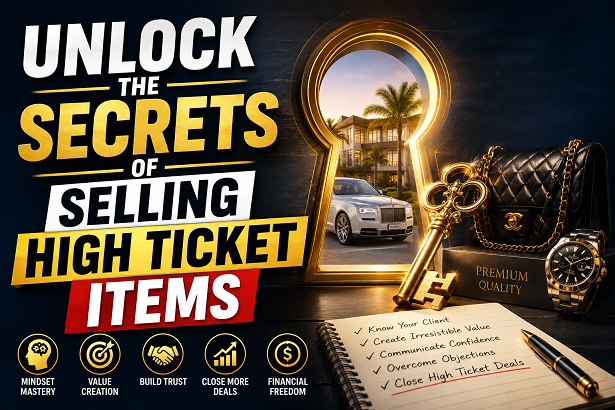
Unlock The Secrets Of Selling High Ticket Items
In the world of sales and commerce, there are two distinct paths to building a multi-million-dollar enterprise. The first is the high-volume, low-margin grind—selling thousands of $20 gadgets daily while battling volatile ad costs, razor-thin profits, and constant customer support churn. The second path is far more lucrative, stable, and sustainable: mastering the art of premium positioning and learning how to unlock the secrets of selling high ticket items.
Whether you are selling high-ticket B2B software, enterprise consulting packages, luxury assets, specialized medical equipment, or high-value coaching programs, closing premium offers requires an entirely different playbook. You cannot sell a $10,000, $25,000, or $100,000 offer using cheap promotional tactics or discount countdown timers. Premium sales rest on trust, authority, positioning, precise discovery, and value stacking. This guide breaks down the core sales mechanics, funnel structures, and psychological frameworks needed to attract high-net-worth buyers and close premium deals consistently.
1. The Economics of High-Ticket vs. Low-Ticket Sales
To understand why top-tier entrepreneurs focus exclusively on high-ticket offers, look at the underlying math. Reaching $100,000 in gross revenue selling a $50 product requires acquiring 2,000 separate customers—each requiring ad spend, onboarding, customer support, and payment processing fees. Generating that same $100,000 with a $10,000 high-ticket offer requires closing only 10 qualified clients.
Focusing on high-value sales allows businesses to spend more to acquire a customer, hire top-tier account managers, deliver white-glove service, and protect high profit margins even during shifting market conditions.
High-Ticket vs. Low-Ticket Sales Dynamics
This table compares the operational dynamics between low-ticket commodity e-commerce and high-ticket enterprise sales:
| Sales Dimension | Low-Ticket E-Commerce ($10 – $200) | High-Ticket Offers ($3,000 – $50,000+) |
|---|---|---|
| Buying Trigger | Impulse, trend-driven, emotional desire | Strategic ROI, risk elimination, transformational outcomes |
| Sales Channel | Automated checkout page, direct ads | Application funnels, discovery calls, custom proposals |
| Customer Support Burden | High volume, frequent returns and refunds | Low volume, high-touch account management |
| Target Market Focus | Broad mass market appeal | Highly targeted, pre-qualified niche prospects |
2. Secret #1: Authority Positioning and Value Stacking
The single biggest mistake sales professionals make when introducing a high-ticket item is leading with features rather than outcomes. Premium clients do not pay $25,000 for “12 module video courses” or “weekly coaching calls”—they pay for the speed, certainty, and transformational results those deliverables create.
To command top-tier pricing, structure your offer around two key pillars:
- Perceived Certainty: Premium buyers want to know that your process will work for their specific situation. You establish this through detailed case studies, client testimonials, industry credentials, and clear frameworks that remove implementation risk.
- The Value Stack Method: Instead of presenting an offer as a single lump-sum expense, break down every component of your delivery—such as custom implementation, 1-on-1 strategy access, proprietary tools, and ongoing support—and highlight the standalone market value of each piece.
3. Secret #2: The High-Ticket Application & Pre-Qualification Funnel
When selling high-ticket items, you should never appear desperate for a sale. High-ticket sales rely on scarcity and selectivity. The most successful sales funnels use an application process to filter prospects before scheduling a consultation call.
Key Stages of a High-Converting Premium Funnel:
- Targeted Traffic Generation: Driving high-intent corporate traffic via specialized SEO, organic thought-leadership content, or targeted LinkedIn and Google search ads.
- Value-First Asset (VLS or Case Study): Delivering a short, impactful video breakdown or case study that proves your unique methodology works without relying on high-pressure sales pitches.
- Qualification Application: Requiring prospective buyers to answer specific questions regarding their current revenue, key operational challenges, and investment budget before booking a call.
- Discovery & Strategy Consultation: Conducting a structured discovery call to uncover the client’s core pain points, confirm fit, and present your high-ticket solution.
4. Secret #3: Overcoming Premium Price Objections
When a qualified prospect says, “This is too expensive,” they rarely mean they lack the capital. In high-ticket sales, price objections usually mean the perceived risk of the purchase still outweighs the perceived value of the outcome.
To overcome price resistance when closing high-value items, apply these battle-tested closing frameworks:
- The Cost of Inaction Framework: Help the prospect calculate the ongoing financial cost of leaving their problem unsolved over the next 12 months. If ignoring the problem costs them $100,000 per year, a $15,000 solution becomes an obvious financial decision.
- Reframing Cost to Expected ROI: Reframe the price tag from a sunk lifestyle expense to a strategic investment that generates measurable returns over time.
- Flexible Milestone Financing: Offer structured corporate payment terms or milestone-based installment plans to make the investment manageable while protecting baseline margins.
Frequently Asked Questions (FAQ)
What defines a high ticket item or premium service?
High-ticket items are premium offers priced significantly above average market rates—typically ranging from $3,000 to over $100,000+. They deliver transformative outcomes, bespoke customization, or high-ROI enterprise solutions.
How do high-ticket sales strategies differ from low-ticket e-commerce?
Low-ticket sales rely on impulse buys, high traffic volumes, and automated checkouts. High-ticket selling focuses on relationship building, discovery consultations, deep value positioning, and objection handling.
What is the most effective sales funnel for closing premium clients?
The standard high-ticket framework utilizes targeted inbound media or ad traffic, a high-value case study or masterclass, an application filter to pre-qualify prospects, and a 1-on-1 strategy discovery session.
How do you handle price objections when selling premium offers?
Address price objections by shifting the discussion from cost to return on investment (ROI) or risk mitigation. Highlight the cost of inaction and structure transparent value stack comparisons.