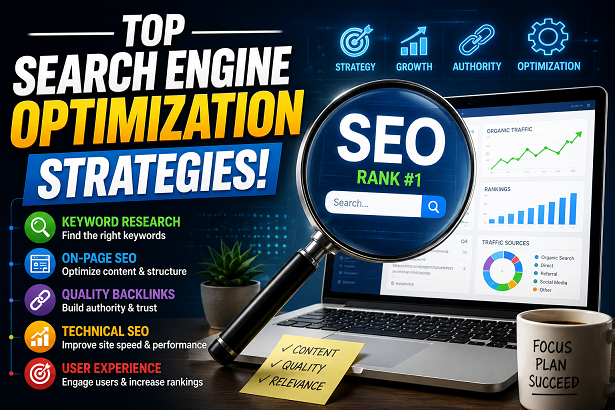
Top Search Engine Optimization Strategies
Securing and maintaining top positions in search engine results pages requires far more than haphazard keyword stuffing or basic meta tags. Modern search algorithms evaluate hundreds of micro-signals, ranging from deep semantic context and user intent matching to real-world performance metrics and brand authority. Mastering the top search engine optimization strategies is essential for driving predictable, high-converting organic traffic that outlasts volatile ad spend budgets.
As search engines incorporate sophisticated AI language models and prioritize instant user satisfaction, webmasters must evolve their optimization techniques. Whether you manage an enterprise SaaS platform, a local service website, or a content-driven blog, implementing a structured SEO framework ensures your pages satisfy both search engine crawlers and human readers. Below is a deep-dive blueprint outlining the most effective strategies to dominate search visibility.
1. Aligning Content with Advanced Search Intent & Semantic Entities
Relevance serves as the foundational ranking signal for search engines. To capture top rankings, your content format must directly answer what the user is looking for. Google utilizes natural language processing (NLP) models to analyze semantic relevance, ensuring pages cover related entities and subtopics rather than just repeating isolated keyword phrases.
- Informational Intent: Users seeking definitions, how-to guides, or tutorials require thorough explanations, step-by-step procedures, and structured FAQs.
- Commercial Investigation: Users comparing products or tools expect unbiased data tables, comparative reviews, and transparent pricing insights.
- Transactional Intent: Buyers ready to convert require seamless checkouts, clear product specifications, trust badges, and frictionless user interfaces.
Core SEO Ranking Pillars Compared
The table below summarizes the core pillars evaluated by search engine evaluation systems:
| Optimization Pillar | Core Focus Area | Primary Metric / Indicator |
|---|---|---|
| Topical Relevance | Matching user intent and semantic entities | Comprehensive content clusters and entity coverage |
| Technical Performance | Core Web Vitals and crawlability | LCP (<2.5s), INP (<200ms), CLS (<0.1) |
| Authority Signals | Backlink profile and brand mentions | Referring domain quality and anchor text context |
| Trust & Credibility | E-E-A-T compliance and transparency | Verified author credentials and secure SSL configuration |
2. Mastering Core Web Vitals & Technical Site Speed
Website performance is no longer just a design consideration; it is an official page experience ranking factor. If a website loads slowly or feels unresponsive, real users abandon the page, sending negative engagement signals to search crawlers. Google evaluates performance using Core Web Vitals based on real-user field data collected across a rolling window.
- Largest Contentful Paint (LCP): Measures loading speed. The primary visual element should load in under 2.5 seconds. Optimize images, leverage fast hosting, and utilize content delivery networks (CDNs).
- Interaction to Next Paint (INP): Measures page responsiveness. The ideal score is under 200 milliseconds, ensuring the site feels snappy when users click or tap elements.
- Cumulative Layout Shift (CLS): Measures visual stability. The score should remain below 0.1 to prevent unexpected element shifts while media assets load.
3. Establishing Robust E-E-A-T and Backlink Authority
Google’s quality rater framework heavily emphasizes E-E-A-T: Experience, Expertise, Authoritativeness, and Trustworthiness. This is especially critical for YMYL (Your Money or Your Life) niches such as finance, health, legal, and technology.
To demonstrate high E-E-A-T, ensure your content features verified author biographies, transparent sourcing, clear contact channels, and verifiable credentials. Pair this with high-value off-page SEO strategies. Each editorial backlink from an authoritative domain acts as a vote of confidence, passing PageRank signals that elevate your site’s overall visibility.
4. Optimizing for AI Search Overviews and Featured Snippets
With search engines increasingly presenting AI-generated summaries at the top of results pages, adapting your formatting strategy is critical. AI overviews extract direct answers from structured, authoritative web pages.
- Clear Answer Blocks: Place concise, direct definitions and bulleted summaries immediately following your subheadings.
- Comprehensive FAQ Schema: Implement valid JSON-LD FAQ structured data to help search bots parse your content effortlessly.
- Logical Document Outlines: Use precise H1, H2, and H3 hierarchies to establish topical context for automated crawlers.
Frequently Asked Questions (FAQ)
What are the most effective search engine optimization strategies?
The most effective strategies include aligning content strictly with search intent, publishing authoritative content that builds E-E-A-T, optimizing Core Web Vitals (LCP, INP, CLS) for fast performance, earning high-relevance backlinks, and structuring data for AI search summaries.
How do Core Web Vitals impact Google search rankings?
Core Web Vitals measure user experience through loading speed (LCP), responsiveness (INP), and visual stability (CLS). Because Google evaluates these metrics at the 75th percentile of real user visits, a fast and responsive site gains a direct ranking advantage over slow competitors.
Why is E-E-A-T critical for modern SEO performance?
Experience, Expertise, Authoritativeness, and Trustworthiness (E-E-A-T) help search engines evaluate whether content is accurate, reliable, and written by qualified individuals. It is especially vital for YMYL (Your Money or Your Life) topics.
How can I optimize my content for AI search overviews?
You can optimize for AI-generated summaries by structuring content with clear, concise answers near the top of your pages, utilizing comprehensive FAQ schema, incorporating numbered lists, and providing data-backed answers.