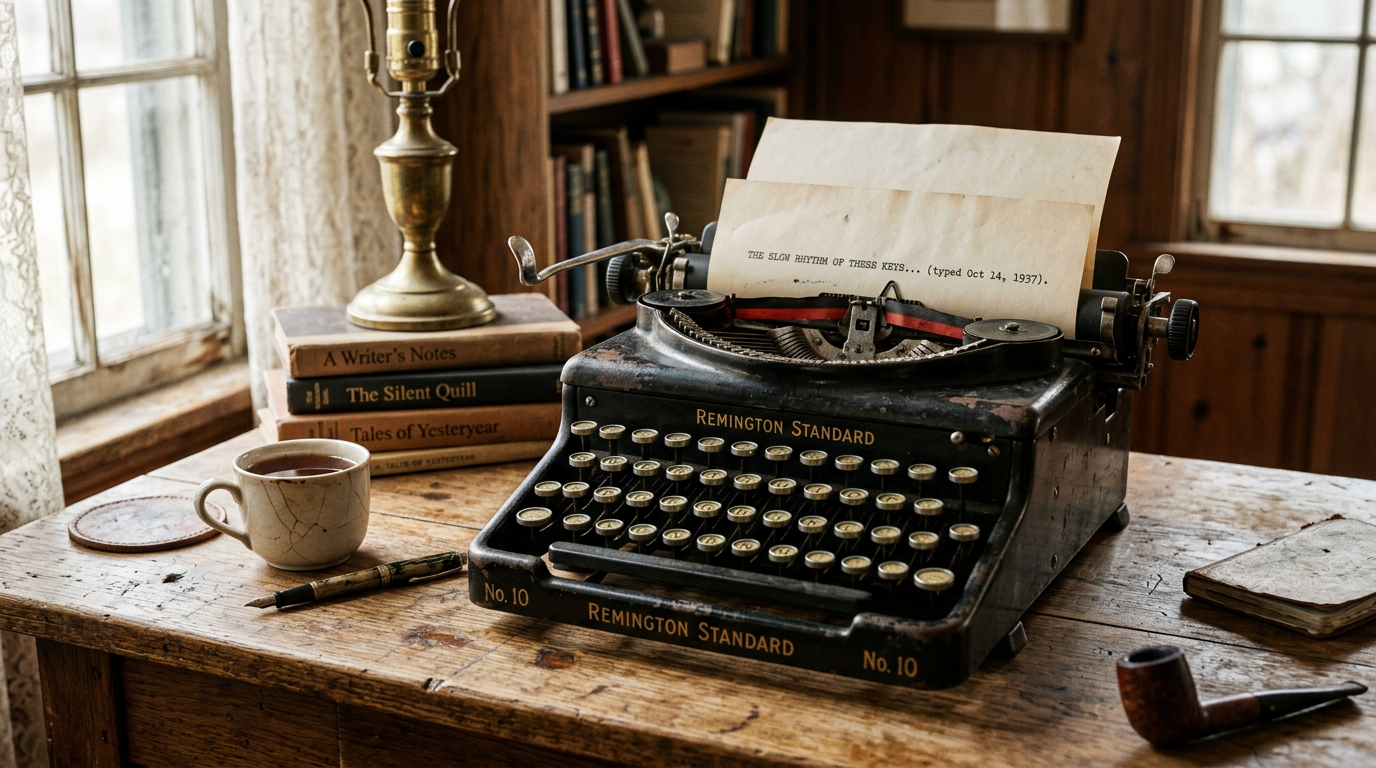
Are You Still Using That Slow, Old Typewriter? The Unlikely Analog Revolution in a Hyper-Digital World
Imagine this scenario: You sit down at a sleek, ultra-thin $2,000 laptop. You open a fresh document in Microsoft Word or Google Docs, determined to finally write that chapter, finish that project proposal, or draft that long-form article. You type two sentences. Then, a subtle banner notification slides in from the top right corner of your screen—an urgent email. Below that, a Slack badge flashes red. A YouTube tab whispers from your browser background. Within five minutes, your creative momentum is shattered, dissolved into a maze of browser tabs and digital multitasking.
Now, step into another room. On a solid wooden desk sits a 1950s Smith Corona Silent-Super or an Underwood No. 5. There are no Wi-Fi chips, no push notifications, no battery percentage warnings, and no backspace key to instantly erase a half-formed thought. When a key strikes the paper, the sound is crisp, mechanical, and permanent.
If someone saw you typing on it, they might ask condescendingly: “Are you still using that slow, old typewriter?”
What they fail to realize is that millions of novelists, poets, journalists, and creative thinkers are intentionally making this switch. Far from being a mere hipster fad or romantic nostalgia trip, the return to manual typewriters and distraction-free writing machines represents a profound counter-cultural revolt against digital cognitive fragmentation. In this exhaustive investigation, we explore the science of deep focus, the mechanical tactile genius of vintage typewriters, and why going slower might just be the fastest way to unleash your creative potential.
Table of Contents
- 1. The Tyranny of the Modern Screen: Why Laptops Kill Deep Focus
- 2. The Psychology of “Forward-Only” Drafting: Why No Backspace is a Superpower
- 3. Kinesthetic Writing: The Physical Joy of Key Travel & Paper Resistance
- 4. From Tom Hanks to George R.R. Martin: Famous Modern Typewriter Devotees
- 5. The Modern Middle Ground: Smart Typewriters & Mechanical E-Ink Displays
- 6. Analog Manual Typewriter vs. Modern Laptop: Feature Comparison
- 7. Collector’s & Writer’s Field Guide: Finding & Restoring Vintage Typewriters
- 8. Frequently Asked Questions (FAQs)
1. The Tyranny of the Modern Screen: Why Laptops Kill Deep Focus
In his landmark book Deep Work, computer science professor Cal Newport argues that the ability to perform demanding tasks without distraction is becoming increasingly rare—and simultaneously incredibly valuable in our economy. Modern laptops and tablets, while technically marvels of human engineering, are fundamentally built as attention-extraction devices.
Every word processor on a modern operating system lives inside an ecosystem designed to interrupt you. When you type on a computer, your brain is forced to spend continuous mental energy resisting temptations: checking breaking news, glancing at unread messages, or tweaking formatting margins. This mental tax is known as context switching cost.
The Illusion of Digital Speed
We assume that because a computer allows us to type at 90 words per minute, it makes us faster writers. But typing speed is not writing speed. Writing is the complex act of structuring ideas, synthesizing arguments, and weaving narrative threads. When you are interrupted every three minutes by a browser notification, your cognitive continuity drops off a cliff. You may spend four hours at your desk, but only yield 300 usable words.
“A computer is great for editing, formatting, and distributing words. But for the raw, terrifying act of pulling a story out of thin air, a device that can also stream video and check email is your worst enemy.”
2. The Psychology of “Forward-Only” Drafting: Why No Backspace is a Superpower
Ask any seasoned novelist what the biggest barrier to completing a first draft is, and they will give you a single answer: The Internal Editor.
On a modern computer screen, as soon as you finish writing a paragraph, your eyes wander upward. You notice a clunky adjective or an awkward sentence structure. You hit backspace, rewrite it three times, delete it entirely, and spend fifteen minutes tweaking a single opening paragraph. By the end of the session, you are mentally exhausted and have made zero progress on the rest of the chapter.
The Manual Typewriter Imperative
On a manual typewriter, there is no backspace key in the modern sense. You can strike through a word or place an X over a mistake, but you cannot delete the physical ink on the paper. You are forced to leave your mistakes behind and keep moving forward.
This “forward-only” dynamic completely re-wires your psychological relationship with drafting:
- Embracing Imperfection: First drafts are meant to be messy. A typewriter forces you to accept flawed sentences so you can finish the complete story arc.
- Uninterrupted Momentum: Because you cannot fix previous paragraphs without retyping the page, your mind stays focused exclusively on what happens next.
- Visual Proof of Progress: Watching a tangible stack of freshly typed paper accumulate on the right side of your desk provides a physical dopamine hit that a digital document counter can never replicate.
3. Kinesthetic Writing: The Physical Joy of Key Travel & Paper Resistance
Human beings are physical creatures. We evolved to interact with three-dimensional objects featuring weight, texture, sound, and mechanical resistance. Modern flat glass touchscreens and shallow laptop butterfly keyboards strip away all sensory richness from the writing experience.
Typing on a classic manual typewriter—such as a 1960s Olympia SM9 or a 1930s Royal Model O—is a physical, kinesthetic performance. You feel the physical weight of the key levers, the tension of the internal drawband, and the satisfying mechanical snap as the steel typebar strikes the fabric ribbon against the rubber platen roller.
The Acoustic Rhythm of Creativity
The auditory feedback of a typewriter plays a massive role in cognitive immersion. The rhythmic clack-clack-clack of typing creates an acoustic focal feedback loop. The ding of the margin bell warns you that you are approaching the end of a line, forcing a natural micro-pause before sweeping the carriage return lever across with your left hand.
This physical rhythm anchors your physical body to the task. You are not merely thinking words; you are physically crafting them into physical paper impression.
4. From Tom Hanks to George R.R. Martin: Famous Modern Typewriter Devotees
If you think manual typewriters belong strictly in museums, consider the impressive list of modern visionaries who refuse to abandon their analog machines:
- Tom Hanks: The Academy Award-winning actor is one of the world’s most famous typewriter collectors, possessing over 250 vintage models. He wrote his book of short stories, Uncommon Type, entirely on manual typewriters and co-produced the acclaimed documentary California Typewriter.
- George R.R. Martin: The author of A Song of Ice and Fire (Game of Thrones) writes his massive epic novels on an isolated, air-gapped DOS computer running WordStar 4.0—devoid of internet or modern spellcheck—to preserve complete creative focus.
- Quentin Tarantino: The iconic filmmaker drafts his screenplays by hand and on manual typewriters before handing them off for digital formatting, citing the necessity of tangible physical connection to character dialogue.
- Cormac McCarthy: The legendary Pulitzer Prize-winning author wrote every single one of his masterpieces—including The Road and No Country for Old Men—on a single, portable 1958 Olivetti Lettera 32 typewriter that he bought secondhand for $50.
5. The Modern Middle Ground: Smart Typewriters & Mechanical E-Ink Displays
What if you love the distraction-free focus and tactile feel of a typewriter, but you still need your final text in a digital format for editing, emailing, or publishing? You don’t necessarily have to retype physical paper pages by hand or scan them with OCR software.
The demand for distraction-free writing tools has spawned an exciting new category of Smart Typewriters and hybrid digital word processors:
1. Astrohaus Freewrite (Smart Typewriter)
The Freewrite is a purpose-built digital drafting machine featuring an e-ink screen, full-size mechanical key switches (Cherry MX Brown), a solid aluminum chassis, and zero internet browsing capability. It automatically backs up your raw text directly to cloud storage (Google Drive, Dropbox, or Astrohaus Cloud) via background Wi-Fi while keeping you completely isolated from notifications.
2. Vintage Typewriters + OCR Scanning Apps
Many authors prefer writing on genuine 1950s manual machines. Once a draft page is completed, they use smartphone apps like Adobe Scan or Google Lens to immediately convert physical paper pages into clean, editable digital text files in seconds.
3. Dedicated Retro Word Processors (Alphasmart Neo 2)
Cult favorite devices like the vintage AlphaSmart Neo 2 offer indestructible battery life (700+ hours on 3 AA batteries), instant power-on, a simple monochrome LCD screen, and a mechanical keyboard. When plugged into a laptop via USB, it acts as a keyboard and automatically pastes your written text at lightning speed.
6. Analog Manual Typewriter vs. Modern Laptop: Feature Comparison
To understand why writers choose distinct tools for distinct stages of the creative process, consider this side-by-side comparison matrix:
| Feature / Dimension | Vintage Manual Typewriter | Modern Laptop / Computer | Smart Typewriter (Freewrite) |
|---|---|---|---|
| Primary Purpose | Pure first-draft creation | Editing, research, formatting, publishing | Distraction-free digital drafting |
| Distraction Risk | Zero (No screens or Wi-Fi) | Extreme (Social media, web, email) | Zero (Cloud sync only, no browser) |
| Keyboard Feel | Deep mechanical key travel (Heavy tactile) | Shallow scissor/membrane switches | Mechanical Cherry MX switches |
| Editing Capability | None (Strike-through only) | Infinite (Easy delete, copy, cut, paste) | Minimal (Forward typing focused) |
| Power Requirements | 100% Mechanical (Zero electricity) | Requires frequent battery charging | Long battery life (Weeks per charge) |
| Document Output | Physical paper original sheet | Digital file (.docx, .pdf) | E-ink display + Cloud TXT sync |
7. Collector’s & Writer’s Field Guide: Finding & Restoring Vintage Typewriters
If you are ready to experience the deep focus of manual typing, where should you start? Not all old typewriters are created equal. Some were built as rugged daily workhorses, while others were flimsy budget student models.
The Holy Trinity of Writer-Friendly Typewriters
- Olympia SM3 / SM4 / SM9 (Germany): Widely considered the “Mercedes-Benz” of manual typewriters. Built with legendary German precision engineering, offering crisp action, rock-solid stability, and beautiful typography.
- Hermes 3000 (Switzerland): Famous for its silky smooth key action, iconic seafoam green aesthetic, and buttery carriage return. It remains one of the most sought-after machines by professional authors.
- Smith Corona Silent-Super / Sterling (USA, 1950s): The quintessential American typewriter. Extremely reliable, easy to service, widely available, and featuring comfortable rounded green keys with smooth action.
Essential Restoration & Maintenance Tips
Found an old machine at a flea market or antique shop? Here is how to clean and prepare it for daily writing:
- Never Use WD-40 on Typewriter Segment Joints: WD-40 attracts dust and hardens into a gummy varnish over time, locking up the mechanical typebars. Instead, clean sticky joints with mineral spirits or 99% isopropyl alcohol using a toothbrush.
- Replace the Ribbon: Standard 1/2-inch universal typewriter ribbons fit 90% of vintage manual machines and cost less than $10 online.
- Preserve the Platen Rubber: If the large rubber roller (platen) is hard as rock, feed two sheets of paper into the machine instead of one. The second backing sheet acts as a cushion, dampening noise and protecting the steel typebars from wear.
8. Frequently Asked Questions (FAQs)
Writers use manual typewriters primarily for absolute focus. Typewriters eliminate digital notifications, social media interruptions, and the temptation to constantly edit while drafting, allowing writers to enter an uninterrupted creative flow state.
Popular modern alternatives include distraction-free smart typewriters like the Freewrite, mechanical keyboards paired with e-ink displays, or dedicated retro digital word processors like the Alphasmart Neo 2.
Yes, for first drafts. Because you cannot easily backspace or delete sentences on a manual typewriter, it forces writers to move forward and complete the narrative structure rather than endlessly polishing the first chapter.
Not at all. Standard 1/2-inch universal typewriter ribbons are widely produced and available online. Basic maintenance requires simple mechanical cleaning, occasional segment oiling, and fresh platen rubber preservation.