If you are looking for a legitimate AI software tax deduction to lower your business liability as a freelancer, independent contractor, or digital creator, you are in the right place. Generative AI tools are no longer experimental novelties; they are foundational utilities in 2026. Writers are leveraging advanced large language models to construct frameworks, video editors rely on synthetic frame generation tools to slash production schedules, and software developers routinely use predictive code completions to debug deployments.
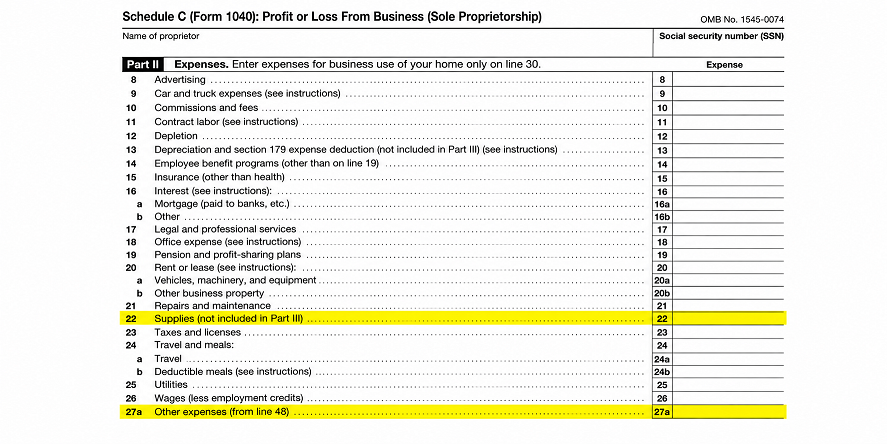
Yes, you can write off AI software subscriptions on your taxes if you are self-employed, a 1099 independent contractor, a freelancer, or a small business owner. Under IRS Section 162, cloud-based AI tools (like ChatGPT, Claude, and Midjourney) are 100% tax-deductible as ordinary and necessary business expenses, provided they are used directly for business operations. You write them off on Schedule C (Form 1040) under line 22 (Supplies) or line 27a (Other Expenses).
The Shifting Landscape of Digital Infrastructure in 2026
If you are operating as a freelancer, independent contractor, or digital creator in 2026, your tech stack looks completely different from what it did a few years ago. Generative AI tools are no longer experimental novelties; they are foundational utilities. Writers are leveraging advanced large language models (LLMs) to construct frameworks, video editors rely on synthetic frame generation tools to slash production schedules, and software developers routinely use predictive code completions to debug deployments.
However, as you transition from a single $20-a-month subscription to a stacked infrastructure of Claude Pro, Midjourney, GitHub Copilot, and automated workflows through Zapier AI, your software overhead can easily spiral into hundreds of dollars monthly. When tax season approaches, leaving these expenses off your tax return means leaving real money on the table.
This comprehensive guide dives deep into the specific mechanics of US tax law, demonstrating exactly how to write off your AI software subscriptions, allocate mixed usage legally, and organize your documentation to survive an Internal Revenue Service (IRS) audit.
Table of Contents
- 1. The IRS Framework: Is an AI Software Tax Deduction Allowed
- 2. The Ultimate AI Deduction Matrix
- 3. Deep Dive: Deductions by Digital Profession
- 4. The Mixed-Use Conundrum: How to Prorate AI Use
- 5. Where Does It Go on Schedule C?
- 6. Audit-Proofing Your AI Tech Stack
- 7. Critical Pitfalls and Common Mistakes to Avoid
- 8. The Entity Distinction: 1099 vs. W-2 Employee Rules
- 9. Frequently Asked Questions
1. The IRS Framework: Is an AI Software Tax Deduction Allowed?
The IRS does not maintain a specific checklist named “Approved AI Deductions.” Instead, the tax code relies on universal principles established under Internal Revenue Code (IRC) Section 162, which governs trade or business expenses.
To qualify as a legitimate tax deduction, an AI software subscription must meet a dual standard: it must be both ordinary and necessary for your specific line of work.
Defining “Ordinary” in the AI Era
An expense is considered ordinary if it is common and universally accepted within your business sector. In 2026, this is a clear-cut threshold. If you are an online marketer, using an AI copywriting engine or predictive analytics platform is completely standard practice. It is no different than a mechanic buying a wrench or an accountant subscribing to traditional spreadsheets.
Defining “Necessary”
An expense is necessary if it is helpful, appropriate, and directly contributes to your ability to generate income. Crucially, the IRS does not require an expense to be completely indispensable to label it “necessary.” If a premium subscription to an AI video synthesis tool cuts your editing turnaround time in half, enabling you to take on more client contracts, it perfectly satisfies the necessary clause.
2. The Ultimate AI Deduction Matrix
Because AI software relies on cloud infrastructure, it falls squarely under the umbrella of Software-as-a-Service (SaaS). Below is a structural matrix outlining how common AI platforms are categorized for professional tax write-offs in the US market.
| AI Platform/Tool | Primary Business Function | Typical Deductibility % | Schedule C Placement |
|---|---|---|---|
| ChatGPT Plus / Claude Pro | Research, content outlines, scripting, and data cleaning | 70% – 100% (Subject to pro-rating) | Line 22 (Supplies) or Line 27a |
| Midjourney / DALL-E 3 | Commercial graphic asset generation, UI design prototyping | 100% (If strictly for client projects) | Line 22 or Line 27a |
| GitHub Copilot / Cursor AI | Automated code generation, code testing, and script debugging | 100% (For professional developers) | Line 27a (Other Expenses) |
| Runway Gen-3 / Sora Premium | B-roll video generation, advertising creative elements | 100% (For creators and multimedia agencies) | Line 22 or Line 27a |
3. Deep Dive: Deductions by Digital Profession
The legitimacy of your write-off hinges entirely on the logical nexus between the tool’s capability and how you generate revenue. Let’s evaluate the explicit scenarios that pass IRS audit parameters across distinct digital fields.
Freelance Writers, Editors, & Digital Marketers
If your 1099 income is derived from content creation, copy editing, or digital strategy, specialized language platforms are standard tools of your trade. Writing off premium tiers of ChatGPT, Claude, or Grammarly Premium is fully justified. These tools handle semantic mapping, preliminary topical research, and structural changes. The business connection is obvious: your output is text, and these tools optimize text production speed.
Graphic Designers, Illustrators, & Video Editors
For visual artists, generative image servers and neural rendering platforms represent major workflow optimizations. Subscriptions to Midjourney, Adobe Firefly, or specialized video platforms like Runway are completely defensible. If you are generating commercial background graphics for a web development client, the cloud cost to produce those assets is a direct operational expense.
Software Engineers, Developers, & Systems Architects
If you build software for a living, code intelligence engines like GitHub Copilot, Cursor AI, or premium IDE plug-ins are critical pieces of your workspace. They serve as an advanced automated code reviewer, highlighting memory leaks and speeding up builds. Writing these off under professional software configurations is standard operational practice.
4. The Mixed-Use Conundrum: How to Prorate AI Use
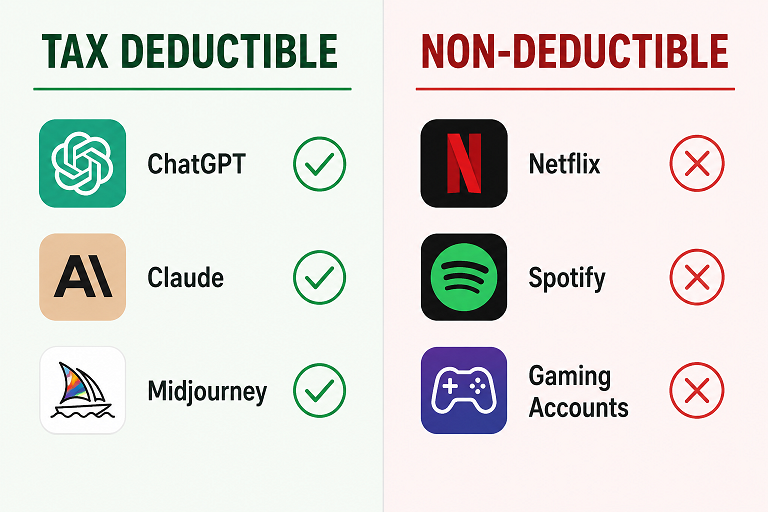
Look, here is where things get sticky. The IRS knows that many freelancers use the same AI accounts for both professional tasks and casual personal interests. If you spend your morning using Claude Pro to process a client’s CSV data format but spend your evening using it to generate custom recipes or plan a personal vacation, you cannot write off 100% of the cost.
You must calculate and apply a **pro-rated deduction** percentage based entirely on a reasonable allocation of usage. Let’s look at the underlying math of how this allocation modifies your total write-off:
To determine your total deductible amount ($D$), you multiply the total annual cost of the subscription ($C$) by the percentage of time the platform is used purely for business operations ($P_{\text{biz}}$):
$$D = C \times P_{\text{biz}} $$
For example, if you pay for an enterprise AI workspace that costs $C = \$600$ per year, and you can reliably show that $P_{\text{biz}} = 75\%$ of the system prompts were run to complete client deliverables, your actual write-off is calculated as follows:
$$D = \$600 \times 0.75 = \$450$$
The remaining \$150 represents non-deductible personal use. To make this process seamless, the absolute best practice is to set up a dedicated workspace or a separate account tied explicitly to your professional business email, keeping your casual testing completely segregated.
5. Where Does It Go on Schedule C?
When properly filing your AI software tax deduction on Form 1040, you have a few valid options for placing cloud-based software fees. The IRS does not have a dedicated line labeled “SaaS or Cloud Software,” so you should stick to these two standard paths:
Option 1: Line 22 (Supplies)
This line is intended for non-physical and physical operational supplies used to deliver your core service. Many digital accountants place minor software platforms here if they are directly consumed in daily creative work.
Option 2: Line 27a (Other Expenses)
This is often the cleanest choice for high-volume SaaS bills. You list the total under Part V (Other Expenses) on page 2 of Schedule C, writing “Cloud Software Subscriptions” or “AI Technology SaaS” explicitly next to the dollar amount.
Affiliate Recommendation for Bookkeeping: If you find tracking these expenses manually across your accounts overwhelming, using automated cloud tracking tools like Intuit QuickBooks Self-Employed can completely automate the sorting process, separating your business SaaS deductions directly onto the correct Schedule C categories every single month.
6. Audit-Proofing Your AI Tech Stack
If the IRS flags your tax return for a standard review, it will require clear documentary evidence of your expenses. Bank statement printouts showing a clean deduction row are helpful, but they aren’t enough to pass deep scrutiny. You need a rock-solid paper trail.
1. Keep the Original PDF Invoices
Do not simply ignore the automated billing emails sent by OpenAI, Anthropic, or Midjourney. Download the detailed itemized PDF receipts every month. Ensure your business name or trading name is explicitly visible on the billing profile layout whenever possible.
2. Maintain a Digital Context Log
If you split an account between personal and business use, keep a simple running log (a spreadsheet in Google Sheets or a page in Notion works perfectly). Note down the specific projects or client accounts linked to those software fees. If an auditor asks, “What business value did this specific Claude engine yield in October?” you can instantly show them the client project link.
While digital PDFs are great, keeping a dedicated physical backup using a [Fujitsu ScanSnap Portable Scanner] ensures you never lose a paper trail if an operational audit happens.

7. Critical Pitfalls and Common Mistakes to Avoid
Even though writing off software is common practice, making sloppy claims can cause your tax returns to be flagged as an IRS red flag. Keep these strict operational guardrails in mind:
- The Hobby Loss Rule (Section 183): A common mistake when claiming an AI software tax deduction is trying to write off casual personal hobbies.”
- Hidden Annual Financing Fees: If you choose an annual plan to save money on a tool, make sure you write off the exact amount paid in that specific tax year. If you pay for an ongoing subscription via a personal credit card and accumulate interest, that interest is non-deductible. Always use a dedicated business card to keep your financing fees distinct.
- Double-Deducting Bundles: If you subscribe to a broad creative suite (like Adobe Creative Cloud with integrated Firefly AI), do not list the broad suite under software while trying to write off the AI element separately. You can only claim the actual amount out of pocket.
To dive deeper into advanced write-offs beyond software, picking up an authoritative guide like [J.K. Lasser’s Small Business Taxes 2026] is a smart investment.

8. The Entity Distinction: 1099 vs. W-2 Employee Rules
This is a critical legal reality for the current tax season. Under the rules established by the Tax Cuts and Jobs Act (TCJA), W-2 corporate employees cannot deduct out-of-pocket workspace expenses or software platforms on their federal tax returns.
If you are a remote corporate employee and you purchase ChatGPT Plus out of pocket to make your internal workflow faster, you are not legally allowed to write it off on your taxes. Your best path is to ask your employer to directly purchase the software or reimburse you through an explicit corporate expense system.
Conversely, if you are a 1099 independent contractor, freelancer, or LLC operator, you are a distinct business entity. You retain full access to all IRC Section 162 SaaS deductions to lower your overall self-employment tax burden.
If you prefer a guided approach to claiming your AI software deductions, using [TurboTax Home & Business Premium] makes it incredibly easy to input your Schedule C data.

9. Frequently Asked Questions
Can I write off API usage costs if I am building a custom AI application?
Yes, absolutely. If you pay for OpenAI or Anthropic API keys to run code tests, populate data layouts for clients, or run an active application, those development token fees are 100% tax-deductible. They are classified as software operational utilities or technical infrastructure fees. This ensures your custom API tokens are safely included in your overall AI software tax deduction total.
What happens if I buy an AI tool using a personal credit card?
You can still legally deduct the expense, but it complicates your record-keeping. You will need to carefully cross-reference your personal credit card statements with the official software receipts to prove the business connection to an auditor. To keep your system simple, switch your payment profiles over to a dedicated business card immediately.
Can I write off an AI subscription if the tool is still technically in beta?
Yes. The deployment stage of the platform does not impact its tax status. As long as you are actively paying a fee to access the platform and using it directly to finish client projects or support your business operations, it qualifies under standard SaaS tax guidelines.
Conclusion: Claim Your Workspace Deductions Safely
Taking advantage of a legitimate AI software tax deduction is a smart way to manage your cash flow as a digital professional. If a tool helps you complete client deliverables, refine your creative work, or manage your business data faster, it is an ordinary and necessary asset for your trade.
Take the time to organize your digital receipts, establish a clean subdirectory tracking log, and categorize your cloud expenses accurately on your Schedule C. By keeping a clear paper trail, you can confidently claim your deductions and lower your tax bill safely.
Disclaimer: This guide is intended strictly for educational and informational purposes and does not constitute formal legal or certified tax advice. Tax codes and regional interpretations can change quickly. For explicit questions regarding your specific entity setup, income filing, or business categories, always consult with a Certified Public Accountant (CPA) or a qualified tax professional based in the United States.
Additional Resources
#TaxTips2026 | #FreelanceTaxes | #TaxWriteOffs | #ScheduleC | #SelfEmployed#AITools | #SaaSTaxes | #ChatGPT | #ClaudeAI | #Midjourney | #AIForBusiness#SolopreneurLife | #IndependentContractor | #1099Worker | #SmallBusinessTax, #FreelanceTaxes, #TaxTips2026, #ChatGPT, #SaaSTaxes
